
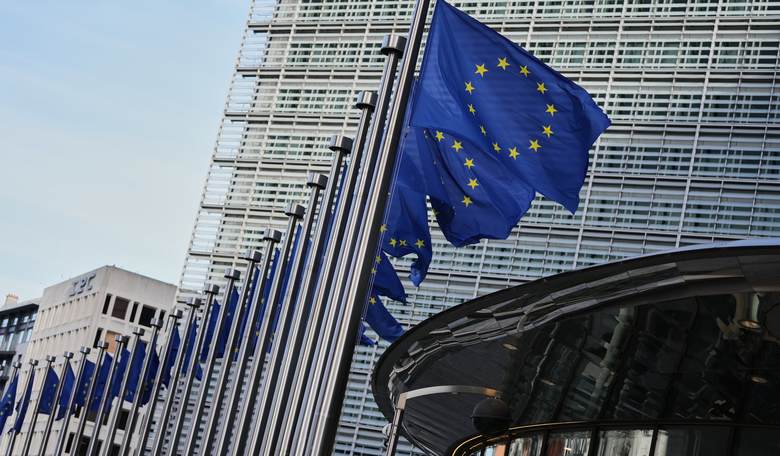
There is something almost comical about the European Union's endless promises to impose tougher sanctions on Iran. Almost, because the consequences are deadly serious. Every Iranian missile attack, every assault on commercial shipping, every terrorist plot, and every new atrocity against the Iranian people produces the same familiar response from Western capitals. Outrage, condemnation, and solemn promises of further sanctions. Then the diplomatic machinery grinds forward, and the mullahs continue their murderous business.
The latest example is extraordinary. French supermarkets have become targets of cyber sabotage, with hundreds of refrigerators and freezers remotely manipulated, destroying enormous quantities of food. France blames Iran's Islamic Revolutionary Guard Corps, the IRGC. Tehran denies responsibility. French Foreign Minister Jean-Noël Barrot now expects further European sanctions to be approved on December 14. So, here we go again. Another month of deliberation. Another package of sanctions. Another opportunity for European politicians to congratulate themselves on their determination to confront Tehran.
But what exactly are we sanctioning? And why, after decades of supposedly crippling economic restrictions, does this dictatorship retain the resources to finance repression, missiles, drones, proxy militias, and international terrorism? The answer lies in the enormous gulf between announcing sanctions and enforcing them. In February 2026, the EU finally designated the IRGC as a terrorist organization. The United States and Canada had already taken that step. Britain has sanctioned the IRGC in its entirety and introduced additional national security restrictions. Yet the British designation is legally different from proscription under terrorism legislation.
These distinctions matter. Freezing the assets of a terrorist organization and prohibiting financial support for it are important measures. But they do not automatically prohibit every commercial transaction with the country in which that organization operates. And therein lies the scandal. According to the European Commission's own figures, trade in goods between the EU and Iran reached €3.7 billion in 2025. European exports accounted for approximately €3 billion, while imports from Iran totaled around €800 million. Trade in services added another €1.6 billion in 2024. These are official figures, published openly by Brussels. They demonstrate that despite years of denunciations, substantial commercial relations have continued.
Of course, some trade is perfectly lawful. Medicines, food, and other humanitarian necessities must remain available to ordinary Iranians. Nobody should advocate starving a population already suffering under a brutal dictatorship. But the figures raise uncomfortable questions. Which European companies are still trading with Iran? Who ultimately owns their Iranian counterparts? How thoroughly are transactions scrutinized for connections to the IRGC's sprawling commercial empire?
The Revolutionary Guards are far more than a military organization. Their influence extends across construction, energy, transport, telecommunications, and financial networks. Through subsidiaries, intermediaries, and opaque ownership arrangements, they have developed an economic structure that makes identifying the ultimate beneficiaries of commercial transactions exceptionally difficult. This is where sanctions enforcement becomes decisive. A prohibition against financing the IRGC is only as effective as the ability to establish who actually controls the company receiving the money.
The international oil trade presents an even greater challenge. Iran has continued to find customers for its petroleum despite extensive American restrictions. China remains the principal destination for Iranian crude, much of it moving through networks of intermediaries, discounted sales, and vessels whose ownership and operating arrangements can obscure their commercial activities. The so-called shadow fleet, involving opaque ownership, ship-to-ship transfers, and manipulation of shipping information, illustrates how sanctions can be circumvented when enforcement is inconsistent. Every shipment that successfully evades restrictions potentially provides additional revenue to the Iranian state. Money is fungible. Revenue entering the regime's coffers can relieve financial pressure elsewhere, including on the security apparatus responsible for domestic repression and regional aggression. Western governments understand this perfectly well. Yet the international machinery required to expose beneficial ownership, investigate financial intermediaries, restrict illicit shipping and penalize sanctions evaders remains fragmented.
There is another uncomfortable truth. Sanctions have undoubtedly damaged Iran's economy. Inflation, currency depreciation, restricted investment, and financial isolation have inflicted enormous hardship. But the burden frequently falls most heavily on ordinary citizens, while politically connected elites retain privileged access to foreign currency, smuggling networks, and protected commercial opportunities. A sanctions policy that impoverishes the population while allowing the ruling establishment to preserve its wealth is hardly an advertisement for Western strategic brilliance.
The regime's methods were already familiar. Armed proxies, intimidation, political infiltration, and systematic exploitation of international hesitation. What has changed is the geographical reach of the threat. European supermarkets are now apparently legitimate targets in Tehran's campaign of intimidation, according to the French government's attribution. The response must surely go beyond another collection of names added to a sanctions register.
Europe should demand rigorous disclosure of commercial relationships involving Iranian state enterprises, investigate suspected IRGC ownership networks, and coordinate financial enforcement with Britain, America, and Canada. Governments should target the intermediaries facilitating illicit oil exports and publish meaningful evidence of enforcement, including frozen assets, intercepted transactions, and penalties imposed. Humanitarian exemptions must remain protected. The objective should be to deprive the dictatorship and its security apparatus of resources, rather than punish its victims. Above all, Western governments must abandon the illusion that sanctions announcements constitute a foreign policy.
Iran's rulers have spent decades learning how to survive economic pressure. They exploit divisions between Western governments, commercial self-interest, and the reluctance of politicians to confront the consequences of their own declarations. The people of Iran, who have repeatedly risked their lives demanding freedom, deserve something better than another diplomatic press release. If the IRGC is a terrorist organisation, Western policy must reflect that reality in practice, across banking, shipping, procurement, and international commerce. Otherwise, the next Iranian outrage will produce the next solemn promise of sanctions, while the financial networks sustaining the dictatorship continue operating.
The question is no longer whether the West can announce tougher sanctions. It is whether it has the political courage to enforce the sanctions it already possesses.
Struan Stevenson was a member of the European Parliament representing Scotland (1999-2014), president of the Parliament's Delegation for Relations with Iraq (2009-14) and chairman of the Friends of a Free Iran Intergroup (2004-14). He is an author and international lecturer on the Middle East.