
There is something breathtaking about the audacity of Iran's clerical dictatorship. Having dragged the Middle East into a devastating conflict, threatened international shipping, and attacked its neighbors, Tehran has presented Washington with seven demands that must be met before negotiations can begin. These reportedly include lifting American sanctions, releasing frozen Iranian assets, and paying war reparations. The mullahs want to be rewarded before discussing the consequences of their own behavior.
The proposal, delivered through Qatar, comes at a dangerous moment. With America's midterm elections over, President Donald Trump has refused to rule out renewed military operations against Iran. Tehran threatens retaliation on an even greater scale. Diplomats are scrambling to prevent another explosion of violence across a region already exhausted by war.
Avoiding further bloodshed is essential. But confusing the temporary absence of fighting with durable peace would be a grave mistake. During my 15 years in the European Parliament, including five years as president of its Delegation for Relations with Iraq, I witnessed Tehran's interference in neighboring countries. The regime cultivated militias, infiltrated political institutions, and exploited instability while presenting itself as a responsible diplomatic partner. The current negotiations bear the hallmarks of that familiar strategy.
Mohsen Rezaei, secretary of Iran's Supreme National Security Council, has declared that the Strait of Hormuz will remain restricted until Washington fulfills Tehran's conditions. A regime that has weaponized one of the world's most important maritime passages is effectively demanding payment for restoring freedom of navigation.
Tehran has discovered a particularly cynical way of exploiting the crisis. It has announced exemptions for vessels from China, India, Iraq, and Qatar. Chinese and Indian ships may be charged transit fees, while Qatar receives free passage. India is expected to provide medicines, China offers political backing, and Qatar remains the principal diplomatic intermediary. This is no generous concession to international commerce. It is a calculated attempt to divide the international community, secure essential supplies, and extract political and financial advantages from a crisis of Tehran's own making.
China, which purchases most of Iran's exported oil, welcomes preferential treatment. India needs reliable access to Gulf energy. Qatar has substantial commercial interests in keeping maritime routes functioning. Iraq remains deeply exposed to Iranian influence. Such arrangements establish an appalling precedent. Freedom of navigation becomes a privilege granted by an authoritarian regime rather than a principle of international law.
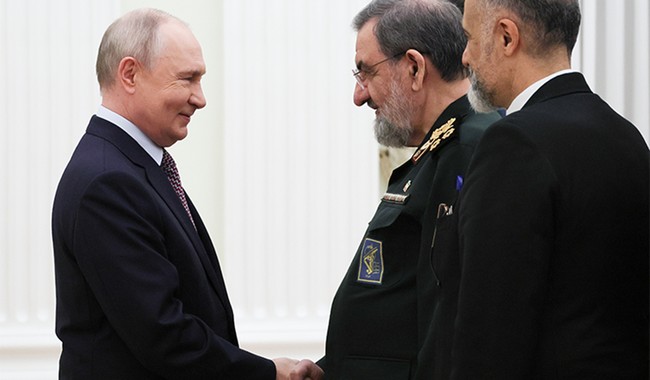
Meanwhile, Rezaei has traveled to Moscow for discussions with Vladimir Putin, carrying a personal message, allegedly from the shadowy Supreme Leader Mojtaba Khamenei. Tehran is seeking Russian diplomatic support while exploring closer energy cooperation and regional security arrangements. Putin, accustomed to using energy and military pressure as instruments of foreign policy, will hardly be troubled by his Iranian partners' methods.
But what would happen if Washington accepted Tehran's demands? Sanctions relief and the release of frozen assets would provide substantial financial breathing space. There is little reason to believe these resources would primarily improve the miserable circumstances of ordinary Iranians. The Revolutionary Guards, security apparatus, and regional proxies would compete for renewed funding. Hezbollah in Lebanon, Hamas in Gaza, the Houthis in Yemen, and militias across Iraq have demonstrated the destructive consequences of Iran's regional ambitions. Giving the regime fresh resources without enforceable restrictions risks rebuilding these destabilizing networks.
Even more alarming is the nuclear question. Washington insists that Iran's nuclear program must form part of initial negotiations. Tehran wants its demands satisfied first. If sanctions disappear before credible nuclear safeguards are established, the regime could gain the time, money, and opportunity to reconstruct capabilities damaged during the war. Any agreement would have to contain intrusive international inspections, independently verifiable restrictions, and effective mechanisms for responding to violations. Promises from Tehran are insufficient. The history of nuclear diplomacy with the Islamic Republic should have taught Western governments that lesson.
There is another issue almost entirely absent from these frantic diplomatic exchanges. What about the Iranian people? While foreign ministers discuss sanctions, shipping lanes, and security guarantees, millions of Iranians remain trapped under a dictatorship that answers demands for freedom with imprisonment, torture, and executions. Their aspirations appear secondary to the governments seeking accommodation with Tehran.
The Iranian people’s struggle for democratic change deserves recognition. Any lasting settlement must distinguish between protecting Iran as a nation and preserving the clerical establishment that rules through fear. The international community should support a peaceful, democratic transition determined by Iranians themselves, with free elections, equality before the law, and separation of religion and state. Replacing one dictatorship with another would perpetuate the tragedy.
Where, then, does Iran go from here? Trump faces an unenviable choice. Renewed military action could unleash another disastrous regional confrontation. Capitulation could rescue a weakened dictatorship and encourage further nuclear and regional adventurism. Alternatively, Washington and its allies should pursue a negotiated end to hostilities while insisting upon verifiable commitments, freedom of navigation through Hormuz, and meaningful nuclear restrictions. But such negotiated provisions have been tried before without success.
It is time for the West to realize that the survival of the clerical regime is not synonymous with stability. Tehran's seven demands are less a blueprint for peace than an attempt to turn military confrontation into political and economic advantage. The mullahs are gambling that fear of another war will persuade their adversaries to concede what years of diplomatic pressure failed to secure. Rewarding that gamble would be disastrous. Peace is desperately needed. But a settlement that restores the regime's finances, revives its nuclear ambitions, and abandons the Iranian people would merely prepare the ground for another catastrophe.
The West has tried appeasement and has tried war. Both have failed. Now surely the way forward is for Western nations to support the Iranian people and their bid to overthrow this evil theocratic dictatorship and replace it with a democratic republic. The Middle East has suffered enough from agreements that postpone the reckoning while leaving the causes of conflict untouched. This time, the objective must be something more enduring than another temporary reprieve for Tehran's rulers.
Struan Stevenson was a member of the European Parliament representing Scotland (1999-2014), president of the Parliament's Delegation for Relations with Iraq (2009-14), and chairman of the Friends of a Free Iran Intergroup (2004-14). He is an author and international lecturer on the Middle East.