
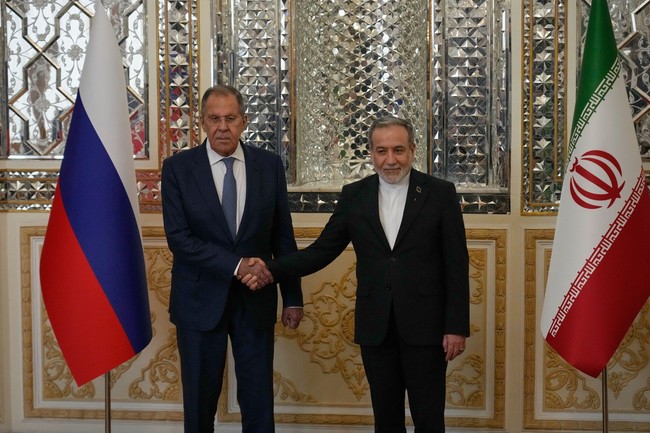
The growing embrace between Vladimir Putin’s Russia and the Islamic Republic of Iran should set alarm bells ringing in every Western capital. What is presented as a strategic partnership is, in reality, a marriage of convenience between two authoritarian regimes united by their hostility toward the democratic world, their contempt for Western sanctions, and their determination to undermine the international order. Britain, Europe, America, and Ukraine would be foolish to mistake this convergence of interests for a durable alliance. Yet they would be equally foolish to underestimate the damage it can inflict.
History offers a compelling warning. Russia and Iran have spent centuries alternating between cooperation, rivalry, and outright hostility. Their present intimacy is driven less by enduring friendship than by a shared perception of Western weakness and a mutual desire to escape isolation.
In the 19th century, imperial Russia waged war against Persia and imposed the Treaty of Gulistan in 1813 and the Treaty of Turkmenchay in 1828. Persia surrendered extensive territories in the Caucasus, including lands corresponding to parts of present-day Azerbaijan and Armenia. Russia secured military and commercial privileges, while Persia was forced to accept humiliating terms and substantial financial reparations.
These treaties became enduring symbols of national humiliation in Iran. The pattern continued into the 20th century. Russia and Britain carved out competing spheres of influence in Persia under the Anglo-Russian Convention of 1907, largely disregarding Iranian sovereignty. Russian troops occupied parts of the country, and Moscow repeatedly sought to exercise political and economic control over its southern neighbor. Such episodes explain why Iranian suspicion of Russian intentions has deep historical roots. The relationship also contains more recent reminders of Moscow's opportunism. During the Syrian conflict, Russia and Iran cooperated to preserve Bashar al Assad's regime, but their interests were never identical. Both wanted influence, military access, and political leverage. Neither was motivated by disinterested friendship.
Today, the war against Ukraine has transformed their relationship. Tehran supplied Russia with Shahed drones, which became a central component of Moscow's campaign against Ukrainian cities, energy infrastructure, and civilian targets. Cooperation has extended into military technology, industrial production, and diplomatic coordination. In return, Iran has sought advanced Russian weaponry, technical expertise, and international support. The strategic partnership treaty signed in January 2025 formalized this closer relationship. Although it fell short of a mutual defense pact, it provided a framework for expanded military and economic cooperation. The absence of a binding commitment to defend one another is significant. It demonstrates that even now, each regime retains the freedom to pursue its own interests when circumstances demand.
Ukraine is the immediate victim of this cynical partnership. Every Iranian drone supplied to Russia helps sustain a war of aggression that has killed civilians, displaced millions, and devastated Ukrainian communities. The transfer of military knowledge and the development of domestic drone production have also helped Moscow reduce its dependence on foreign suppliers. Cooperation between the two countries gives Russia additional capacity to wage a prolonged war, placing further pressure on Ukraine's air defenses, electricity networks, and exhausted armed forces. There is a wider danger. Battlefield experience gained in Ukraine can be used to improve weapons, electronic warfare systems, and tactics. Lessons learned by Russia and Iran may eventually threaten Western forces and their partners elsewhere. Ukraine has become a testing ground for technologies that could shape future conflicts far beyond Europe.
For the European Union, the implications are profound. European governments must confront a security challenge that stretches from the eastern frontiers of NATO to the Middle East and the Persian Gulf. Iranian assistance strengthens a Russian military machine that already threatens European stability. Meanwhile, cooperation between Moscow and Tehran creates additional opportunities to evade sanctions, move sensitive goods, and circumvent export controls. Europe must therefore tighten enforcement, target the networks that facilitate military procurement, and improve the protection of critical infrastructure. Energy security, maritime security, and the defense industrial base should be treated as interconnected priorities. Appeasement will merely encourage further risk-taking.
Britain has an especially important role. As a leading European military power and a close NATO ally of the United States, the U.K. should help coordinate intelligence sharing, sanctions enforcement, and air defense support. London must also recognize that Russian and Iranian activities can converge in cyber operations, covert influence, and threats to shipping. A policy focused exclusively on Ukraine would miss the wider strategic picture. Washington faces an equally serious challenge. Russia's confrontation with the West and Iran's hostility toward American influence in the Middle East increasingly reinforce one another. Military cooperation can complicate U.S. planning across two theatres simultaneously, stretching resources and creating opportunities for adversaries. American policymakers should therefore resist the temptation to treat European security and Middle Eastern security as separate problems.
Yet the West must understand the limits of this partnership. Moscow has repeatedly demonstrated that its support for Tehran depends on Russian calculations. Iran, in turn, pursues its own revolutionary and regional ambitions. Their historical grievances, competing interests, and unequal capabilities remain powerful sources of friction. The Kremlin may cooperate with Tehran today and abandon it tomorrow if a more attractive bargain emerges. That possibility should encourage strategic realism, rather than complacency. Western governments should exploit disagreements between the two regimes wherever possible, while ensuring that diplomacy offers neither government an easy route to military advantage or sanctions relief without verifiable concessions.
The lesson is clear. Russia and Iran have become closer because their leaders believe confrontation with the West serves their interests. Their partnership is transactional, opportunistic, and potentially dangerous, even if it falls short of a formal military alliance. Britain, Europe, and America must respond with unity, stronger defenses, and sustained support for Ukraine. They should also preserve diplomatic channels and recognize the historical mistrust that complicates relations between Moscow and Tehran.
Above all, Western leaders must judge this partnership by its actions rather than its declarations. When Iranian weapons help Russia attack Ukrainian civilians, and when military cooperation strengthens two regimes determined to challenge Western security, the consequences are unmistakable. Friendship is a convenient word for propaganda. Strategic interests are the real currency of international politics. The West ignores that distinction at its peril.
Struan Stevenson was a member of the European Parliament representing Scotland (1999-2014), president of the Parliament's Delegation for Relations with Iraq (2009-14), and chairman of the Friends of a Free Iran Intergroup (2004-14). He is an author and international lecturer on the Middle East.