
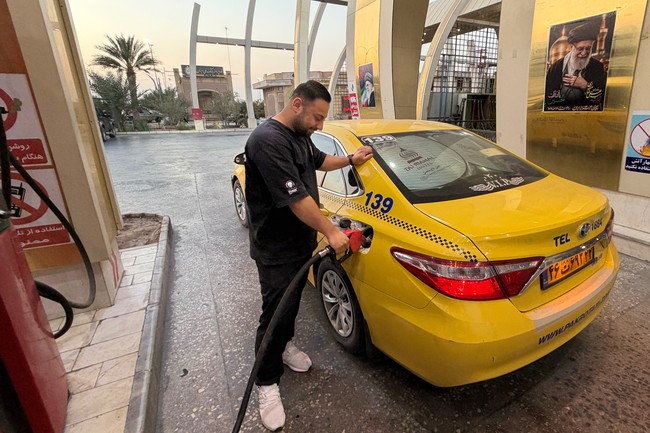
While the world watches gas prices rise because of the war in Iran, the suffering of Iranians themselves receives far less attention. Western motorists complain about filling their tanks. Inside Iran, families face a far crueler calculation. Every additional transport expense means less money for food, medicine, and rent. For millions already struggling to survive, another increase threatens the fragile arithmetic that keeps hunger from the door.
On September 8, the regime doubled the price of gas purchased beyond the monthly subsidized allowance, from approximately $0.083 to $0.163 per U.S. gallon. Motorists retain access to 15.9 gallons at $0.025 per gallon and another 13.2 gallons at $0.049 per gallon. Officials portray this as a carefully targeted adjustment. Such soothing language offers scant comfort to people whose livelihoods depend on keeping their vehicles moving.
The government insists that only heavier consumers will pay the higher rate. This conveniently overlooks how an economy functions. Drivers delivering meals, carrying passengers, or transporting purchases provide services across society. When their costs rise, the pressure travels beyond the filling station. Families without cars can still pay through higher fares and delivery charges. The supposed protection offered by a subsidized quota disappears when other household expenses climb.
Consider a Snapp driver interviewed by Euronews in Tehran. Snapp is Iran’s equivalent of Uber. His monthly gross earnings were 650 million rials ($283), while commissions, petrol, maintenance, and vehicle depreciation swallowed almost 300 million rials ($130). What remained had to sustain his household. Higher fares might protect his income, but his passengers were themselves struggling. He was trapped between rising operating costs and customers approaching the limits of what they could afford.
This latest blow falls upon a country already enduring punishing inflation. The figures cited for July put annual inflation at 66 percent, with food inflation reaching 128 percent. Behind those percentages are parents reducing portions, pensioners abandoning meat and workers watching wages lose value before payday. Eventually, economy becomes deprivation. Families who have already surrendered every modest comfort are being asked to surrender more.
Yet the demand for sacrifice comes from a ruling establishment steeped in venal corruption. The mullahs and their Islamic Revolutionary Guard Corps (IRGC) lackeys preside over a system in which political loyalty opens doors to wealth and influence, while ordinary enterprise struggles beneath arbitrary power. Their sermons about restraint would carry greater weight if those issuing them faced the daily humiliations endured by workers, pensioners, and the unemployed.
Corruption compounds every economic failure. Resources that should improve public services become opportunities for patronage. Commercial privilege rewards connections rather than competence. Secrecy protects the powerful from scrutiny. The resulting waste is passed down to citizens through deteriorating services, shrinking purchasing power, and fresh demands for payment. The motorist at the pump is helping shoulder the cost of a system whose beneficiaries remain insulated from its consequences.
Petrol alone neither caused this catastrophe nor determines every retail price. Much freight travels in diesel vehicles. Nevertheless, higher petrol costs can spread through passenger transport, small businesses, and delivery services. The deeper scandal is that a country endowed with immense petroleum resources struggles to satisfy domestic demand. Reported August consumption reached 38 million gallons daily against production capacity of 32 million gallons. Aging vehicles and inadequate infrastructure expose years of failed stewardship.
A responsible government would publish credible accounts, explain its choices and allow citizens to challenge them. Iran’s rulers treat scrutiny as a threat. Those demanding decent wages, equal rights, or accountable government encounter an apparatus designed to defend the ruling elite. Economic injustice and human rights abuse reinforce each other. Corruption flourishes where exposure invites punishment, while repression protects those profiting from public impoverishment.
The frenzy of executions gives that repression its most chilling expression. The gallows serve a political purpose beyond the destruction of individual lives. They send a message to every family contemplating protest, every young person demanding freedom, and every prisoner refusing submission. A leadership confident of its legitimacy would have little need to govern through such terror. Each execution deepens the gulf between the rulers and the people they claim to represent.
The political sensitivity of gas prices is etched into Iran’s recent history. The November 2019 increase helped ignite nationwide demonstrations, answered with lethal repression. That memory hangs over every subsequent decision at the pumps. Reports of security deployments around the latest increase reveal a leadership anticipating confrontation. The authorities understand how quickly anger over living costs can become a challenge to the entire structure of power.
Fear, however, supplies neither bread nor employment. Armed men beside filling stations cannot repair household budgets. Prison cells cannot restore purchasing power. Executions cannot remedy corruption or close the gap between production and consumption. Violence may drive anger temporarily out of sight, but the grievances accumulate with every shopping bill and every exhausted worker returning home with less than the family needs.
The international debate must make room for these people. Iran’s crisis reaches far beyond oil benchmarks and shipping routes. It concerns a population forced to finance its own impoverishment while enduring coercion from those responsible. Governments should demand an end to executions, defend political prisoners, and hold perpetrators accountable. The Iranian people deserve the freedom to replace this corrupt tyranny with democratic government. The world should stand beside them.
Struan Stevenson was a member of the European Parliament representing Scotland (1999-2014), president of the Parliament's Delegation for Relations with Iraq (2009-14), and chairman of the Friends of a Free Iran Intergroup (2004-14). He is an author and international lecturer on the Middle East.