





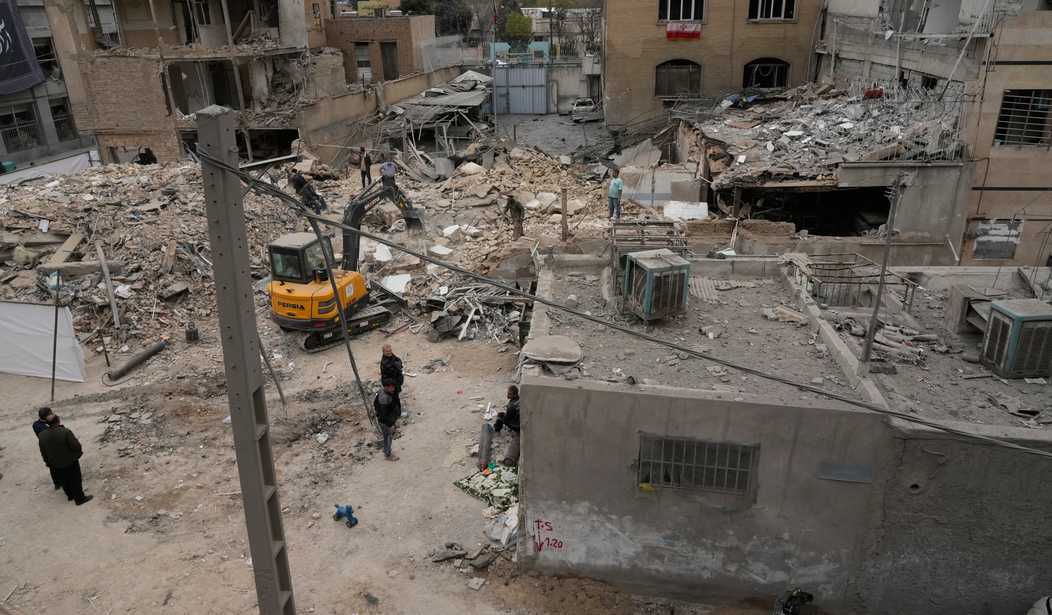
As the war surrounding Iran enters its 18th day, the country stands at a moment of historic uncertainty. Missiles and drones have struck military installations and strategic infrastructure across the country, while the regime’s leadership struggles to project an image of authority. Yet the most important battle may not be unfolding in the skies above Iran or in the waters of the Persian Gulf. It is taking place on the ground, inside the country itself.
Even as explosions reverberate across the region, Resistance Units linked to the Iranian opposition movement, the People's Mojahedin Organization of Iran (MEK), have intensified their campaign against the theocratic regime. Their actions, ranging from acts of defiance to targeted disruption, highlight a reality Tehran’s rulers have long feared, that an external conflict could ignite a domestic uprising capable of toppling the regime from within. For decades the clerical establishment has relied on two pillars to maintain its grip on power, repression at home and confrontation abroad. The current war is exposing the fragility of that strategy.
Adding to the uncertainty is the conspicuous disappearance of Mojtaba Khamenei, the powerful son of the assassinated Ayatollah Ali Khamenei. Mojtaba was announced as his father’s successor as Supreme Leader, but for nearly three weeks, he has made no verified public appearance or statement, apart from a contrived report that had clearly been prepared by his close advisors. In a political system where every signal of authority is carefully choreographed, such silence is striking. Rumors swirl through political circles in Tehran and across the Iranian diaspora. Some, including U.S. Secretary of War Pete Hegseth, suggest he may have been seriously injured during the opening strikes on regime command centers. Others believe he has been moved to a fortified bunker complex alongside senior commanders of the Islamic Revolutionary Guard Corps (IRGC). Whatever the truth, his absence underscores the regime’s vulnerability. When authority depends on projecting absolute control, even a hint of weakness can send tremors through the system.
Meanwhile the conflict threatens the world’s most critical energy corridor, the Strait of Hormuz. With shipping disrupted and oil tankers facing growing risks, U.S. President Donald Trump has urged international partners to help reopen the waterway and guarantee freedom of navigation. Nearly one-fifth of the world’s traded oil passes through the narrow channel between Iran and Oman, meaning prolonged disruption could send shockwaves through the global economy.
For Tehran, however, threatening the strait has long been a strategic weapon. By demonstrating its ability to choke off energy supplies, the regime hopes to deter further military pressure and force the international community to reconsider the costs of confrontation. Yet such brinkmanship carries enormous risks. Escalation in the Gulf could rapidly widen the conflict and draw additional powers into the crisis.
At the heart of the regime’s survival strategy lies the IRGC. Far more than a conventional military force, it forms the backbone of the Islamic Republic’s political and economic power, controlling vast commercial empires while commanding elite military units and intelligence networks.
Despite the destruction of several bases and weapons depots, the Guard Corps is unlikely to collapse quickly. Its surviving commanders have spent decades preparing for precisely this scenario. Much of Iran’s military infrastructure is buried deep underground in hardened bunkers and tunnel complexes designed to withstand sustained bombardment. Missile launch sites and command centers are dispersed across remote mountain ranges and deserts, reflecting a doctrine of endurance rather than outright victory.
Yet military survival alone may not save the regime. Years of economic mismanagement, corruption, and repression have left Iranian society deeply disillusioned with the ruling clerics. Waves of nationwide protests in recent years have shown that millions of Iranians are no longer willing to accept the status quo. There are also persistent reports that the Central Intelligence Agency has begun quietly supplying arms to Iranian Kurdish groups, long-time adversaries of the regime who have endured repeated repression under clerical rule. Kurdish regions in western Iran have historically been centers of resistance to Tehran’s authority, and their experienced fighters, the Peshmerga, are among the most formidable irregular forces in the Middle East. Should these Kurdish forces coordinate with Resistance Units linked to the People's Mojahedin Organization of Iran, the regime could suddenly face a far more dangerous internal front.
So where might the war go from here? The conflict could escalate dramatically if the IRGC attacks shipping in the Strait of Hormuz or strikes regional targets. Alternatively, international pressure might push the parties toward a fragile ceasefire that freezes the battlefield without resolving the deeper crisis. But there is a third possibility, one that Tehran fears most. If the war weakens the regime’s ability to enforce control, the Iranian people themselves may become the decisive factor. Resistance networks could expand their operations, protests could erupt again across major cities, and security forces could find themselves stretched to breaking point.
History offers many examples of regimes that survived foreign wars only to fall to internal revolt. The collapse of seemingly unshakeable systems often begins when fear shifts from the people to those who rule them. After nearly half a century of clerical rule, Iran may be approaching such a moment. Missiles and bombs may shape the battlefield, but they will not determine Iran’s future. In the end, the decisive struggle will take place not in the Gulf or the skies above Tehran, but in the hearts and streets of the Iranian people themselves.
Stevenson was a member of the European Parliament representing Scotland (1999-2014), president of the Parliament's Delegation for Relations with Iraq (2009-14) and chairman of the Friends of a Free Iran Intergroup (2004-14). He is an author and international lecturer on the Middle East.
Editor's Note: For decades, former presidents have been all talk and no action. Now, Donald Trump is eliminating the threat from Iran once and for all.
Help us report the truth about the Trump administration’s decisive actions to keep Americans safe and bring peace to the world. Join Townhall VIP and use promo code FIGHT to get 60% off your VIP membership.

Join the Conversation
VIP members get the ability to comment on articles.