





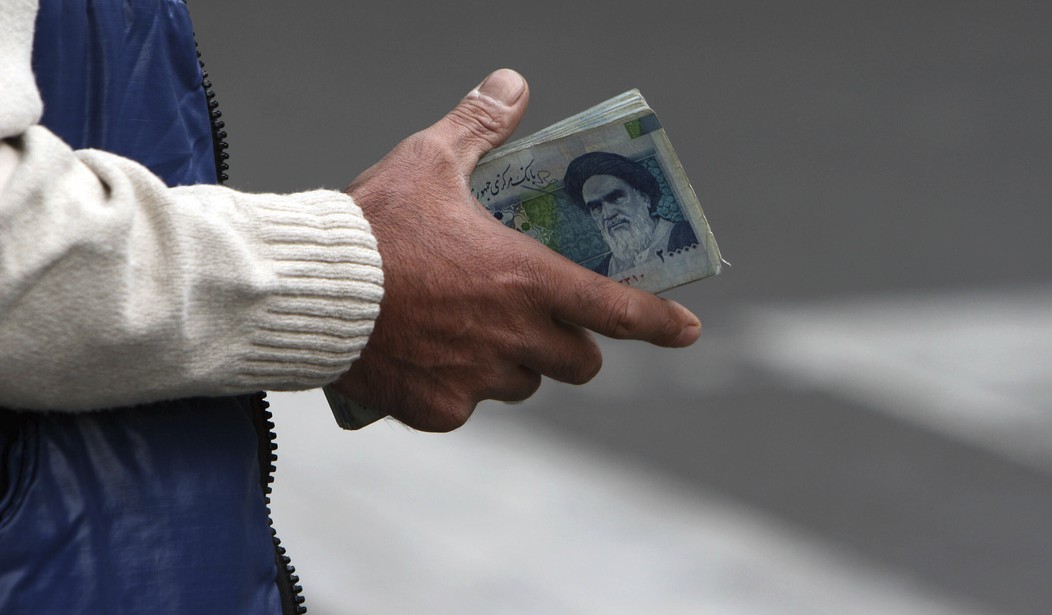
Amid an orgy of executions and the accelerating collapse of its economy, the mullahs' regime has driven the Iranian people to unprecedented levels of hardship. The latest plunge of the national currency to a historic low is not an accident of market forces, nor the consequence of global instability. It is the inevitable result of decades of plunder, corruption, and ideological fanaticism by a ruling clerical mafia whose survival depends on bleeding the nation dry. In recent days, the U.S. dollar smashed through the 1,250,000-rial threshold for the first time, shattering all previous records. At the time of the anti-Shah revolution in 1979, there were 74 rials to the U.S. dollar. State media declared that the rial "is melting away." In truth, it is not the rial that is melting, it is the regime itself.
The mullahs' solution to every crisis has always been repression at home and aggression abroad. Economic stewardship has never been on their agenda. Iran is a wealthy country, blessed with oil, gas, mineral resources, a young and dynamic population, and a rich cultural heritage. Yet under the venal dictatorship of Ali Khamenei, it has been reduced to penury. The catastrophic collapse of the rial is the clearest evidence of a regime in terminal decline, clutching at any mechanism, no matter how destructive, to prolong its grip on power.
State-run newspapers lament that the currency has lost a staggering 70 percent of its value in only 12 months. The sudden spike is being blamed on seasonal demand for the New Year or supposed uncertainty surrounding negotiations with the United States under President Trump. But even the regime's own media have ridiculed these excuses. The website Tabnak pointedly asked on December 1: "In any other economy, emergency lights would be flashing, but in Mirdamad [Central Bank headquarters], not even the curtains have moved… Why can't the Central Bank calm the market?"
The answer is painfully clear. The Central Bank is not failing to act; it is refusing to act. In the clerical dictatorship, the bank's job is not to serve the public interest; it is to serve the regime's survival strategy. Governor Mohammadreza Farzin, hand-picked by Khamenei's inner circle, has presided over a series of absurd policy decisions, including appointing an automotive executive to run currency affairs at the height of a monetary crisis. Farzin's inaction is not incompetence; it is complicity. The collapse of the rial is not the regime's problem; it is the regime's preferred solution.
For ordinary Iranians, the consequences are catastrophic. The official minimum wage for the Persian year 1404, just over 100 million rials per month, is worth less than $80 at today's exchange rate. A worker two years ago, earning a lower nominal salary, could afford far more. Today, families must choose between heating their homes and feeding their children. Items as basic as bread, rice, and cooking oil have become luxury goods. Millions now live below the poverty line, clinging to two or three jobs simply to stay alive.
What is emerging is nothing short of an "army of the hungry," a massive class of impoverished citizens with nothing left to lose. These are the very conditions that preceded Iran's nationwide uprisings in 2019 and 2022. By engineering poverty on such a scale, the mullahs are creating a social powder keg. Each tick upward in the dollar exchange rate is a spark, edging Iran closer to an explosion.
If Iran is becoming poorer by the day, the regime has never been richer. By allowing the currency to collapse, the ruling clique sells its foreign currency reserves, derived from oil, petrochemical exports, and illicit trade, at astronomical rates on the domestic market. The result is a tidal wave of rials that the government uses to paper over its massive budget deficit.
This deficit does not stem from investment in public services, welfare, or infrastructure. It arises from the vast sums required to finance domestic repression, ballistic missile development, the nuclear program, and the regime's web of proxy militias across the Middle East. Billions are drained into Hezbollah in Lebanon, the Houthis in Yemen, and the brutal militias in Iraq. All of this is paid for by Iranians who cannot afford a loaf of bread.
Even the regime's own outlets have been forced to acknowledge the truth. In February 2025, Serat News admitted that "economic mafias… are raising rates by creating false demand." But this "mafia" is not some shadowy private cartel. It is the Islamic Revolutionary Guard Corps (IRGC) itself, along with Khamenei's sprawling financial empire, two institutions that have seized control of most of Iran's economy. Whether through currency manipulation, smuggling, or the looting of national industries, the IRGC and the Supreme Leader's office operate as a gargantuan criminal enterprise, siphoning the country's wealth to fund a machinery of death and destruction.
Iran's economic collapse rests on two foundations: a bankrupt, mafia-like regime that uses the rial as a weapon against its own people, and a fundamentally ruined economic system built on cronyism and corruption. Decades of mismanagement have hollowed out production, devastated agriculture, and pushed millions into unemployment. The once-thriving middle class, a crucial pillar of any functioning society, has been obliterated.
With inflation spiralling, foreign investment extinct, and sanctions tightening, the rial has only one direction left, downward. This trajectory is irreversible as long as the current regime remains in power. Currency collapse has become the barometer of the mullahs' desperation, a measure of their willingness to sacrifice the last shreds of national stability to cling to their crumbling throne.
The regime has chosen to impoverish its own nation rather than relinquish power. Yet in doing so, it is paving the way for its own destruction. When the people rise again, as they surely will, it will not be for bread alone. It will be for dignity, for justice, and for freedom from a tyrannical system that has robbed them of all three.
The rial may be melting away, but so too is the regime that destroyed it.
Struan Stevenson is the Coordinator of the Campaign for Iran Change (CiC). He was a member of the European Parliament representing Scotland (1999-2014), president of the Parliament's Delegation for Relations with Iraq (2009-14), and chairman of the Friends of a Free Iran Intergroup (2004-14). He is an author and international lecturer on the Middle East.
Editor’s Note: Do you enjoy Townhall’s conservative reporting and opinion? Support our work by joining Townhall VIP! Use the promo code FIGHT to get 60% off your VIP membership!

Join the Conversation
VIP members get the ability to comment on articles.