







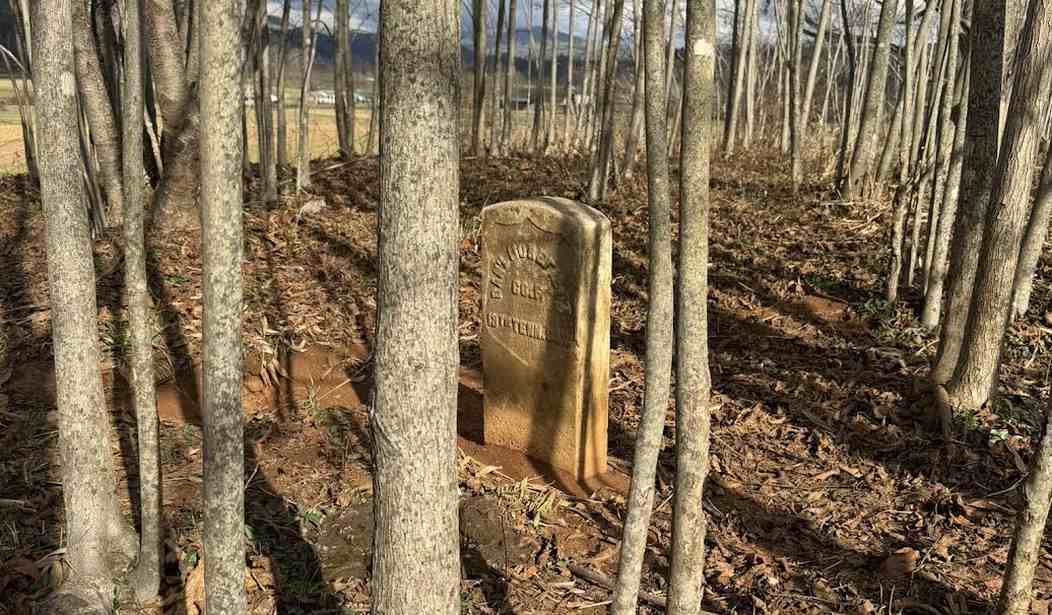
My daughter, Hannah, and I went on an interesting adventure last month, grave hunting in Mountain City, Tennessee, ancestral home of the Morefield clan. If you know any Morefields at all, and you probably don’t because it’s not exactly a common name, it’s quite likely that their ancestors once lived in that area after migrating from North Carolina, then England, before the Revolution. LDS records indicated that our earliest confirmed Morefield ancestor, Daniel (born ~1820), was buried in Wilson-Stout cemetery, one of at least 100 tiny cemeteries in the county.
Using the geolocation given, we finally found it on the top of a small hill in the middle of a massive farm field. It was a sad, forsaken place. Trees, bushes, and other vegetation had taken over decades ago. Cow patties were everywhere. Most of the gravestones had been knocked down, probably by the cows the rusty barbed wire, long lowered in many places, no longer could protect against.
Thankfully, Daniel's marker still stood tall, at least for now, proclaiming his Civil War service in the Union’s 13th Tennessee Cavalry (I’ll forgive him for siding with the Yanks, but only because East Tennessee was a mess back then). It's probably just a matter of time before even that collapses, though, because it was evident that an animal had been actively burrowing under it. We had been told that his son and my great-great-grandfather, Alexander, who also served with him in the 13th, was buried there also. We found his wife Matilda’s marker, but not his. We’ll be back at some point to look again.
Daniel, my great-great-great-grandfather, died in 1894, geographically one hour from where we live now but in a different world entirely. In 20 years, the world would be at war. Not only would mankind learn to fly, but it would learn how to drop death from the clouds. Motorized vehicles were about to replace the only form of transportation he knew. Even if he and the people in that tiny, remote farming village had read the fantastical tales of Jules Verne, they could never have imagined the technological juggernaut that was about to transform everything their descendants would experience. Sometimes, ironically, I feel like we're in a similar place now, on the verge of our world changing in ways we can't even imagine.
I thought of that funeral, on top of that quiet grassy knoll with stunning mountain views on every side, of his wife and all his many children and even more grandchildren walking or riding a horse or carriage from a nearby church that no longer stands to mourn the family patriarch. Families were rarely small then, and his was no exception. It had to have been a crowded place, at least on that day. None of them could have imagined the dizzying changes that were about to happen over the coming decades. And even if they knew, they would never have guessed that, despite it all, the land upon which they were standing would remain largely unchanged, that nobody would be around to care as nature and the cow patties took everything surrounding the lonely marker where they laid the family patriarch to rest.
We were probably the first visitors to that grave, besides the critters, of course, in many years. I didn’t know him, but he was still family, an ancestor, blood of my blood. For that alone, he deserves my homage, but even so, I have no idea what kind of man he was or what he meant to any of the people who mourned him. I do know he was a farmer after he was a soldier, as was his son. His grandson, Wiley, my great-grandfather, eventually moved to Southwest Virginia to work in the coal mines, as did his son, Harding, after serving in the Navy during World War II. I still remember hearing my grandfather's war stories, though not directly from him, as a child.
What did it all mean, if anything? The old saying goes that every human alive, no matter how famous or infamous or rich or poor or known or unknown they were, will someday die and leave a grave that eventually goes unvisited.
My father, who died in May, is buried in a real veteran's cemetery with real groundskeepers to keep it nice, but even his resting place will fade with time, and those of us who fondly remember him and the man he was will also pass, and the same for us, and so on. At some point, nobody alive will have the faintest memory of any of us. Eventually, long from now, the earth itself will be destroyed, taking every trace of humans and their 'accomplishments' with it.
If Christianity is right, and I do hope it is, we will meet our ancestors and see our loved ones again someday. But for now, visiting that grave was a clarifying and humbling experience, a sad reminder of just how temporary our lives and our times really are.
Editor’s Note: Do you enjoy Townhall’s conservative reporting that takes on the radical left and woke media? Support our work so that we can continue to bring you the truth.
Join Townhall VIP and use the promo code FIGHT to get 60% off your VIP membership!


Join the Conversation
VIP members get the ability to comment on articles.