





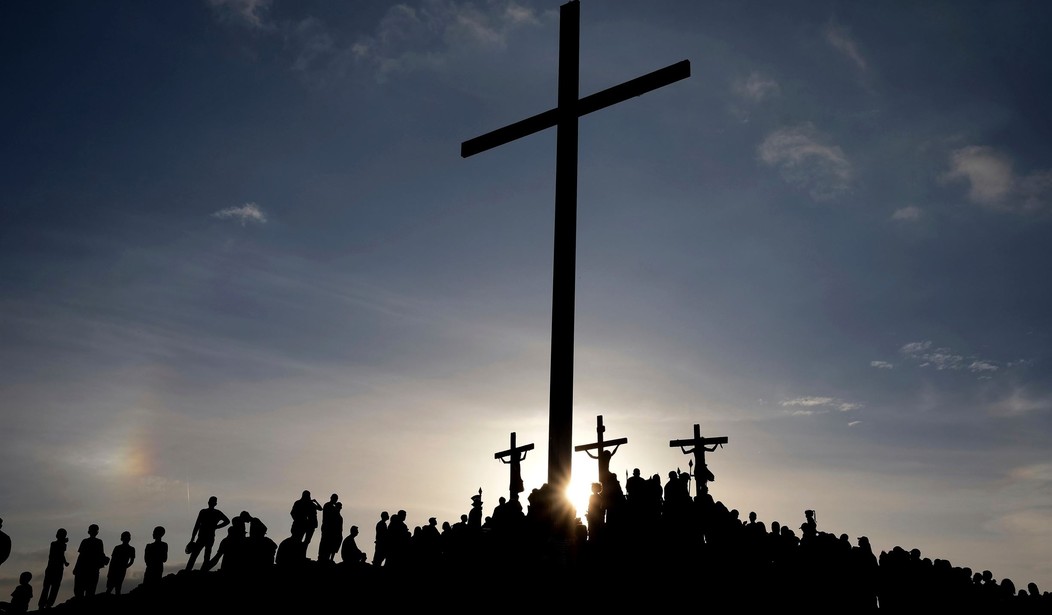
What if Good Friday is not a tragedy, but the moment a covenant is sealed?
Good Friday is not, in its deepest meaning, about death.
That is the scandal—and the mistake.
We approach the Cross as if it marks the end: a brutal execution, a divine transaction, a necessary payment to settle a cosmic debt. But the Church has always insisted on something more unsettling—and more profound. She calls this day good. Not because suffering is good. Not because death is good. But because something older than death is being fulfilled.
The Passion is not simply a sacrifice. It is a wedding. Not metaphorically, not sentimentally—but covenantally, historically, and bodily. If we miss that, we miss the meaning of the Cross itself.
From the very beginning of Scripture, marriage is the language through which God reveals Himself. Before there is sin, before there is sacrifice, there is this declaration: “The two shall become one flesh” (Genesis 2:24). This is not merely anthropology. It is theology. The union of man and woman establishes a shared life—visible, binding, and irrevocable. It is covenantal at its core.
And that word—covenant—matters. A covenant is not a contract. It is not an exchange of goods or services. It is the total exchange of persons, often sealed in blood, establishing kinship where none existed before.
So when God calls Israel, He does not speak in abstract philosophical terms. He speaks as a bridegroom: “I will betroth you to me forever” (Hosea 2:19–20), “I pledged myself to you… and you became mine” (Ezekiel 16:8), “As the bridegroom rejoices over the bride…” (Isaiah 62:5). This is not poetic decoration. It is diagnostic. God is telling us what kind of relationship this is. It is a marriage.
Yet by the time we arrive at the Passion, something has shifted in how many interpret the story. The Cross is often reduced to a mechanism: sin creates a debt; God demands justice; Christ pays the price. This framework is not entirely wrong—but it is radically incomplete. Because it cannot explain the form of the Passion. Why does it begin with a meal? Why the language of “body” and “blood given”? Why does Christ insist on participation—“Take, eat… take, drink”?
A purely legal model cannot explain why the Passion looks like a covenant ceremony.
The turning point is not the Cross. It is the Upper Room. On the night before He dies, Christ takes bread and wine and declares: “This is my body… this is my blood of the (new) covenant” (Matthew 26:26-28). These words are deliberate. They echo Sinai, where Moses sealed the covenant with Israel by declaring, “Behold the blood of the covenant” (Exodus 24:8). But here, something astonishing happens. Christ does not sprinkle blood on the people. He gives it to them to drink. This is no longer merely a covenant—it is a union. Interior, participatory, total.
In Jewish nuptial custom, the shared cup of wine signified consent. The bridegroom would offer it; the bride would receive it. To drink was to say yes. And here, Christ—the Bridegroom—offers the cup. “Take. Drink.” This is the proposal.
What begins at the table is completed on the Cross. From His pierced side flows blood and water (John 19:34). The early Church immediately recognized the meaning: just as Eve was drawn from Adam’s side, the Church is drawn from Christ (“The Lord God caused a deep sleep to fall upon Adam…” Genesis 2:21–22; Augustine, Tractates on John).
Marriage is sealed in the giving of the body. So is the Cross. Christ does not merely declare love. He gives His body. He pours out His blood. He holds nothing back. The Cross is not just Christ dying for us. It is Christ giving Himself to us. And that distinction changes everything. A payment can be made without intimacy. A debt can be settled without love. But a bridegroom does not approach his bride as a creditor. He approaches her as one who desires union—costly, total, irrevocable. The Passion, then, is not the interruption of a mission. It is the fulfillment of a marriage.
But like any marriage, what is begun must unfold. The vow has been spoken. The blood has been given.
But the Bride is not yet fully revealed. That happens in silence.



Join the Conversation
VIP members get the ability to comment on articles.