





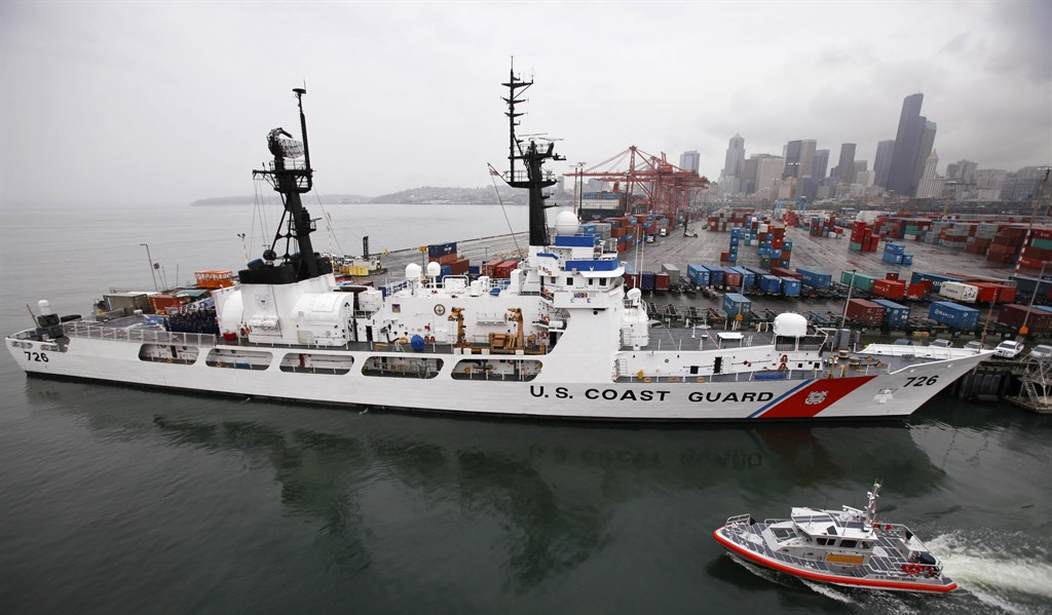
Last week, US Coast Guard Commandant, Admiral Paul Zukunft, confirmed he will not follow US Navy Secretary Ray Mabus down the rabbit hole of eliminating traditional ratings for enlisted personnel. Bravo Zulu! Pressed to follow the politically correct route of putting aside tradition and people for a hollow claim on equity (every man and woman becomes just a number) and efficiency – another Obama-era claim – the US Coast Guard said “no.”
The Commandant, a strategic thinker and respected listener, said the idea would “cause chaos," adding, "I cannot afford chaos when every person in the Coast Guard has a 24-by-7 job to do." Clear thinking, willingness to make tough calls, focus on higher purpose, mission, and people – is what distinguishes this Commandant, and makes our US Coast Guard the envy of the world. Predecessors of Admiral Zukunft, including Admirals James Loy, Robert Kramek and Paul Yost were cut from similar cloth. Each wrestled tough questions, found answers respecting past and future.
Ironically, the Coast Guard is the smallest independent active-duty force, numbering in the range of 40,000, in contrast to the Navy, which stands at nearly 325,000. The Coast Guard has about 25 ratings, while the Navy had – until recently – near 90. Still, the comparison is apt. The Navy ought to be able to track 90 ratings, job descriptions in which enlisted personnel – including at one time my father – took great pride. With an average 3600 sailors per specialty/rating, tracking should be elementary.
Admiral Zukunft pointed out Coast Guardsmen are "very proud of the rating badge that they wear on their sleeve," adding he “listened to my master chief and he's provided me the best advice… say no.” How refreshing, a leader who listens instead of telling others what they should think. Winston Churchill once said, “It takes courage to stand up and speak, and … it takes courage to sit down and listen.” Leaders do both.
Contrast Navy leadership. The difference is stark, inviting other comparisons. Take morale. Coast Guard morale is high, while Navy morale has plummeted. Understanding why is no mystery. By throwing away traditions, one after another – ship-naming protocols to enlisted ratings – current Navy leaders devalue individualism, naval history, pride in workmanship, unit and service cohesion, objective strength, and cross-service readiness.
Justifying the end of Navy ratings, the Secretary said it would “promote … cross-training and boost sailors’ post-service employment opportunity.” So, shall we end ships and planes to encourage facility with apps and i-phones? These decisions reveal a fundamental misunderstanding of people, policy, strategy, and why Americans choose the Navy.
More to the point, people are not play things. Service in the Navy is not to make political appointees feel good. The Secretary is oblivious. Recently, he chopped the suffix “-man” from Navy job descriptions, favoring “gender neutral” titles, thus banning “yeoman,” “airman,” “fire controlman,” and others. Contradicting his own reasoning, he then retained “seaman.” Logic be damned, politics full ahead.
The whole notion is absurd – like other au currant ideas. “Mankind” is a gender-neutral descriptor, as all the world knows. It is a taxonomic binomial name for homo sapiens, the suffix “-man” from Old England for homo sapiens. Likewise, early German “-mann,” means women and men. But history and language be damned, politics full ahead.
This Administration’s effort to change language is Orwellian double-speak, the essence of socialist dogma, how you alter how people think, textbook Marx. First, they conceive (can we still say that?) a genderless world, deeming it perfect equality. Then they create a sex-less third gender and stuff those of us who naively think we have a gender into it – or try. Utterly absurd. The utopian notion (someone’s utopia) is one hermaphroditic culture, devoid of healthy differences – complete fiction. Sublime oneness is rubbish.
Lost is pride in relative strengths, unique jobs, practiced workmanship, and individualism. The Navy’s ratings change depersonalizes individual jobs, turning sailors into numbers; neutering Navy personnel undermines personal identity and the value of difference itself – not to mention motivation, production, readiness and morale. Bad ideas. Ironically, mandating sameness assures continuing freefall in Navy morale.
All this is lost to the politically correct. So the Navy suffers endless social experiments, retraining in transgender bathroom etiquette, issuing a “sex change manual” (permitting extended time to readjust), on and on. Navy policies and priorities? Hardly. Then add christening (can we still say that?) ships with Leftist political names. Why? The Obama Administration’s approach to men and women in uniform – and naval history – is painful: They do not count.
Against this backdrop, the US Coast Guard’s refreshing appeal to common sense – to tradition and mission, unity and readiness, morale and respect for people – is gratifying, reassuring, instructive – and uplifting. Perhaps the next Secretary of the Navy will re-look how best to encourage, respect, train and support America’s men and women in uniform, how better to honor the past and future. The US Coast Guard is, for now, a beacon.
Looking ahead, the next Secretary of the Navy faces tough decisions, such as how did we get to the point where Congress and the Pentagon knowingly created a failed, underperforming, wildly over-budget “Littoral Combat Ship” (which started on muddy requirements and ended unable to perform)? Who pushed that endgame, why and how do we reverse such forced errors?
But other questions are not hard. Restoring ratings and ending political correctness is easy. We owe those who serve in the Navy and Marine Corps something better than misguided, political, costly mistakes. We can listen to all ranks, plus experts in readiness, unit constitution and cohesion, naval architecture, procurement reform. Doing so, we will be better prepared.
Which brings us back to the US Coast Guard. No wonder their motto is Semper Paratus – “always ready.” They are. Now, the US Navy needs to be. Admiral Zukunft, thank you for the example. May the next Administration hear you!


Join the Conversation
VIP members get the ability to comment on articles.