





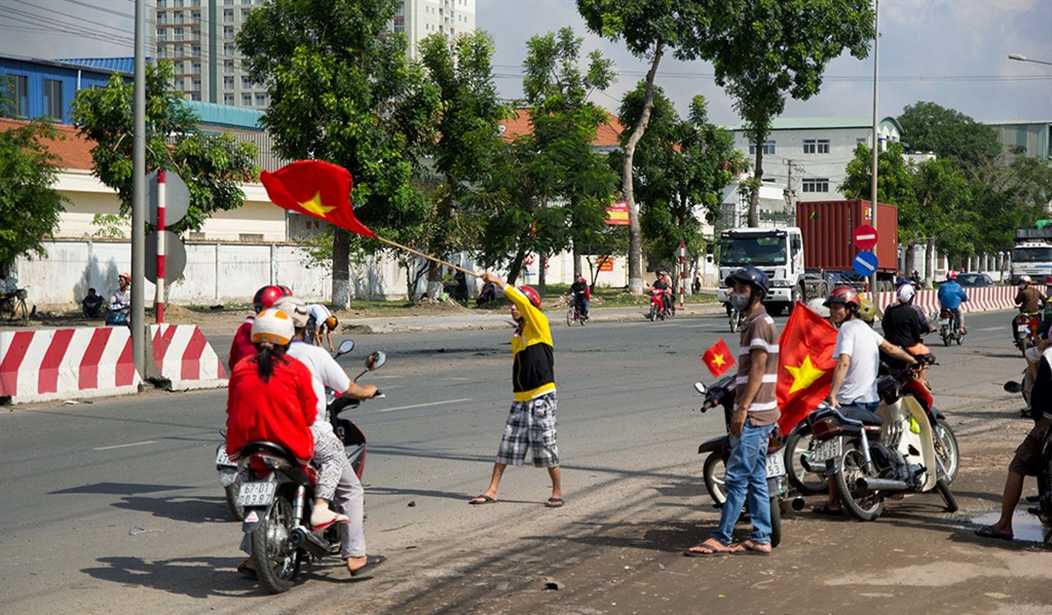
As recently as 1990, Vietnam was the poorest country in the world, poorer even than the poorest countries in Africa. During the war, 14 to 15 million tons of bombs and explosives fell on Vietnam – 10 times as many as had been dropped on Germany during the course of the Second World War. The communist north won the war and the new government introduced a planned economy throughout the country, leading to even more poverty. What the war had not destroyed, the planned economy did.
With a GDP of 98 US dollars per capita, Vietnam was poorer than Somalia. The country had to import rice because its own system of collectivized agriculture was unable to meet its own population’s basic needs. Since monthly salaries covered no more than a week’s living expenses, almost every household was forced to find extra sources of income to make up the shortfall. It became common in Hanoi for families to use one room of their apartment house units to raise pigs. Pig-farming was the best source of extra income and most families turned one room of a three-room apartment over to pigs, hardening themselves against the noise, odor and poor hygienic conditions.
Nowadays, Vietnam is one of the fastest-growing countries in the world and a major exporter of electronic goods, such as smartphones. According to the World Bank, the percentage of the Vietnamese population living in poverty has fallen from 79.7 percent to 5 percent since 1993. This is the upshot of a sharp increase in economic freedom. In 2024, Vietnam is the top climber in the Index of Economic Freedom, which the Heritage Foundation has been publishing every year since 1995.
The current ranking covers 176 countries and is based on assessments of twelve specific criteria. While the state of economic freedom in the world has, according to the Heritage Foundation, fallen to the lowest level since 2001 and the United States has its worst rating since the index was first compiled in 1995, Vietnam has bucked the global trend and improved greatly.
Vietnam might only rank 59th out of 176 countries, but it is catching up in leaps and bounds: Vietnam climbed 13 (!) places compared to the previous year, where it was 72nd. In a long-term comparison since 1995, Vietnam has gained 21 scores, more than any other country of comparable size in the world (the United States has lost more than 6 points over the same period). Of the 40 countries in the Asia-Pacific region assessed in the index, Vietnam now ranks eleventh.
Vietnam may still officially call itself “socialist” and have a one-party system, but the people in Vietnam have a distinctly capitalist mindset. It is certainly easier to find a Marxist at an American or European university than at a university in Vietnam. Not so long ago, I was invited by the Foreign Trade University to a workshop on the topic of how to further improve the perceptions of the rich.
And that is despite the fact that the rich are already held in such high esteem in Vietnam today. Unlike in many Western countries, where rich people are scapegoats for every negative development in society, for many people in Vietnam they are role models. An international survey in 13 countries revealed that there is only one country – Poland – in which attitudes toward the rich are slightly more positive than in Vietnam. And when asked which economies in the world they most admire, a majority of Vietnamese respondents mention Japan, South Korea, and Singapore. China and North Korea come last. Among those under the age of 30, the United States ranks second.
The starting point for the changes in Vietnam were the Đổi Mới market economy reforms that started in 1986. These reforms introduced private property rights, reduced the influence of the state, and allowed the markets more freedom. Vietnam also opened itself to the world and welcomed international investors. The policy was similar to Deng Xiaoping’s reforms in China. But while state influence on the economy has grown again in China in recent years, as yet no such similar development has been observed in Vietnam. Some companies are even relocating from China to Vietnam in pursuit of more economic freedom.
Of course, Vietnam still has a lot of work to do, as the current Index of Economic Freedom shows. The Heritage Foundation awards very good scores to Vietnam in the categories “Fiscal Health”, “Government spending”, “Tax burden,” and “Trade freedom”, while there is still a lot of catching up to do in the areas of “Government Integrity” and “Judicial Effectiveness.” Corruption remains a major problem and there are still too many state-owned enterprises.
But if Vietnam continues on the path of market economy reforms, it has the chance to become one of Asia’s leading economic nations.
Rainer Zitelmann is the author of the just-published book How Nations Escape Poverty, which focuses on the rise of Poland and Vietnam.

Join the Conversation
VIP members get the ability to comment on articles.