







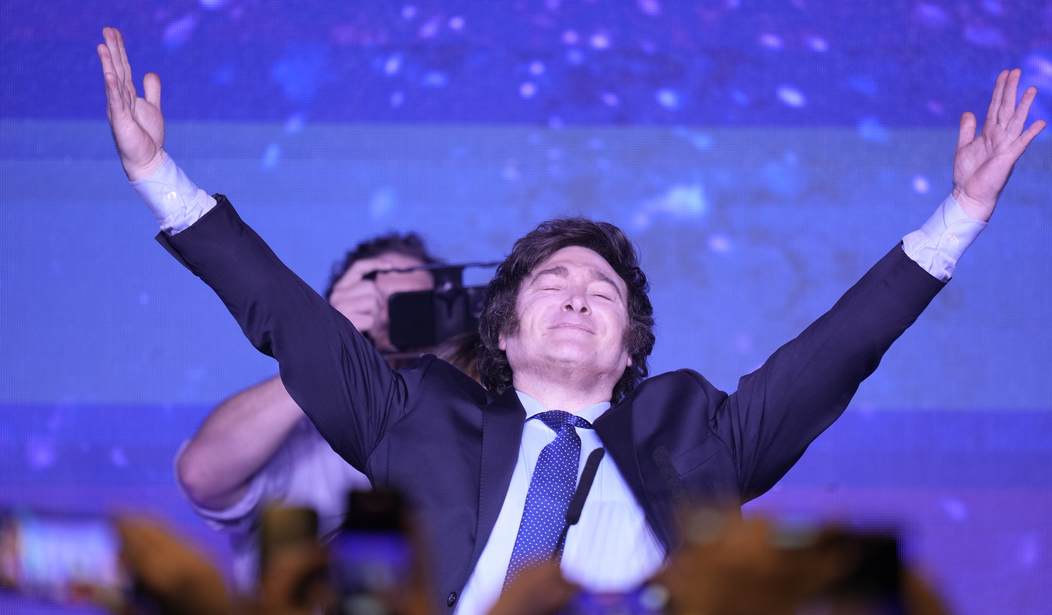
The libertarian Javier Milei was elected Argentina’s new president on November 19, winning 55.7 percent of the vote. But things won’t be easy for Milei. On November 24, just a few days after the election, I met Nicolás Emma, the leader of the Buenos Aires office of Milei’s libertarian party, at the party’s headquarters in the country’s capital. Several other party organizers were also present, including Gustavo Federico and Facundo Ozan Carranza. During the conversations I had with these and other leading figures from Milei’s party, representatives of think tanks, and Argentinian journalists, it became clear time and time again that Milei faces a truly Herculean task.
There are many daunting challenges, chief of which is the country’s triple-digit inflation rate. Milei’s party has only 35 out of 257 deputies in Argentina’s Chamber of Deputies (Cámera de Diputadas). His fiercest opponents, the left-wing Peronists and other leftists, hold 105. In the Senate (Senado), Milei’s party has only eight out of 72 members. That surprised me at first, but it is because only half the seats in the lower house were up for election this time around. It will be another two years before the other seats are contested. In the Senate, only a third of members were newly elected. Milei can issue presidential decrees to force through some policy changes, but any tax reforms will need to be approved by both the Chamber of Deputies and the Senate. Milei can also use referendums to mobilize popular opinion, but referendums can only be held on certain issues and are not binding.
During my discussions, representatives of Milei’s party repeatedly singled out Argentina’s trade unions as their main adversaries. The trade unions are extremely strong in Argentina, very political and firmly in the hands of the Peronists. Milei’s people expect particularly strong opposition in response to his plans to privatize his country’s main public broadcaster. The biggest challenge that Margaret Thatcher faced in the UK in the 1980s was overcoming the opposition of left-wing trade unions – who crippled the country with strikes that often dragged on for months.
Milei’s people say that there are hundreds of thousands of “employees” in the civil service who literally do nothing but draw their pay checks and stand up for the Peronists day in, day out. As soon as their jobs come under threat, there will be massive resistance.
One pivotal question that I asked again and again was whether the people of Argentina will have enough patience for Milei’s reforms, especially if the situation initially deteriorates? Experience from other countries (e.g. Thatcher’s reforms in the UK in the 1980s, Leszek Balcerowicz’s reforms in Poland in the 1990s) shows that market economy reforms always involve some things getting worse at first. Subsidies are abolished, hidden unemployment becomes open unemployment. It is only after an initial “lean period,” which in the best case can last two years, that things begin to improve. The answer from Milei’s people: He has already repeatedly pointed out that it would take at least three terms to push through his reforms and make Argentina successful again.
The main issue for Argentines, as all polls show, is the fight against inflation. Augustin Etchebarne from the Libertad y progreso think tank believes that the Milei’s promised dollarization of the currency will not take place for at least the first two years, especially as the banks are mounting significant resistance and the economy minister and head of the central bank will probably be appointed by Macri supporters. All that remains is the radical reduction of subsidies in order to stabilize the budget.
Another question is just how loyal supporters of Maurico Macri, with whom Milei has formed an alliance to win the run-off election, will prove to be in the longer run? And how strong an influence do right-wing nationalists exert within the ranks of Milei's libertarian party?
In addition, Milei must first establish a proper, nation-wide political base. There are currently various independent branches of the party in the country’s individual regions. I met the people in Buenos Aires who are working on creating the legal conditions to merge them into one party.
The crux of the matter is that even if Milei succeeds in implementing his reforms, despite not having majorities in either the Chamber of Deputies or senate (the first hurdle), everything will depend on whether the population of Argentina has the patience to endure the lean period required for market-economy reforms (the second hurdle).
Rainer Zitelmann is the author of the book In Defense of Capitalism. https://in-defense-of-capitalism.com/


Join the Conversation
VIP members get the ability to comment on articles.