





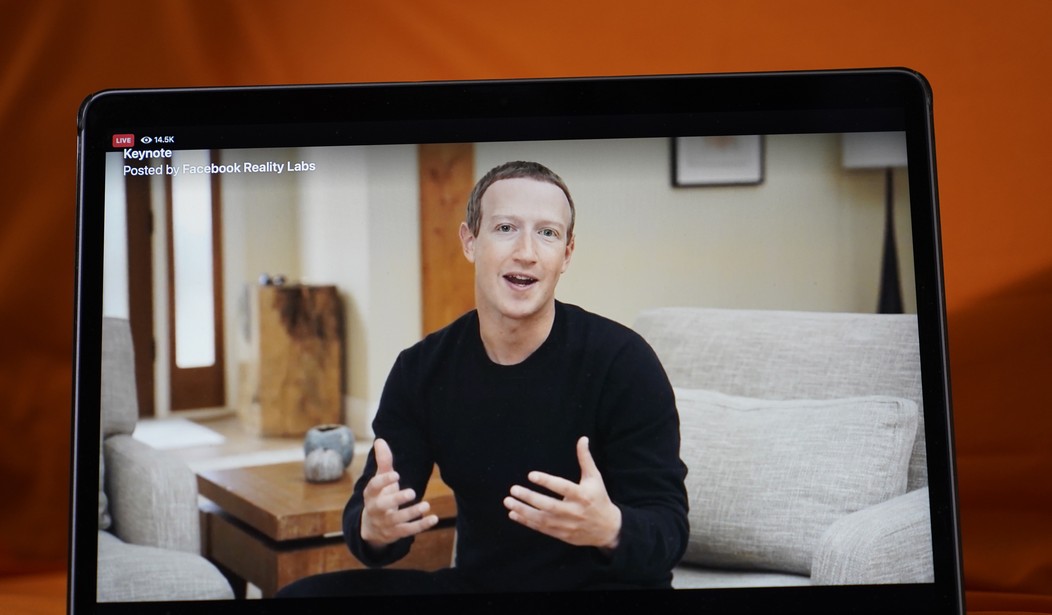
Facebook Company has failed in its apparent attempt to disappear into the witness protection program for creepy technology by re-branding as "Meta". Along with this new facelift for the holding company of Facebook and all of the corporation's other tech holdings -- notably WhatsApp, Instagram, and Oculus VR -- founder Mark Zuckerberg has announced that the company has plans for creating a whole "Metaverse," a virtual alternative reality.
Sounds a lot like the Matrix depicted in the 1999 movie of the same name in which Laurence Fishburne's Morpheus asks Keanu Reeves' Neo: "You take the blue pill, the story ends, you wake up in your bed and believe whatever you want to believe. You take the red pill, you stay in wonderland, and I show you how deep the rabbit hole goes."
Meta seems to be creating a "blue pill" world that not only risks denaturing people's sense of reality, but also seriously reducing the diversity of society in the most critical way: that of ideas and thinking.
You might think that it's no big deal and that there's no harm in a parallel online world that helps people escape the daily grind in the same way that scrolling on social networks already does. That's the naive, "blue pill" way of looking at it. The past arguably provides the most informed view of the future.
The path that social networking has taken already is a lot like the high-potential, straight-A high-school quarterback who morphs into a nearly unrecognizable disappointment and shows up to the 10-year reunion ranting about politics.
As one of the very earliest adopters of Facebook in the mid-00s, it's difficult to explain to latecomers what the platform once was. Back then, it felt like an intimate chat board for reunited childhood friends. Its primitive layout was like that junk drawer we all have; it looks messy, but we can instantly find anything inside it. Then came the frustrating redesigns, along with the monetized ads. Both helped to scale the platform from an intimate village into a large online city that replaced your familiar daily interactions with those of strangers. It became an avalanche of "likes" and comments from that creepy guy -- oh, you know the one -- the friend of the friend of your second cousin. A photo of you duck-facing cheek to cheek with your dog? Five seconds later... "like"! A post showing you laying in a hospital bed in a full body cast? "Like!"
Next came the algorithm-driven news feeds, with the platform selecting what gets placed in front of you based on a formula that no government has been able to successfully unravel. But what did seem apparent was that Facebook was feeding you more of the kind of content that you or your social network already had interacted with -- or viral content with which others had interacted en masse. Any dumb photos seemed to get preference over thoughtful text.
Emotionally charged political posts that garnered the most reactions were shoved front and center as users polarized into ideologically defined online tribes which defended their dogma against the perceived enemy camp to the exclusion of reasonable critical thought.
Then came censorship of one side of many charged debates. We still don't know how it's decided that certain views end up targeted for censorship, but what's certain is that arguing the need to cull "disinformation" or "fake news" -- as legislators have encouraged Facebook to do -- is a fool's errand.
It's not because a government says that something is true that it necessarily is. As we've seen in matters ranging from war to the current COVID-19 pandemic, states and those representing them are often proven wrong in the official information that they convey and attempt to propagate as gospel.
Yet they dare to claim that they hold the sacred truth and demand that post-state private institutions of global governance that tech giants like Facebook have become enforce their chosen dogma.
The state has ultimately outsourced its information operations to these platforms by virtue of communicating its acceptable narratives and demands for online censorship of competing views branded as "fake news", and the platforms seem mostly happy to comply, if only to avoid regulatory punishment.
It's the users who ultimately find themselves victims of this outsourcing of government-approved propaganda as they passively consume the end-result of this public-private operation to manufacture consent in the direction that's considered acceptable by the state.
Further, behind algorithm-driven information operations that permeate social media, the platforms also serve as a dragnet for user data for exploitation by commercial partners, as well as the state, which can easily request and obtain information from the company.
The only limits are set by you and the information that you're willing to enter. But imagine if rather than a platform onto which you type you can physically inhabit a blue pill world, thanks to virtual reality technology. How far would you be willing to go to surrender control over your conscience to an illusion of choice wrapped in an orchestra of entertainment conducted by Big Brother?



Join the Conversation
VIP members get the ability to comment on articles.