





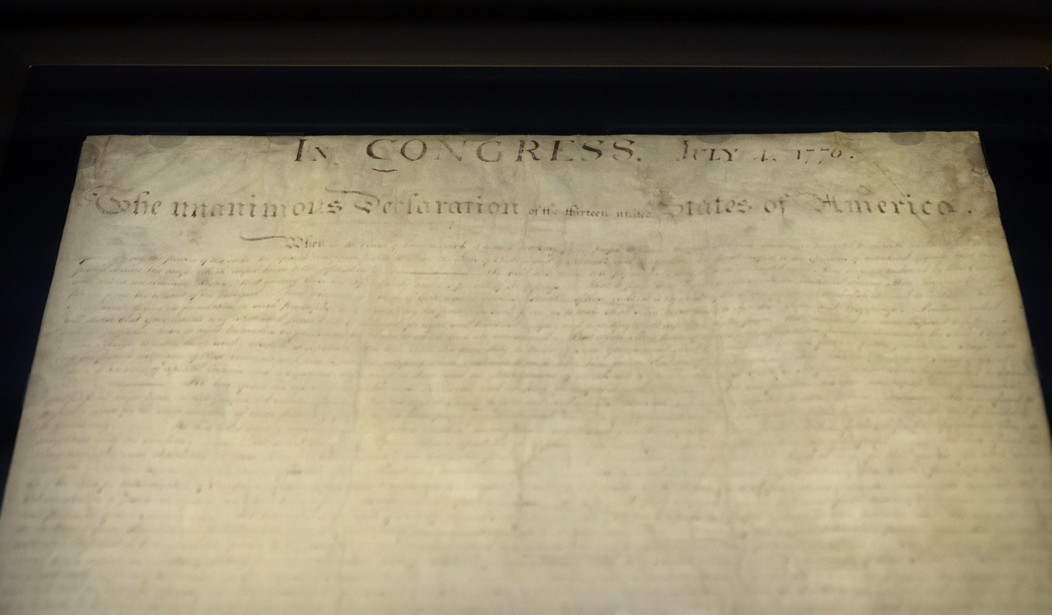
Article V of the Constitution states that a convention for states to propose amendments to the Constitution will be held when two-thirds of the state legislatures around the country apply to hold one. This is an alternate way to amend the Constitution; historically, only Congress has amended the Constitution. By 1979, two-thirds of the states had applied to Congress for a convention, 39 of the 34-state threshold, and that number continues to increase. However, according to the Federal Fiscal Sustainability Foundation (FFSF), “Since 1979, Congress has breached this unambiguous and non-discretionary ‘shall call’ obligation under Article V.”
Since Congress has been stuck in gridlock for years, unable to control runaway spending, an Article V Convention is seen as a way for the states to bypass Congress and put a check on federal power. FFSF has been one of the leading organizations in this area. Its board includes Ken Cuccinelli, former Attorney General of Virginia and Acting Deputy Secretary of the U.S. Department of Homeland Security. FFSF is pushing for a fiscal responsibility amendment.
The Convention of States (COS) is another leading organization in this area. In addition to advocating for fiscal responsibility, COS seeks amendments to limit the power and jurisdiction of the federal government and impose term limits on Congress and federal officials.
FFSF, which is led by former U.S. Comptroller General David Walker, said the states need to sue Congress over its refusal to adhere to the Constitution. Article V consultant Sam Fieldman identified at least six states that have standing to file in federal court written into their rules, including Arizona. Charles Cooper of Cooper & Kirk PLLC, a prominent conservative D.C. litigator known for high-profile cases, has drafted a proposed lawsuit. FFSF shopped it to Republican state attorneys general and legislatures.
Some lawmakers have introduced resolutions supporting the lawsuit. In Arizona, Senate President Warren Petersen and then-House Speaker Ben Toma issued a letter in February 2024 demanding that Congress act, or they would consider joining other states in a lawsuit. “By failing to record and count these applications and to call a convention, Congress has violated its constitutional mandate and subverted the states’ equal power to propose constitutional amendments,” the two said.
The Congressional Research Service (CRS) contends that fewer than two-thirds of states have submitted applications, asserting that the applications must be contemporaneous and on the same subject. CRS claims that under this criterion, only 19-20 states have submitted applications for the Convention of States, and only 27-28 for a balanced budget convention.
But Article V never says the language in the proposals from each state must be the same, nor does it say anything about timing.
U.S. Republican House Speaker Mike Johnson (LA-04) has been a longtime supporter of using Article V to call a convention aimed at limiting federal spending and power. As Chair of the House Judiciary Subcommittee on the Constitution and Limited Government, Johnson held a hearing on Article V and the Convention of States just before becoming Speaker.
"The government has grown too large and they put this [Article V] safeguard in there and they said, 'look, we want the power to be reserved to the people,' he said in 2016. "This is the measure of last resort, and my friends, to me, we are at the last resort."
A few conservative groups have opposed an Article V convention, fearing a runaway convention where radical changes are made that fundamentally rewrite the Constitution. However, numerous constitutional legal scholars point out that the Founding Fathers drafted the language very narrowly in order to prevent this. There have been about 650 conventions among the states in our nation’s history, on topics like trade, slavery and infrastructure. None of them resulted in runaway situations.
Michael Kapic, a retired corporate executive turned historian who researched state conventions in his book, “Conventions that Made America,” told The Epoch Times, “The idea that we’ve never done this before is totally foreign.” He said, “we’ve done this hundreds of times over the last three centuries,” going back to even before the Constitution was drafted in 1787.
Any amendment proposed by an Article V convention must then be ratified by three-quarters of the states, just like amendments proposed by Congress. So nothing terribly controversial is going to get through.
The Left opposes an Article V convention because state legislatures lean more Republican. Republicans dominate both chambers of the legislature in 28 states currently, while Democrats control only 19 state legislatures. However, Democrats are careful not to publicly admit this is the real reason they oppose it. They were furious when Article V proponents figured out in 2020 that they could include states that had previously applied for dissimilar topics.
Groups that support a convention include the American Legislative Exchange Council (ALEC), Americans for Tax Reform, some Heritage Foundation affiliates, the Federalist Society, FreedomWorks, Tea Party Patriots, Club for Growth, State Policy Network and American Cornerstone Institute. Prominent individual supporters include Senators Rand Paul, Mike Lee and Ron Johnson; many Republicans, including Ron DeSantis; Ben Carson, Allen West, the late Charlie Kirk, James O’Keefe, Pete Hegseth, James Dobson, Mark Levine, Sean Hannity, Ben Shapiro and Rick Santorum.
States have submitted applications to Congress over 700 times. Why does Congress, with all of its corruption, get to flagrantly disregard the Constitution and solely propose amendments, when our state legislators are just as equal in this area? Johnson has admitted he doesn’t have the support in Congress to recognize the applications. It will be fascinating when the states sue Congress, because the current Supreme Court is regarded by legal experts as one of the most federalism-friendly Supreme Courts in modern history.
Editor’s Note: Do you enjoy Townhall’s conservative reporting that takes on the radical Left and woke media? Support our work so that we can continue to bring you the truth.
Join Townhall VIP and use promo code FIGHT to receive 60% off your membership.

Join the Conversation
VIP members get the ability to comment on articles.