





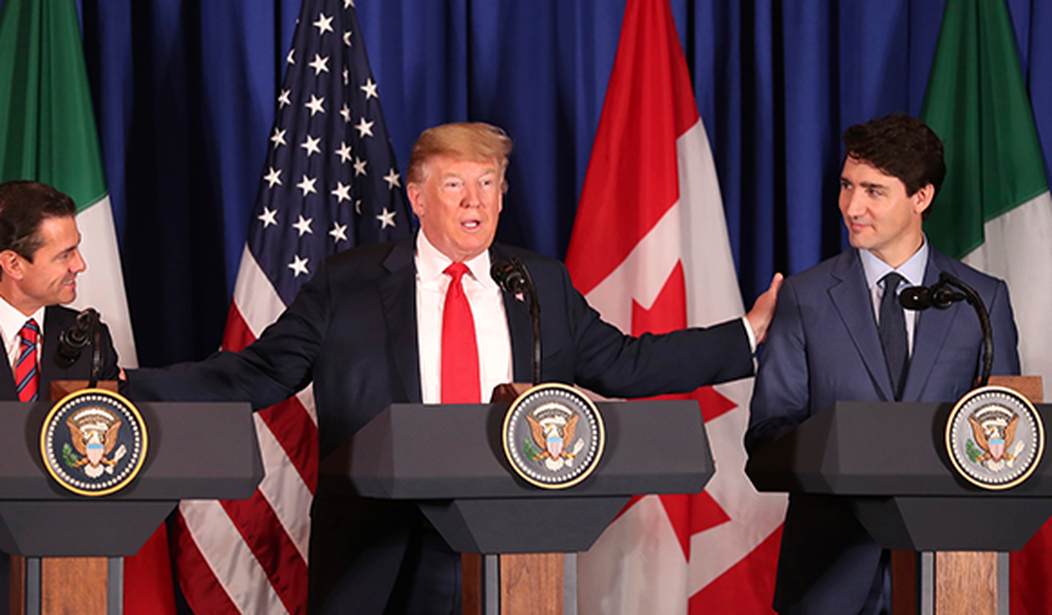
President Trump is eager to have Congress ratify the United States-Mexico-Canada Agreement, which modernizes NAFTA. He has been complaining over Twitter about the Democrats neglecting it because they are focused so much on impeachment. Congressional Democrats have issues with it currently and want changes made, but House Speaker Nancy Pelosi says things are moving along. If they don’t agree to pass it, Trump has threatened to withdraw from NAFTA. But is the new agreement much of an improvement?
NAFTA helped the three countries’ economies and made Mexico and Canada the U.S.’s two biggest trade partners. The USMCA would take things a step further. Robert E. Lighthizer, the president’s chief trade negotiator, said it would “help stop the outflow of manufacturing jobs and return many to the United States.” Because the labor provisions in NAFTA were in a side agreement that was not binding, American manufacturers continued to flock to Mexico where wages were low.
In order to get Mexico and Canada to agree to the USMCA, Trump agreed to end steel and aluminum tariffs on the two countries. The agreement was almost derailed when Trump threatened to impose tariffs on Mexico over immigration, but he backed down.
The agreement supports 12 million American jobs. It increases exports to Mexico and Canada, particularly agricultural products. One key victory for Trump was getting Canada to open up its dairy market to American farmers. This significantly benefits small and medium sized U.S. businesses.
Democrats want the agreement to address climate change. So far it does not. However, it does include new provisions to protect the environment, such as requirements to improve air quality, prevent and reduce marine litter, support sustainable forest management, and ensure appropriate procedures for environmental impact assessments. Democrats still want more, including provisions on wastewater and pollution from recycled batteries.
Democrats want stricter labor regulations in Mexico. They proposed allowing U.S. authorities to inspect Mexican labor conditions as part of USMCA, but Mexico turned it down. Democrats aren’t satisfied with a requirement that 40 to 45 percent of automobile parts must be made by workers who earn at least $16 an hour by 2023. However, the agreement does state that Mexican workers have the right to unionize, mandates safe working conditions and bans forced labor.
The agreement increases the requirement for home built autos in order to qualify for zero tariffs. Now, in order to get the break, 75 percent of automobile components must be manufactured in one of the three countries, up from 62.5 percent under NAFTA.
Democrats want to make dispute settlements binding. Under NAFTA, enforcing provisions was difficult since each country could block these panels. The U.S. particularly does not want to give up control over U.S. trade remedy laws.
Democrats want to decrease the length of intellectual property protections for biologics, which are medicines made from living materials. The USMCA provides 10 years of protection before other manufacturers can make similar products. The U.S. provides 12 years of protection. Democrats want to lower the USMCA length to five or seven years. But they will face strong opposition from brand-name drug manufacturers.
The USMCA provides protections for internet companies so they’re not liable for content their users produce. This is troublesome, since internet companies frequently restrict conservative content while acting as publishers. So why should they get additional protections as platforms? They can’t have it both ways. You’re either a platform, which is completely neutral, or you’re a publisher, which isn’t neutral.
So how good is the trade agreement, really? The left-leaning Washington Post says it mostly leaves NAFTA intact, or changes it in ways Democrats and their union allies have long demanded. The provisions relating to the environment and labor are now incorporated into the main text of the agreement where they can be enforced, which they weren’t under NAFTA. If you want to bring manufacturing jobs back to the U.S., then the stricter labor regulations are a good thing.
Trump is eager to get the USMCA passed this fall, so he can tout it in his campaign for reelection. He has referred to NAFTA as the “worst trade deal in history,” due to the loss of American jobs, and wants to be able to show he fixed it. While free market absolutists may not like the heightened labor provisions, bringing American companies back to the U.S. will be something Trump can brag about.


Join the Conversation
VIP members get the ability to comment on articles.