





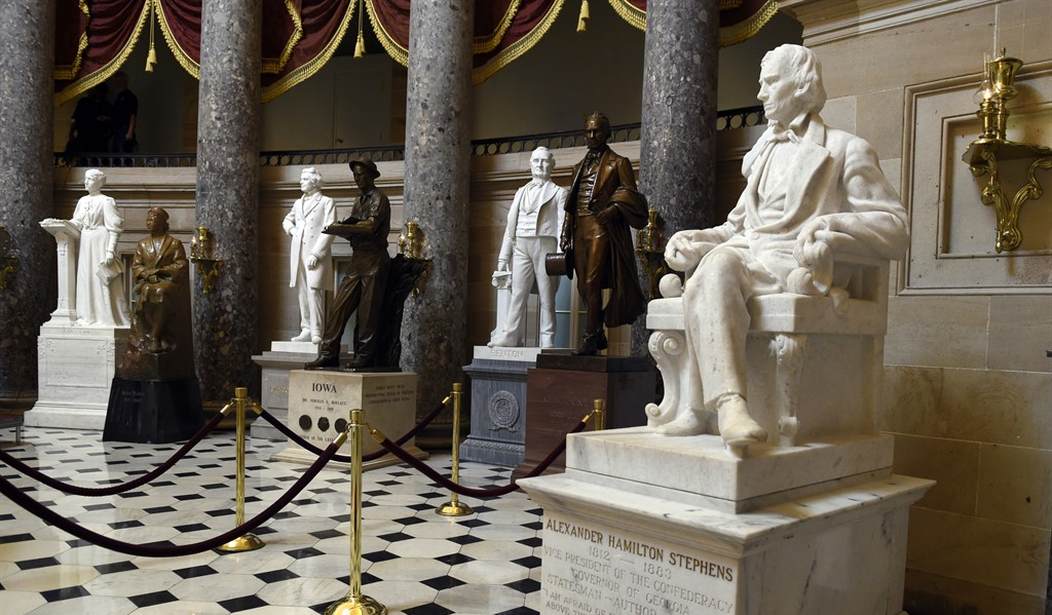
Congress officially writes the laws in the country, but they increasingly pass broad, vague generalities that allow regulators, bureaucrats, and judges to make all of the important policy decisions, often decades after the Congress that enacted the original law has left office.
The Supreme Court just upheld an IRS rule that spends about $20 billion a year on the theory that, quoting John Roberts: "the phrase 'an Exchange established by the state'... may be limited in its reach to State Exchanges. But it is also possible that the phrase refers to all Exchanges--both State and Federal."
Really?The FCC recently issued an order reversing two-decades of free-market policy and reclassifying the Internet as a heavily regulated and taxed public utility under the Communications Act of - yes, seriously - 1934.
The EPA has become a super-legislature unto itself, using the Clean Air Act of 1970 as an all-purpose license to regulate the entire economy in the name of global warming and the Clean Water Act of 1972 as a grant of power over every puddle and stream in America.
Members of Congress complain a lot about the bureaucracy, but a lot of them secretly like outsourcing the real decision making. Otherwise they wouldn't keep doing it.
Fortunately, a moment of clarity for the American people is expected soon, when the House - and then possibly the Senate - will vote on fixing the country's regulatory system and restoring the basic constitutional principle that Congress is responsible for writing the laws.
The bill, H.R. 427, sponsored by Rep. Todd Young of Indiana, is known as the Regulations from the Executive in Need of Scrutiny (REINS) Act.
It didn't come from any of the lobbyists, think tanks, or so-called experts in Washington: it came from a veteran, former judge, and longtime political activist named Lloyd Rogers in Alexandria, Kentucky.
In 2009, Rogers went to meet with his then-congressman, Geoff Davis. Both were outraged about an EPA stormwater management consent decree that cost the three northern Kentucky counties in a consolidated sewer a billion, with a B, dollars, approximately doubling water bills. Rogers, having studied the Constitution, didn't understand how the EPA could double his taxes without so much as a vote in Congress.
Rogers asked Davis: "How come you guys can't vote on these things?" He handed Davis a piece of paper with a paragraph of text. It said:
Proposed legislation:
In adherence to the U.S. Constitution, Article 1, Section 1 "All legislative Powers herein granted shall be vested in a Congress of the United States, which shall consist of a Senate and House of Representatives." All rules, regulations, or mandates that require citizens, state or local government financial expenditures must first be approved by the U.S. Congress before they can become effective.
Davis took the idea back to Washington and developed the idea into the REINS Act, which requires all economically significant regulations to be approved by Congress and signed by the president - or subject to a veto-override - before they can take effect.
When Geoff Davis and the bill's original Senate sponsor, Jim DeMint, retired, Todd Young and Rand Paul took over as lead sponsors, and they are leading the charge again this year.
In previous Congresses, the REINS Act passed the House but Harry Reid scuttled it in the Senate without even allowing a vote. That should change this year, with Mitch McConnell in a position to move the brainchild of his fellow Kentuckians forward.
Of course, even if it passes the Senate, President Obama would likely veto it. But he won't be president forever, and the American people deserve to see which members of Congress are up to the job of actually legislating.


Join the Conversation
VIP members get the ability to comment on articles.