





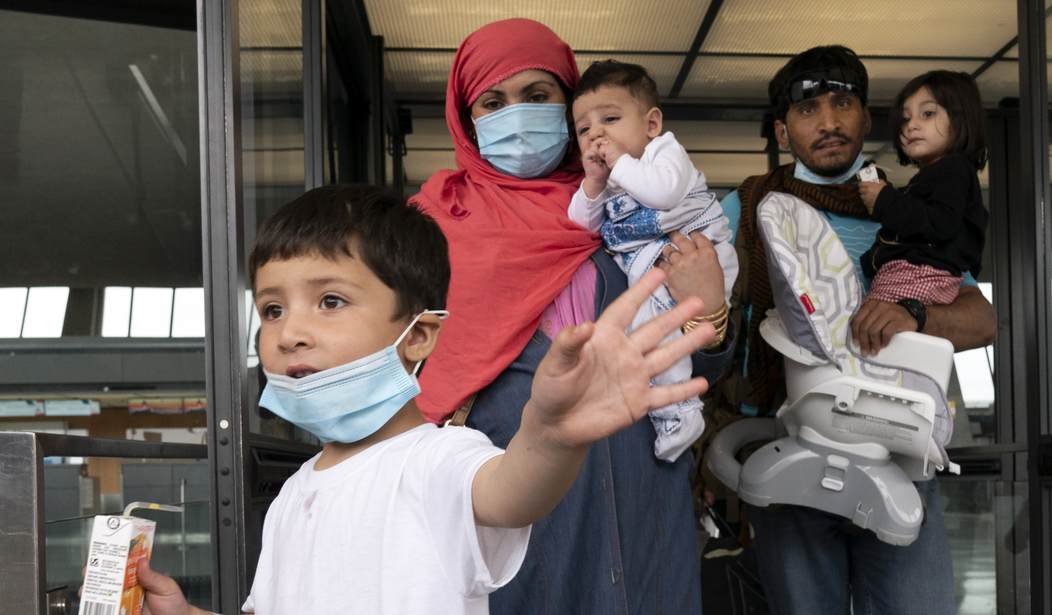
Anyone following the political and media discussion on Afghanistan right now could probably be forgiven if they came away with the impression that we have only two options: either callously abandon our Afghan allies to the Taliban, or resettle hundreds of thousands of Afghans – without being quite sure who they are, because proper vetting takes too long – to the United States. In reality, this is a false dichotomy that obscures a middle-of-the-road option, which was recently outlined by the Federation for American Immigration Reform (FAIR), whereby most of the Afghan refugees would be hosted in neighboring nations, with the potential logistical and financial aid of the U.S. and its allies.
Many of the proponents of mass resettlement to the U.S. argue that America should bring in as many Afghans as possible because we are to blame for the country’s problems. While it is true that the Biden-Harris administration is responsible for its catastrophic handling of the U.S. withdrawal from Afghanistan, the historic roots of the current debacle are much more complex. Afghanistan has been mired in crisis since communists seized power in a coup in 1978, which was followed by a Soviet invasion. The U.S. helped the Afghans, first against the Soviets during the 1980s, and then against the Taliban for the past two decades. We should keep that context in mind as we scramble to address the current crisis.
Rather than flying all the Afghans who do not wish to live under the Taliban – which is undoubtedly millions of people in a country of 38 million – halfway across the world to the United States, we should consider first negotiating with neighboring nations in the region to host most of the refugees/evacuees.
There are ethnic, linguistic, cultural, religious, and even economic arguments for resettling Afghans in the Central Asian “stans,” Pakistan, and possibly also the wealthy countries of the Arabian Peninsula. For instance, Pashtuns live on both side of the Afghan-Pakistani border, while Afghan Tajiks, Uzbeks, and Turkmen could also feel culturally and linguistically at home in Tajikistan, Uzbekistan, and Turkmenistan respectively. An encouraging sign is that Tajikistan has pledged to accept 100,000 Afghan refugees.
In addition, all of the above countries are Muslim-majority, which means refugees would face less “culture shock” on a religious basis. Moreover, in the particular case of Pakistan, one can also persuasively argue that Islamabad – which has a long history of supporting the Taliban – cannot simply stand aside and wait for America to do all the cleanup. Pakistan must take responsibility and be a part of the solution. In this case, that could mean accepting Afghan refugees.
Finally, we can help many more people, for the same amount of money, by assisting them in neighboring countries. This is important in light of the fact that our economy still has not completely recovered from the destructive impact of the COVID-19 pandemic and that our national debt – almost $29 trillion – exceeds the size of our entire economy. Although we have to help those in need, we also have to be fiscally responsible. The reality is that it is ultimately financially unfeasible to bring millions of Afghans who want to flee the Taliban here. And focusing solely on resettlement to the U.S. means we have no choice but to leave behind many that we could have helped closer to home through a more pragmatic, regional approach.
The rapid fall of Afghanistan to the radical Islamist Taliban, and the ensuing humanitarian disaster, are undoubtedly a great tragedy. As Americans, we cannot look the other way, but we also have to be smart and think outside the box.



Join the Conversation
VIP members get the ability to comment on articles.