





Among Cold War presidents, from Truman to Bush I, there was an unwritten rule: Do not challenge Moscow in its Central and Eastern Europe sphere of influence.
In crises over Berlin in 1948 and 1961, the Hungarian Revolution in 1956 and the Warsaw Pact invasion of Prague in 1968, U.S. forces in Europe stayed in their barracks.
We saw the Elbe as Moscow's red line, and they saw it as ours.
While Reagan sent weapons to anti-Communist rebels in Angola, Nicaragua and Afghanistan, to the heroic Poles of Gdansk he sent only mimeograph machines.
That Cold War caution and prudence may be at an end.
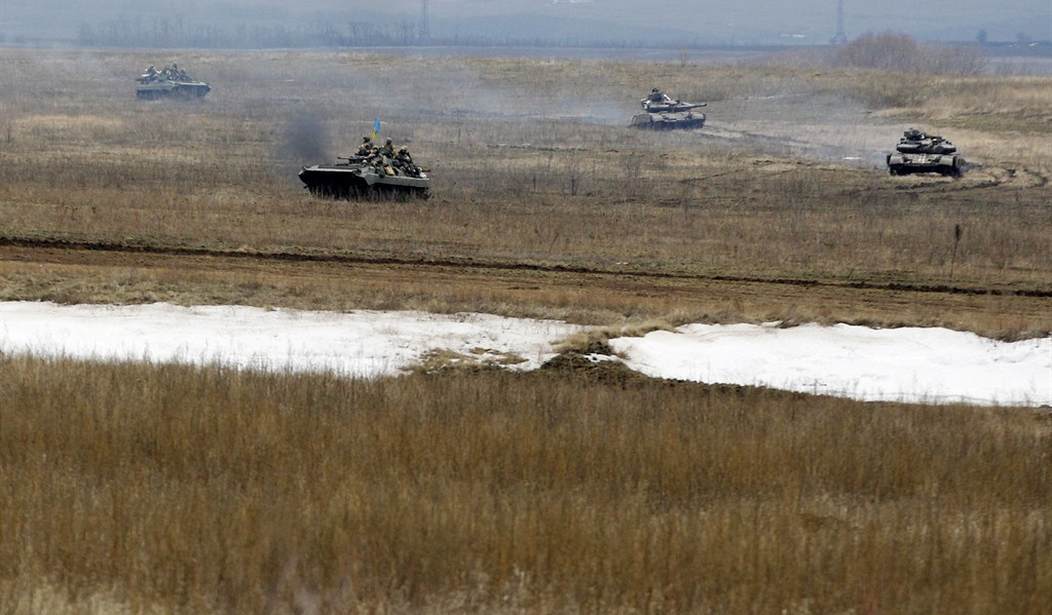
For President Obama is being goaded by Congress and the liberal interventionists in his party to send lethal weaponry to Kiev in its civil war with pro-Russian rebels in Donetsk and Luhansk.
That war has already cost 5,000 lives -- soldiers, rebels, civilians. September's cease-fire in Minsk has broken down. The rebels have lately seized 200 added square miles, and directed artillery fire at Mariupol, a Black Sea port between Donetsk and Luhansk and Crimea.
Late last year, Congress sent Obama a bill authorizing lethal aid to Kiev. He signed it. Now the New York Times reports that NATO Commander Gen. Philip Breedlove favors military aid to Ukraine, as does Defense Secretary Chuck Hagel. John Kerry and Gen. Martin Dempsey of the joint chiefs are said to be open to the idea.
A panel of eight former national security officials, chaired by Michele Flournoy, a potential Defense Secretary in a Hillary Clinton administration, has called for the U.S. to provide $3 billion in military aid to Ukraine, including anti-tank missiles, reconnaissance drones, Humvees, and radar to locate the sources of artillery and missile fire.
Such an arms package would guarantee an escalation of the war, put the United States squarely in the middle, and force Vladimir Putin's hand.
Thus far, despite evidence of Russian advisers in Ukraine and claims of Russian tank presence, Putin denies that he has intervened. But if U.S. cargo planes start arriving in Kiev with Javelin anti-tank missiles, Putin would face several choices.
He could back down, abandon the rebels, and be seen as a bully who, despite his bluster, does not stand up for Russians everywhere.
More in character, he could take U.S. intervention as a challenge and send in armor and artillery to enable the rebels to consolidate their gains, then warn Kiev that, rather than see the rebels routed, Moscow will intervene militarily.
Or Putin could order in the Russian army before U.S. weapons arrive, capture Mariupol, establish a land bridge to Crimea, and then tell Kiev he is ready to negotiate.
What would we do then? Send U.S. advisers to fight alongside the Ukrainians, as the war escalates and the casualties mount? Send U.S. warships into the Black Sea?
Have we thought this through, as we did not think through what would happen if we brought down Saddam, Gadhafi and Mubarak?
America has never had a vital interest in Crimea or the Donbass worth risking a military clash with Russia. And we do not have the military ability to intervene and drive out the Russian army, unless we are prepared for a larger war and the potential devastation of the Ukraine.
What would Eisenhower, Kennedy, Nixon or Reagan think of an American president willing to risk military conflict with a nuclear-armed Russia over two provinces in southeastern Ukraine that Moscow had ruled from the time of Catherine the Great?
What is happening in Ukraine is a tragedy and a disaster. And we are in part responsible, having egged on the Maidan coup that overthrew the elected pro-Russian government.
But a greater disaster looms if we get ourselves embroiled in Ukraine's civil war. We would face, first, the near certainty of defeat for our allies, if not ourselves. Second, we would push Moscow further outside Europe and the West, leaving her with no alternative but to deepen ties to a rising China.
Given the economic crisis in Russia and the basket case Ukraine is already, how do we think a larger and wider war would leave both nations?
Alarmists say we cannot let Putin's annexation of Crimea stand. We cannot let Luhansk and Donetsk become a pro-Russian enclave in Ukraine, like Abkhazia, South Ossetia or the Transdniester republic.
But no one ever thought these enclaves that emerged from the ethnic decomposition of the Soviet Union were worth a conflict with Russia. When did Luhansk and Donetsk become so?
Rather than becoming a co-belligerent in this civil war that is not our war, why not have the United States assume the role of the honest broker who brings it to an end. Isn't that how real peace prizes are won?

Join the Conversation
VIP members get the ability to comment on articles.