





Author's Note: All previous volumes of this series are available here. The first 56 volumes are compiled in the book "Bible Study For Those Who Don't Read The Bible." "Part Two," featuring volumes 57-113, was published in December 2022.
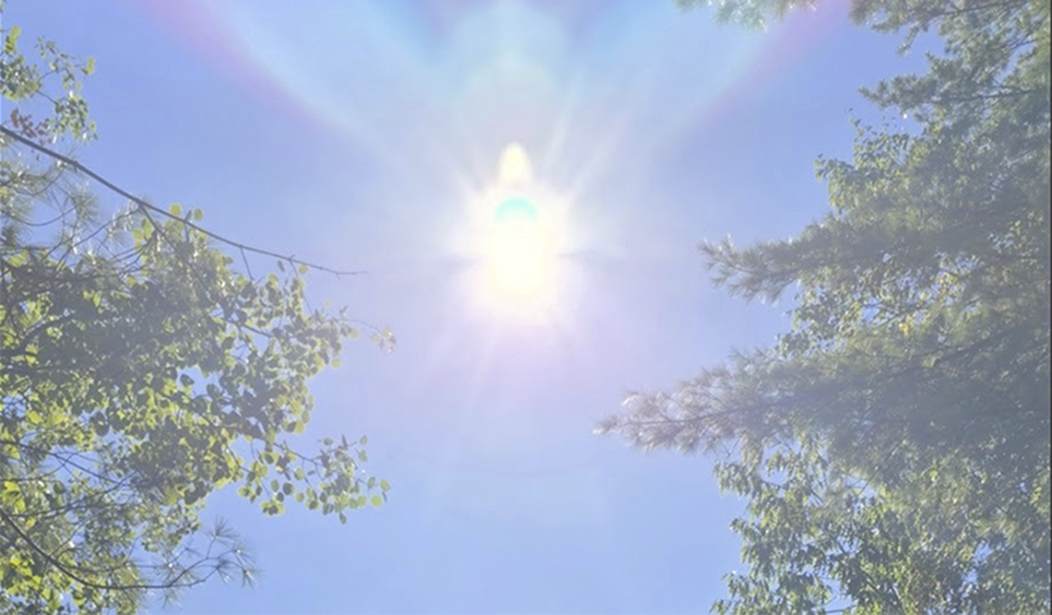
Thanks for joining us for a biblical study about light. This week, we discuss Old Testament/Hebrew Bible verses; next week, the New Testament. What prompted this topic was “enlightening,” followed by the story behind the headline photo.
Last Sunday, I saw the movie "Heaven in Stone and Glass," a multifaceted, in-depth look at Gothic cathedrals architecturally designed for light. During the movie, I received a “ding-ding” from my heavenly “Assignment Editor” with “light” as the topic for this study. Loyal readers know that whenever this happens, I feel humbled and blessed, a signal that someone out there will be touched by what we discuss.
Then, on Thursday, as I began writing this study, I felt prompted to check an email account I use less often. My jaw dropped when I saw a photo my friend David Emmith sent, now shown above. I immediately called to tell him about my Bible study topic, to say he was part of God’s plan, and to ask to use his photo, which he titled “Christ the King on a Throne of Light.” David explained that when he began a set of prayers in Winthrop, Maine, at 2:58 PM on Tuesday, September 22, he felt prompted to take a photo of the sun and, upon reviewing it, noticed how unusual it appeared.
Now that you know the background, let’s turn to the Hebrew Bible and review God’s first direct quote about creating light:
“And God said, ‘Let there be light,’ and there was light. And God saw that the light was good. And God separated the light from the darkness. God called the light Day, and the darkness he called Night. And there was evening, and there was morning, the first day” (Genesis 1:3-5).
Why was “Let there be light” God’s first spoken word at creation? That could be a very long research topic. Briefly, God is the source of all light. A few verses later, He used His light to create the sun, moon, and stars. (See Genesis 1:14-19.)
Light brought systematic order to universal creation, especially when God separated it from darkness. Moreover, light stimulates growth in all living matter. As we read in the verses below, light also symbolizes hope, truth, and God’s presence.
What follows is a famous, magnificent passage known as the “priestly blessing,” often heard in temples and churches. Although the word “light” is not explicitly stated, it is referenced twice, underscoring God’s presence as He blesses His people. It reads:
“The Lord spoke to Moses, saying, ‘Speak to Aaron and his sons, saying, Thus you shall bless the people of Israel: you shall say to them, ‘The Lord bless you and keep you; the Lord make his face to shine upon you and be gracious to you; the Lord lift up his countenance upon you and give you peace’” (Numbers 6:22-26).
As you would expect, Psalms contain many beautiful poetic references to God’s light as a source of hope in times of trouble or despair. They read like open windows into the writer's, King David's, faith and thoughts:
“For it is you who light my lamp; the Lord my God lightens my darkness” (Psalm 18:28).
“The Lord is my light and my salvation; whom shall I fear? The Lord is the stronghold of my life; of whom shall I be afraid?” (Psalm 27:1).
The next Psalm verse exemplifies the belief that God’s light is manifested in our lives:
“For with you is the fountain of life; in your light do we see light” (Psalm 36:9).
Below, David writes that if you trust in God, He will bring His light out of you:
“Commit your way to the Lord; trust in him, and He will act. He will bring forth your righteousness as the light, and your justice as the noonday” (Psalm 37:5-6).
Our final Psalm verse is attributed to Asaph, a musician appointed by King David. It reiterates the priestly blessing we read in Numbers 6:22-26:
“Restore us, O Lord God of hosts! Let your face shine, that we may be saved!” (Psalm 80:19).
Any Old Testament study of light must include passages from the prophet Isaiah. God repeatedly speaks to him about the new light to come out of darkness. The next verse might sound familiar, since it is sung in Handel's Messiah:
“The people who walked in darkness have seen a great light; those who dwelt in a land of deep darkness, on them has light shone” (Isaiah 9:2).
Now we continue this prophetic light theme with a passage about God’s promise, “a light for the nations” — a Messianic prophecy about Jesus Christ, representing the great contrast between light and darkness:
“I am the Lord; I have called you in righteousness; I will take you by the hand and keep you; I will give you as a covenant for the people, a light for the nations, to open the eyes that are blind, to bring out the prisoners from the dungeon, from the prison those who sit in darkness” (Isaiah 42:6-7).
Speaking through Isaiah, God explains that the Servant's mission is Messianic. This mission is greater than just restoring Israel, proclaiming, “I will make you as a light for the nations”:
“He says: ‘It is too light a thing that you should be my servant to raise up the tribes of Jacob and to bring back the preserved of Israel; I will make you as a light for the nations, that my salvation may reach to the end of the earth’” (Isaiah 49:6).
Also note that Isaiah was written approximately 600-700 years before the birth of Jesus. Whereas Handel’s Messiah, written in 1741, includes this verse from Isaiah:
“Arise, shine, for your light has come, and the glory of the Lord has risen upon you” (Isaiah 60:1).
In the verses above and below, Isaiah prophesies a time when God will be the Light to the people of the world, personally and eternally:
“The sun shall be no more your light by day, nor for brightness shall the moon give you light; but the Lord will be your everlasting light, and your God will be your glory” (Isaiah 60:19).
Next week, we “meet” this “everlasting light” born under the brightest star. Amen to that! If you like this topic, please leave a comment. Or email me, as I try to respond to all (friendly and unfriendly).
Myra Kahn Adams is a conservative political and religious writer. Her book "Bible Study For Those Who Don't Read The Bible" reprints the first 56 volumes of this popular study. "Part 2" reprints Vols. 57-113. Order it here.
Myra is also the Executive Director of the National Shroud of Turin Exhibit. You can help support our popular exhibit at the Basilica in Orlando, Florida. Now extended until the end of 2026! Read more here. Contact: Myraadams01@gmail.com
Editor's Note: Do you enjoy Townhall's conservative reporting exposing the radical Left and woke media? Support our work so we can keep bringing you the truth.
Join Townhall VIP and use promo code FIGHT to receive 60% off your membership.


Join the Conversation
VIP members get the ability to comment on articles.