





"Cui bono?" Who benefits? It was the question ancient Romans asked when hoping to cut through a fog of possible causes for a problem.
As of this morning, U.S. Marines were evacuating Sanaa, the capital of Yemen. We've seen this movie before: the bonfires of documents, the hammer blows to equipment, the disabling of weapons, the rush to the helicopters. Think Saigon 1973 or Tehran 1979. Only five months ago, President Obama touted his policy toward Yemen as a success: "This strategy of taking out terrorists who threaten us, while supporting partners on the front lines, is one that we have successfully pursued in Yemen..." Well.
Who benefits? The rebels who took Yemen are Houthis, allies of the Islamic Republic of Iran. This makes four Arab nations (the others are Lebanon, Syria and Iraq) that are now controlled or heavily influenced by Iran. Iran also supports Hamas in Gaza.
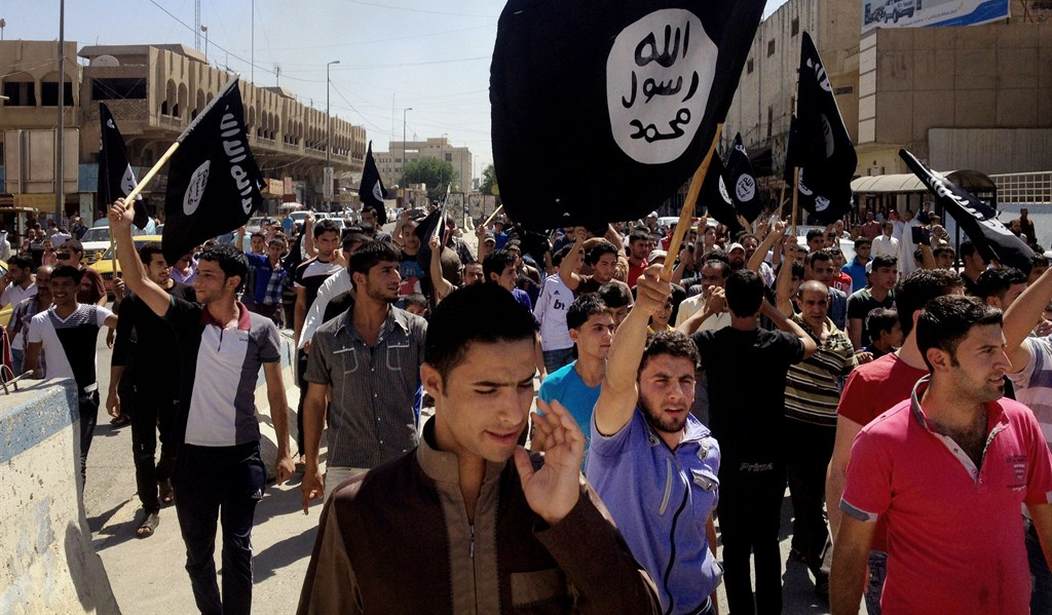
Our eyes are drawn to the pornographic violence of ISIS. After disdaining them as the "JV" team, the president has yielded to public pressure by requesting an authorization for the use of military force, but the document presented is more of an apology note for previous U.S. military actions than a blueprint for war.
This president, he keeps telling us, was elected to end wars, not to start them. There's another Roman adage that's apt here: If you want peace, prepare for war. Let's consider the origins of ISIS. The radical Sunni offshoot of al-Qaida was hatched in an environment made possible by Obama's nonfeasance or malfeasance.
The first policy was Obama's determination not to provide aid to the rebels seeking to topple Bashar al-Assad. His own ambassador, Robert Ford, resigned in protest of Obama's denial of aid to the Free Syrian Army (the non-radical forces opposing Assad).
Denied support from the U.S., the Free Syrian Army lost out to more radical forces, like al-Nusra and ISIS. Assad (doubtless supported by Iran) made the strategic decision to release the leadership of ISIS. Newsweek quoted a Syrian opposition figure who explained, "From the first days of the revolution (in March 2011), Assad denounced (the opposition forces) as being the work of radical Salafists, so he released the Salafists he had created in his prisons to justify the claim. ... If you do not have an enemy, you create an enemy."
The combination of Assad's cynicism (he wanted to make it harder for his opponents to get international support) and Obama's intransigence helped give birth to ISIS.
ISIS was able to spill over into Iraq. How? Because Obama chose, against the advice of his military and other advisers, to remove all U.S. forces from Iraq and to turn a blind eye to the gross abuses committed by Iraq's Iranian-backed Prime Minister Nouri al-Maliki against the Iraqi Sunnis.
Today, ISIS rampages through a lawless Mesopotamia threatening millions of people and committing atrocities that shock the world. The civil war in Syria has taken the lives of 220,000 and displaced 9 million. Iran continues to improve its centrifuges. Yet as recently as last week, National Security Advisor Susan Rice explained that the president's policy is one of "strategic patience." What accounts for this equanimity?
The best insight into the president's motives is supplied by a very troubling piece in Mosaic magazine by the Hudson Institute's Michael Doran. The president has been consistent, Doran shows, from his first days in office. "Obama based his policy of outreach to Tehran on two key assumptions of the grand-bargain myth: that Tehran and Washington were natural allies, and that Washington itself was the primary cause of the enmity between the two." The president has been secretive and dishonest about negotiations with Iran -- and aides have hinted of his intention to block the Senate's ratification power by not calling a nuclear agreement a treaty.
All of Obama's seemingly inexplicable decisions, Doran argues, from Syria to Iraq to the spurning of the Green Revolution in 2009, are of a piece. Obama believes that once a nuclear agreement is reached, Iran will become a stabilizing power in the region and the world.
The Neville Chamberlain analogy is overused, but it is very hard to read Doran's detailed recapitulation of the past six years and conclude anything other than that the answer to "Cui bono?" is Iran.

Join the Conversation
VIP members get the ability to comment on articles.