





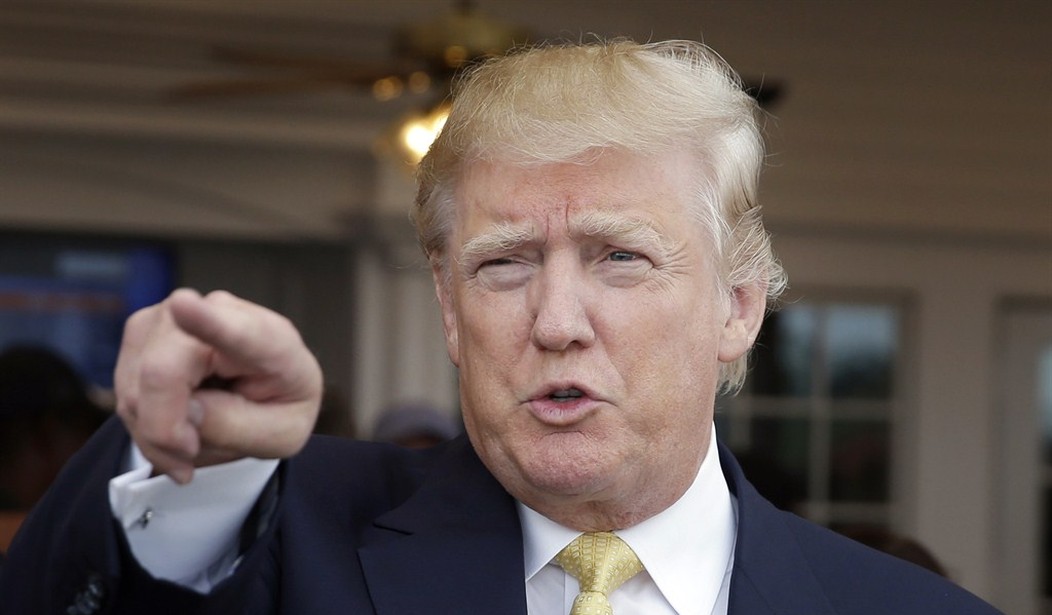
Republican voters have been seething with discontent toward their party's officeholders and have not become enchanted with any one of 15 more or less conventional politicians who are running. Democratic voters support their officeholders with lockstep loyalty and seem untroubled by the serious flaws of their party's clear frontrunner.
This asymmetry helps explain some otherwise puzzling things. One is why polls have continued for several years to show the Republican Party being disliked more than the Democratic Party, even as both parties get roughly the same number of votes. The reason is that while virtually no Democrats express negative feelings about their party, many Republicans do.
Those negative feelings don't, however, prevent Republicans from voting, however grudgingly, for their party's old-timers in general elections. Polls in 2014 showed the 70-something Sens. Mitch McConnell and Pat Roberts, both members of Congress since the 1980s, in close races in heavily Republican Kentucky and Kansas.
Yet both won with solid majorities and by double-digit percentage margins. Each lost his state's biggest metropolitan area, but McConnell carried 110 of 120 counties and Roberts 102 of 105. Sure, Republicans, especially in rural counties, had been grumbling and cussing them out. But they weren't going to vote for a Democrat or, in Kansas, a Democrat-in-disguise running as an Independent.
They're probably still grumbling about McConnell and Roberts today -- and some of them, at least, are telling pollsters they're voting for Donald Trump. Polling suggests that the current Trump vote is coming in large part from non-college-graduate Republicans who are far more numerous outside big metro areas than within.
That resembles the divide in the crucial 2012 primaries in Michigan, Ohio, Illinois and Wisconsin, where Mitt Romney carried the big metro areas -- Detroit, Cleveland/Columbus/Cincinnati, Chicago, Milwaukee -- and Rick Santorum carried most counties beyond.
Democratic voters seem much more content with their officeholders. That's one reason Barack Obama's job approval rating has held pretty constantly around the 45 percent level, not down below 30 percent where George W. Bush's plummeted when Republicans as well as Democrats and Independents soured on the war in Iraq.
Hillary Clinton is in more trouble than Obama with Independents and Republicans, but continues to receive high approval ratings from every Democratic Party core constituency -- blacks, gentry liberals and Hispanics. Even the Birkenstock Belt folks (dovish, environment-conscious, concentrated in university towns and rural ecotopias), who are boosting Bernie Sanders' numbers in Iowa and New Hampshire polls, still give Clinton overwhelmingly favorable ratings.
That support for Sanders echoes the sentiment for the leftist Jeremy Corbyn in the ongoing contest for leader of the British Labour party. Corbyn has no more realistic chance of becoming prime minister than Sanders does of becoming president. But left-wing Democrats and Labourites love candidates who take positions they support but which they understand are unpopular with the broader electorate. Call it the Bulworth syndrome, after Warren Beatty's 1998 movie.
The Bulworth syndrome operates among right-wing Republicans as well. Donald Trump's incendiary statements on immigration appealed to voters tired of being told that Arizona's attempt to enforce federal immigration laws was bad and San Francisco's attempt to block these laws (with "sanctuary cities") was good.
So conservative pundits eager to sniff out any departure from conservative principle by conventional candidates are championing a candidate who has been anything but a consistent conservative over the years and is a prime example of crony capitalism. He got his start in Manhattan real estate with help from state and city governments after he and his family made the second largest contributions (after the candidates' brother) to Hugh Carey's underdog 1974 Democratic primary campaign for governor.
The asymmetry between the parties' voters reflects their different media environments. Talk radio, conservative websites and Fox News bristle with criticism of Republican officeholders and complaints about their squishiness. That helps sustain a critical frame of mind and a sense, particularly outside metropolitan centers, that ordinary people's concerns are being ignored by a manipulative establishment.
In contrast, Democrats, who fancy themselves as critical thinkers, are comfortable consumers of "mainstream" media in which their "smelly little orthodoxies" (George Orwell's term) are rarely challenged.
So supposedly docile Republicans increasingly behave like an unruly mob while supposedly freethinking Democrats keep acting like a regimented army. Curious.

Join the Conversation
VIP members get the ability to comment on articles.