





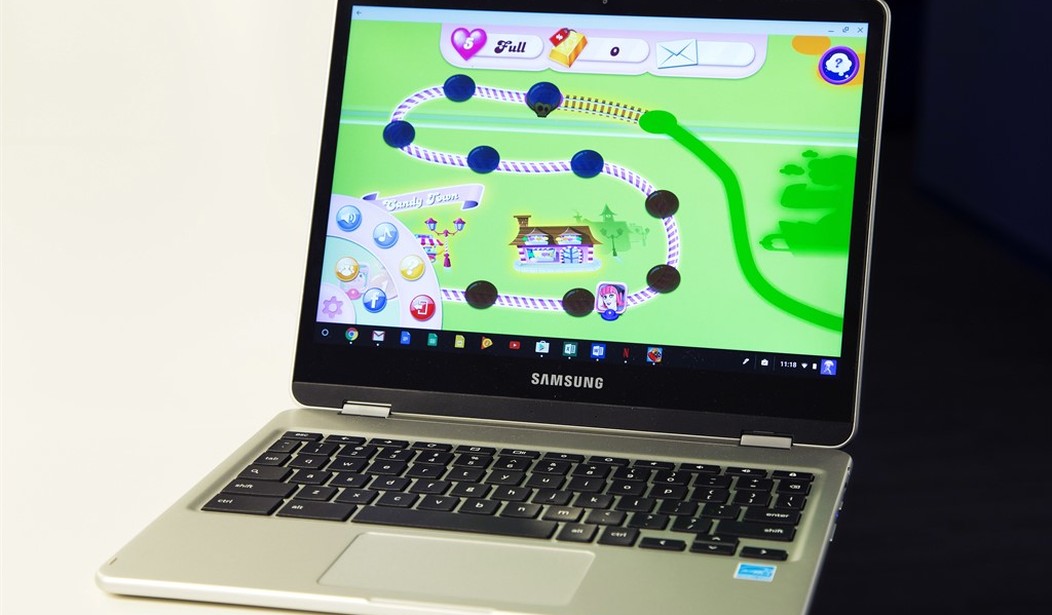
Actor Hugh Grant spoke out publicly last spring about the struggle to keep his kids away from screens, and how schools, rather than being an ally in the fight, have joined the side of Big Tech to keep kids perpetually online. “I’m just another angry parent fighting the eternal, exhausting, and depressing battle" with children who only want to be on a screen. And the final straw was when schools started saying, with some smugness, ‘We give every child a Chromebook, and they do a lot of lessons on their Chromebook, and they do all their homework on their Chromebook,’ and you just thought, That is the last thing they need. And the last thing we need.”
I can imagine a collective sigh of “Amen!” coming from the mouths of countless other angry and exhausted parents when they read Grant’s comments.
I was on the receiving end of a similarly smug pitch when we put our son in public school for the first time when he was in 5th grade and the teacher boasted that every student would be issued a Chromebook. I remember thinking to myself, “That’s not the selling point you think it is.” We pulled him out of public school the following year during the COVID lock-downs after I watched one teacher using a Pixar short to explain story arc (instead of having the students in English class read an actual story), a math teacher using a YouTube video of another math teacher standing in front of a whiteboard explaining how to calculate simple interest instead of teaching it himself, and science and history teachers using Quizizz to “gamify” learning. I pledged to myself that we would never again put him in a school or classroom environment that used computers as a pedagogical tool (as opposed to a subject for study).
I always suspected that the push for computers in the classroom did not come from parents, who often seemed more resigned to EdTech than enthusiastic about it. But they may have consoled themselves with the thought that the mandate was at least backed by solid research that showed a clear benefit. No such research exists. Quite the contrary. A report from the National Education Policy Center, a nonpartisan research group at the University of Colorado at Boulder, found the rapid adoption of mostly proprietary technology in education to be rife with “questionable educational assumptions ... self-interested advocacy by the technology industry, serious threats to student privacy and a lack of research support.”
No, the mandate came from Google, which was raking in an estimated $200 million annually from school-issued Chromebooks by 2020. They wanted to hook these school children while they were young, so they would have a consumer for life.
It turns out school-issued Chromebooks were a Trojan Horse.
Marketing materials revealed during a major social media addiction lawsuit trial happening now show this strategy clearly. A slide from a 2020 presentation states: “If you get someone on your operating system early, then you get that loyalty early, and potentially for life.” The goal is to create a steady “pipeline of future users.” After years of relying on Google tools for schoolwork, those same students will naturally continue using Google products as adults.
Billions in taxpayer dollars have been deployed on a learning experiment to profit one company, with no proof that it would improve learning outcomes. “Far from doubling learning in half the time, digital tools appear to be doing the opposite: halving the learning in double the time,” according to Jared Cooney Horvath in his book, The Digital Delusion.
We are not simply exchanging pen and paper for keyboard and screen. These are not neutral tools. They are doing active harm. According to Horvath, “An OECD international review of EdTech concluded: ‘Students who use computers very frequently at school do a lot worse in most learning outcomes.’” Another study found that “even small daily amounts of digital devices in the classroom are negatively related to scores on a reading comprehension test.” A separate series of analyses concluded, “investing in air conditioning has a more beneficial impact on learning than investing in a laptop for every student.”
The good news is that more and more parents are starting to recognize that we do not have to accept the forced adoption of Google’s business model on our children’s education.
NBC News described the face of an 11-year-old boy lighting up when he was told that he did not have to use his school-issued Chromebook anymore. “The middle schooler had been begging to opt out, citing headaches from the Chromebook screen and a dislike of the AI chatbot recently integrated into it.”
His mother is part of a growing parent‑led rebellion against classroom screens. Families across the country are now formally opting their children out of school‑issued Chromebooks and iPads, citing the very concerns — distraction, diminished learning, exposure to inappropriate content, and a sense that technology is replacing genuine teaching — that so many of us have been raising for years.
Parents are organizing through email lists and group chats, forming a loose but determined network that shares research, strategies, and opt‑out toolkits to help others approach their districts about returning to pen‑and‑paper learning. In fact, many discover they are the first in their entire district to request an opt‑out, leaving administrators scrambling because they had not even considered the possibility that parents might push back.
These parents are not modern-day Luddites. They are not anti-technology. They are pro-human. They recognize that children learn best from other humans, not from screens. As more families choose handwriting over keyboards and real books over glowing screens, they are signaling to schools and to Big Tech that children are not experimental users to be captured early for lifelong brand loyalty. They are students who deserve the kind of education we know works: one grounded in attention, retention, and authentic human instruction.
Melissa Henson is the Senior Policy Advisor for Media and Culture for Concerned Women for America, the nation’s public policy women’s organization, dedicated to promoting biblical values and constitutional principles in public policy. On X: @CWforA
Editor’s Note: Do you enjoy Townhall’s conservative reporting that takes on the radical Left and woke media? Support our work so that we can continue to bring you the truth.
Join Townhall VIP and use promo code FIGHT to receive 60% off your membership.



Join the Conversation
VIP members get the ability to comment on articles.