





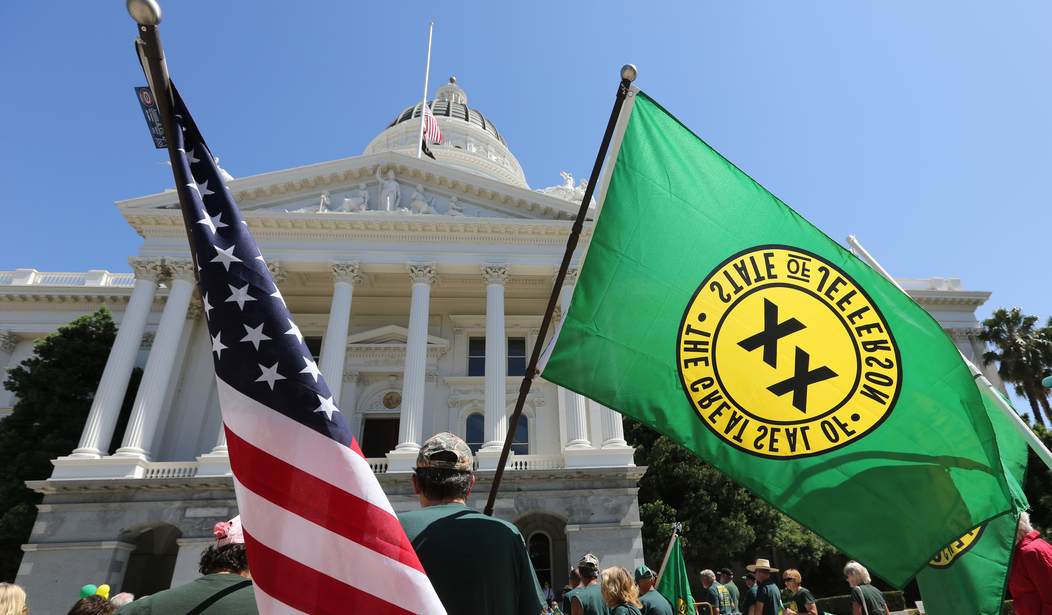
“If the states do not have the right to secede, then they have no rights at all.” — Dr. Walter Williams
Dr. Williams is one of the few men I’ve ever read who understood the American Constitution. That marvelous document has been so warped all through U.S. history that very few Americans truly understand what our Founders did in the Constitution. It isn’t going to change any time soon, and Dr. Williams’ statement is probably shocking to many. Let’s look at it.
The Declaration of Independence created 13 “free and independent states”; it did not create the United States of America (read it). Those states (colonies under England) jealously guarded their individual colonial rights and privileges. When they declared independence, leading minds convinced most colonists that there were certain matters (like fighting a war) that were better accomplished collectively than individually. Many, many of the new Americans were very suspicious of any nationalized government (that was, remember, the very thing they were rebelling against), but enough of them went along with it to establish the United States, and finally, in 1789, provide a constitution for the new nation. That Constitution went into effect only when nine of the states ratified it; the other four didn’t have to, but they eventually did. Each state voluntarily joined the American Union; none of them was forced in, and none of the subsequent 37 states have been “forced” to join the Union, either. That wouldn’t be freedom if they had.
In that 1789 Constitution, the “national” government was allowed very limited power. Congress, the only branch with the authority to make laws, was given only about 17 powers (read Article 1, Section 8); that’s all. The powers of Congress, the president, and courts were clearly defined in the Constitution. And just to make sure Congress stayed within its authorized powers, a Bill of Rights, the first 10 amendments to the Constitution, was added in 1791 to tell Congress what it could not do. The last of those 10 amendments specifically proclaimed that any power not “delegated” to the “United States” belongs to the states or the people.
James Madison, who basically authored the Constitution, said that the federal government’s powers were few and defined; the powers that resided in the states were many and indefinite. It made perfect sense. The states were closer to the people; thus, theoretically, they should be more responsive and aware of their needs. A one-size-fits-all protocol probably wouldn’t work in a country as geographically, economically, and ethnically diverse as the United States.
So, 13 (eventually 50) states voluntarily joined the Union. They were given most of the governmental rights, and the federal government was not to infringe upon those rights. A contract. But power being what it is — even in the hands of Americans — the feds did, indeed, begin to usurp certain rights that belong only to the states. In other words, the federal government broke the contract. What recourse did the states have? Only submission to tyranny?
No, as Dr. Williams said, they had the right to secede if they (eventually) so chose. If they didn’t (don’t), then they really have no rights at all. If all they can do ultimately is submit to whatever Washington, D.C., tells them to do, then what is “states’ rights”? A state only has a “right” if the federal government allows it to have it? That’s not states’ rights; that’s tyranny.
Undeniably, throughout American history, states have abused their powers at times, but I encourage readers to peruse Article 1, Section 8 in the Constitution and show me where 99 percent of what Congress spends money on today is found in those defined powers the Constitution gives it. States haven’t abused their powers nearly as often as Congress has abused its. And every abuse of congressional power is tyranny against the states and the people — taking away a right the Constitution gives only to the states and people.
And when one denies the states have a right to secede against tyranny, then…well, there remains only a tyrannical, totalitarian national government.
Did our Founders have a “right” to secede from England? Did Texas have a “right” to secede from Mexico? Did the Southern states have a “right” to secede from the United States? We may not — and shouldn’t — like slavery, but that’s a different question. Actually, “freedom” would mean a people have the right to secede from their country for any reason. Jefferson in the Declaration: Government’s “just powers” are created by and given from “the consent of the governed.” What can the “governed” do if they no longer “consent” to the government? If they are unwillingly forced to remain in a union they no longer “consent” to, they are no longer “free” to govern themselves. That’s a total denial of the Declaration’s main point. If the American colonists could secede, why can’t the states?
So, yes, if states have no right to secede, they ultimately have no rights at all, except whatever the national government allows them. That’s not the American Constitution, that’s Communist China.
So, that’s why the Democrats…
Disagree with Dr. Williams? Check out Abraham Lincoln: “Any people anywhere, being inclined and having the power, have the right to rise up, and shake off the existing government, and form a new one that suits them better. This is a most valuable—a most sacred right—a right, which we hope and believe, is to liberate the world. Nor is this right confined to cases in which the whole people of an existing government may choose to exercise it. Any port of such people that can, may revolutionize, and make their own, of so much of the territory as they inhabit. More than this, a majority of any portion of such people may revolutionize, putting down a minority, intermingled with, or near about them, who may oppose their movement.”
Unless, of course, they do it when Abraham Lincoln becomes president.
Check out my Substacks: “Mark It Down!” (mklewis929.substack.com) and “Mark It Down! Bible Substack” (mklbibless.substack.com). Both free. Read my great tales of the Old American West, available on Amazon and Kindle: “Whitewater,” “River Bend,” “Return to River Bend,” “Allie’s Dilemma,” and “Kendrick and other stories.” Follow me on X: @thailandmkl.
Editor's Note: Do you enjoy Townhall's conservative reporting exposing the radical Left and woke media? Support our work so we can keep bringing you the truth.
Join Townhall VIP and use promo code FIGHT to receive 60% off your membership.



Join the Conversation
VIP members get the ability to comment on articles.