




Democrats spent the entire midterm campaign promising to make life more affordable. They talked about grocery prices, housing costs, electricity bills, and the financial struggles of ordinary Americans.
Well, congratulations. They won. And now that they've secured control of several critical state governments, they have an opportunity to deliver on those promises.
But don't look now. Democrats may have something else in mind.
How about fundamentally changing the way we elect the president of the United States?
No constitutional amendment. No two-thirds vote in Congress. No ratification by three-fourths of the states. And certainly no meaningful national debate about whether Americans actually want to abandon the presidential election system we've used for more than two centuries.
They may be able to accomplish the whole thing with a handful of votes in several newly Democratic state legislatures.
And thanks to Tuesday's election results, they're closer than ever.
The Electoral College Is Just 48 Votes Away From Becoming Irrelevant
There's something called the National Popular Vote Interstate Compact. It has been quietly working its way through state legislatures since 2006.
Here's the scheme.
Under the Constitution, states have the authority to determine how they appoint their presidential electors. Nearly every state currently awards its electoral votes to the candidate who wins that state's popular vote.
The compact would change that.
States joining the agreement promise to award all their electoral votes to whichever presidential candidate wins the national popular vote, regardless of which candidate wins their own state.
Think about what that means.
Imagine that Pennsylvania votes for the Republican presidential nominee in 2028. Not by a few hundred votes, but by a decisive margin.
Pennsylvania voters have spoken. They want the Republican.
But if Pennsylvania joins this compact and the Democrat wins the national popular vote, Pennsylvania's 19 electoral votes would go to the Democrat.
The candidate Pennsylvania voters rejected would receive every one of Pennsylvania's electoral votes.
That's the arrangement.
To be fair, it would work the other way, too. If Donald Trump had won the national popular vote in 2024 under an operational compact, California would have been required to award him all 54 of its electoral votes.
I wonder how Gavin Newsom would have enjoyed that particular exercise in democracy.
The compact doesn't technically abolish the Electoral College. The electors would still exist. They would still meet. They would still cast their votes.
But the outcome would be determined by the national popular vote rather than the individual results in each state.
The Electoral College would become little more than a constitutional formality.
And here's where things get interesting.
The compact doesn't take effect until participating states collectively control at least 270 electoral votes, the number required to elect a president.
As of today, 18 states and Washington, D.C., have signed on.
Together, they control 222 electoral votes.
They need just 48 more.
Tuesday's Elections May Have Given Democrats Everything They Need
This is where the results of the 2026 midterms become enormously consequential.
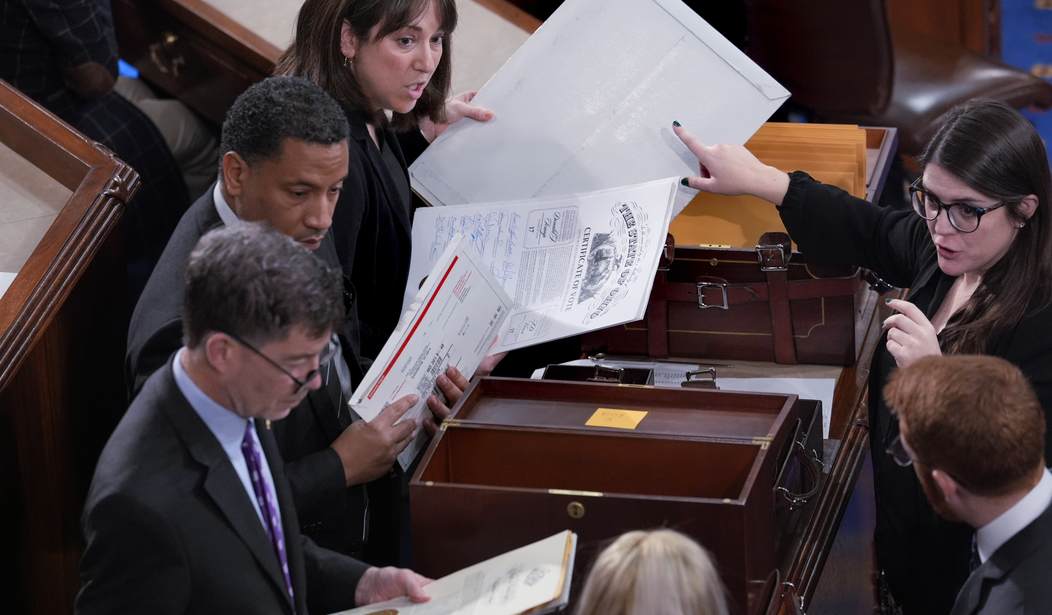
Democrats appear to have gained control of both legislative chambers and the governor's office in five important presidential battleground states.
And none of those states currently belongs to the compact.
Look at the electoral votes:
Pennsylvania: 19
Michigan: 15
Arizona: 11
Wisconsin: 10
Nevada: 6
That's 61 electoral votes.
Add those to the existing 222, and the compact would control 283 electoral votes.
Thirteen more than it needs.
In fact, Democrats wouldn't even need all five states.
Pennsylvania, Michigan, Wisconsin, and Nevada alone would provide 50 electoral votes, bringing the total to 272.
Game over, at least as far as the compact's numerical requirement is concerned.
Now, there are important qualifications. Winning control of a state government doesn't automatically mean Democrats will pass the compact. Michigan Democrats previously controlled their state government and failed to enact it. A Democratic governor in Nevada actually vetoed the proposal in 2019.
And there are substantial constitutional questions that could prevent the agreement from taking effect.
But consider where we stand.
Before Tuesday, the compact's supporters faced a difficult political obstacle. They needed to persuade additional states to join, and Republicans controlled enough legislative chambers and governors' offices to make that unlikely.
Now the legislative path is potentially wide open.
And if these newly empowered Democratic governments act quickly, they could attempt to activate the compact before the 2028 presidential election.
Wait a Minute. Isn't There a Constitution?
There certainly is. And this is where the entire enterprise becomes particularly troubling.
The Constitution establishes the Electoral College and provides a specific process for amending the Constitution.
Changing our constitutional system is supposed to be difficult.
That's intentional.
The Framers understood that fundamental changes to the structure of American government should require a broad national consensus.
But the architects of the National Popular Vote Interstate Compact believe they've discovered a shortcut.
Article II gives state legislatures the authority to determine how presidential electors are appointed. Supporters argue that states can exercise that authority collectively to guarantee that the national popular vote winner becomes president.
There is a legitimate constitutional argument behind that position.
But there is also a serious constitutional objection.
Article I contains the Compact Clause, which restricts certain agreements among states without congressional consent.
And the larger question is whether states can effectively transform the presidential election system through an agreement that circumvents the constitutional amendment process.
The Supreme Court has never definitively ruled on this particular compact.
If it reaches 270 electoral votes, I would expect an extraordinary constitutional battle.
But think about the absurdity of the situation.
We have a constitutional process requiring overwhelming agreement to change the fundamental structure of our government.
Yet the supporters of this compact believe they can achieve substantially the same practical result with ordinary legislation passed by a collection of state governments.
Apparently, the Constitution is perfectly acceptable to Democrats right up until it becomes inconvenient.
What Happens When the National Election Is Close?
Here's another problem that deserves considerably more scrutiny.
Every state runs its elections differently.
Different registration requirements. Different mail-in ballot procedures. Different signature verification standards. Different recount rules. Different deadlines.
Under the current Electoral College system, a disputed presidential election can come down to recounts in a handful of closely contested states.
Now imagine an election in which the national popular vote is separated by 15,000 votes.
Nationwide.
Are we going to recount California? Texas? Florida? New York? Pennsylvania? All of them?
What happens when one state allows a recount and another doesn't?
What happens when a state that never joined the compact becomes the center of a dispute over the national vote total?
What happens when the results of a presidential election depend on thousands of ballots being counted under dozens of different election laws?
Compact supporters insist these problems can be resolved through existing certification procedures.
Perhaps.
But I would like considerably more than a promise from the people proposing to fundamentally change the way we elect our president.
And I suspect millions of Americans would agree.
Remember What Democrats Actually Campaigned On?
Let's return to Tuesday's election.
Democrats campaigned on affordability.
That was the message. That was the promise. That was the reason voters were told to hand them power.
They didn't run a national campaign telling Americans they were going to effectively eliminate the Electoral College.
They didn't spend their advertising budgets explaining the National Popular Vote Interstate Compact.
They didn't stand in front of grocery stores telling struggling families that the solution to expensive eggs was to award Pennsylvania's electoral votes to whichever presidential candidate wins California by the largest margin.
They talked about the cost of living.
And now, having won power on that message, some Democrats have an opportunity to accomplish something that was never a central part of the mandate they sought.
I consider that an extraordinary bait-and-switch.
Of course, Democratic legislators have the legal authority to introduce legislation that wasn't featured in their campaign advertisements. Nobody disputes that.
But there is an enormous difference between having the authority to do something and having earned the public's consent to make a fundamental change to our constitutional system.
If Democrats want to replace the Electoral College with a national popular vote, they should have the courage to campaign on it.
Make the argument.
Explain the consequences.
Tell the people of Pennsylvania, Wisconsin, Michigan, and Nevada that their states could be required to award their electoral votes to candidates their own voters rejected.
And then let voters decide whether that's what they want.
Instead, the compact offers a way to accomplish the transformation through legislative action in states where voters were primarily focused on entirely different issues.
I think that's a betrayal of the voters who trusted Democrats to address their economic concerns.
Republicans Had Better Start Paying Attention
There is something especially frustrating about the fact that this proposal has been around for 20 years.
Twenty years.
The compact was introduced in 2006. Maryland became the first state to enact it in 2007. California joined in 2011. New York followed in 2014. Virginia joined earlier this year.
All the while, the compact's supporters were methodically accumulating electoral votes.
Republicans had plenty of warning.
And now, suddenly, a few state legislative elections may have brought the agreement within striking distance of activation.
This should be a major national political story.
Republican governors, state legislators, members of Congress, and constitutional lawyers should be examining every available legal and legislative avenue for challenging the compact.
The Compact Clause question deserves serious attention. So do the election administration problems and the potential constitutional implications of allowing a group of states to coordinate the selection of a president in this manner.
And the public deserves full hearings, recorded votes, and clear explanations from every state legislator considering this proposal.
This is far too consequential to be buried in an omnibus election bill or quietly passed during a state legislative session while Americans are paying attention to something else.
The compact could become operational for the 2028 election if the required states enact it in time and it survives legal scrutiny.
That leaves precious little time.
The Constitution Is Worth More Than a Political Shortcut
I happen to believe the Electoral College is one of the important features of our constitutional republic.
It preserves the role of the states in choosing the president and reflects the federal structure of our government.
I understand the arguments against it. I understand why people believe the national popular vote should determine the winner.
Those arguments are worthy of debate.
But if we're going to fundamentally change the method of electing the president of the United States, I believe we should do it through the constitutional amendment process.
That process exists for a reason.
And I have very little patience for politicians who discover an ingenious way to avoid it.
What makes the present situation particularly offensive is the possibility that Democrats could use election victories secured on promises of economic relief to pursue a constitutional transformation their voters were never clearly asked to approve.
Americans were promised affordability.
They were promised relief from the rising cost of living.
They were promised that their elected representatives would concentrate on the everyday problems facing their families.
They weren't promised an elaborate interstate arrangement designed to make the Electoral College effectively irrelevant.
Yet that could be precisely what they get.
Republicans should recognize the significance of this moment. The compact is no longer a remote academic exercise. It has a plausible path to 270 electoral votes, and the newly elected state governments could attempt to put it into effect before 2028.
Whether the courts would ultimately permit that is another question.
But the possibility alone should be enough to demand immediate public attention.
Don't look now, but Democrats may be just a few state legislative votes away from fundamentally changing the way America elects its president.
And they won't have to change a single word of the Constitution to try.
Editor's Note: Do you enjoy Townhall's conservative reporting exposing the radical left and woke media? Support our work so we can keep bringing you the truth.
Join Townhall VIP and use promo code FIGHT to receive 60% off your membership.
Join the Conversation
VIP members get the ability to comment on articles.