





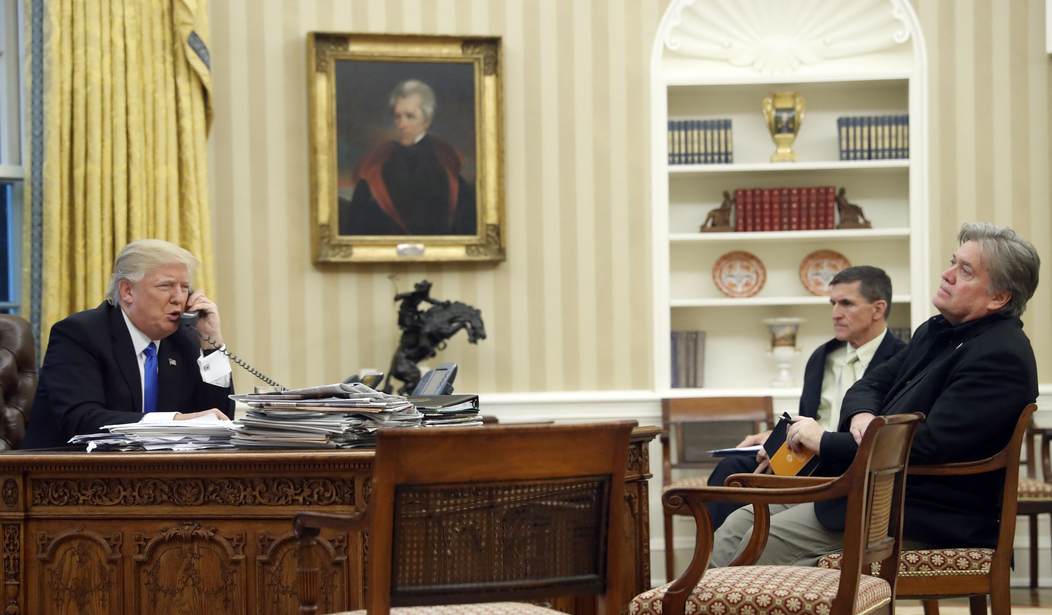
There were two big money-and-politics stories in the first week of the new year: The Dow Jones soared 577 points and Steve Bannon ended his political career.
Are these two events related? Perhaps more than you might think.
Bannon’s peculiar notions of populism were essentially anti-growth. He believed higher taxes, ultra-protectionism, and a cheap dollar would help the middle class. Supply-siders like me know these policies only damage the economy, with the middle and lower classes suffering the most.
And though Bannon was pushed out of the White House months ago, he apparently still had the president’s ear. So his influence has continued to worry investors and business.
But Bannon went belly-up politically this week, and the stock market soared. And some are calling it the Bannon-is-gone rally.
This is an over simplification. There are many positives driving shares higher, including the Trump tax cuts and the expected rise of business profits, the mother’s milk of stocks.
But Bannon was never a strong advocate of the Trump tax-cut plan. Instead, he wanted to raise income taxes for successful earners, from 40 to 44 percent.
Steve Moore, Art Laffer, and I had numerous conversations with Bannon, trying to talk him out of this. President Trump, we argued, would end Obama’s wars on success and business with policies that generate faster economic growth.
How does punishing upper-income people help spur investment or job creation? How does hurting the so-called rich help the middle class? Those are Democrat arguments, and failing ones at that.
A rising ride lifts all boats. JFK, Jack Kemp, and Ronald Reagan believed it. So does Donald Trump.
Would you rather have 2 percent or 4 percent growth? The answer is 4 percent.
But raising income tax rates at the top end --as president Obama did, and Bannon wanted to -- gets you back to 2 percent growth.
Bannon never really understood the incentive model of growth. Rewarding entrepreneurs is the key to prosperity. In this sense, everybody’s in the same boat.
Bannon also was lukewarm on the corporate-tax-cut package. He never bought into the argument that slashing large and small business taxes predominantly benefits wage earners. In fact, everyone benefits: upper, middle, lower.
It’s called making the pie larger.
Late one afternoon, Steve Bannon tried to make a deal with Steve Moore and me in his office: “If you guys back my 44 percent top tax rate, I’ll support your 15 percent corporate tax rate.” We wouldn’t buy it. It made no economic-growth sense.
The fact that Bannon would see us frequently speaks well of him. He was always accessible, friendly, and good humored -- even in debate.
I enjoyed our friendship. He’s been welcome in our Connecticut home. My criticism of his policies is not personal.
That said, backstabbing the president and his family in a book -- Fire and Fury, by Michael Wolff -- was a terrible mistake. As a result, his political career has gone up in flames.
But the market’s up and Bannon’s down. There’s a connection.
Bannon is not only opposed to pro-growth tax-rate relief. He’s a fierce ultra-protectionist. He wants no new trade deals and higher tariffs.
He has argued that the Chinese are guilty of currency manipulation and must be heavily penalized. But the Chinese yuan has appreciated substantially in recent years. So by implication, Bannon was arguing for a cheaper dollar.
Well, no country ever devalued its currency into prosperity.
You know who gets hurt most by tariff taxes? The middle class, paying much higher prices for daily living needs. All manner of businesses also suffer, as imports are choked by tariffs and quotas.
Bannon even favored the border adjustment tax, which would have jacked up import prices. But favoring high tariffs and a crumbling dollar was his worst economic mistake.
So Bannon commits political suicide and the stock market cheers. It’s not far-fetched.
There are many definitions of populism. But I think American populism is a belief that the citizenry should be empowered, not the government. I can agree with Steve Bannon here, in particular when he criticizes crony capitalism and the swamp of money for lobbyist favors.
But I’m not sure Bannon buys into the free-market capitalist model.
Wage earners have suffered over the last 20 years, and the answer is not high tariffs and taxes. The answer is to make America great again by lifting the burden of taxation, regulation, and unlimited government, and restoring a far-reaching, long-lasting prosperity.
Prosperity is American populism. And that’s the President Trump way.
I hope Steve Bannon will reflect on his downfall and revisit these prosperity lessons. In life, doors close and doors open. We can learn from our mistakes and move on to better times.
A smart guy like Bannon should work to help us, not harm us.

Join the Conversation
VIP members get the ability to comment on articles.