





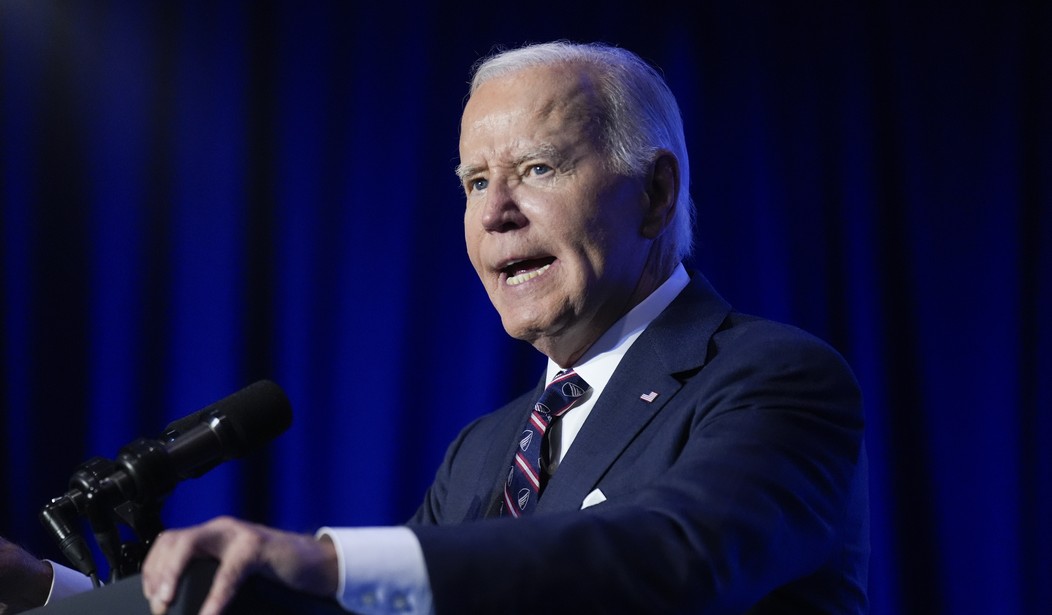
President Joe Biden, to fill a Supreme Court vacancy, said he had but one fixed criterion. The nominee must be a black female.
On the first day of Ketanji Brown Jackson's confirmation hearing, Sunny Hostin, co-host of ABC's "The View," tweeted: "Been crying with pride all day watching Judge Ketanji Brown Jackson breaking this ceiling. Never thought I would feel so very emotional. But I'm all in my feelings."
California Supreme Court Justice Janice Rogers Brown did not set out to become the first black female nominated to the United States Supreme Court. But had it not been for then-Sen. Joe Biden standing in her way 20 years ago, Brown might well have been on the road to "breaking this ceiling."
Brown, the daughter and granddaughter of sharecroppers, was born in Alabama during Jim Crow. As a single mom, she worked her way through college and law school, graduating from UCLA law school in 1977. Over the next 20 years, she worked in the criminal and civil divisions as California deputy attorney general; became the general counsel for the California Business, Transportation and Housing Agency; served as a law professor; and practiced law in private practice.
In 1994, California Republican Gov. Pete Wilson appointed her to the California Court of Appeals and two years later to the California Supreme Court. In California, appointees to its Supreme Court must run for reelection. Despite being appointed by a Republican and her reputation as a conservative jurist, she retained her position with 76% of the vote, a higher percentage than any of the other appointees who ran that year. Brown wrote more majority opinions than any other justice of that court.
In 2003, President George W. Bush nominated her to the U.S. Court of Appeals for the District of Columbia Circuit, from which more justices go on the Supreme Court than any other circuit. Even though Brown had majority support in the Senate, Sen. Biden filibustered her nomination. According to columnist Robert Novak, Biden's obstruction represented "the first full-scale effort in American history to prevent a president from picking the federal judges he wants."
Bush renominated her and she was finally confirmed, with Biden again opposing her confirmation. Months later, Justice Sandra Day O'Connor retired, and Brown was reportedly on the short list to replace her. But Biden appeared on CBS' "Face the Nation" and threatened to again filibuster a Brown nomination. Bush backed down.
Consider this exchange during Ketanji Brown Jackson's confirmation hearing:
Sen. Lindsey Graham: Do you know Janice Rogers Brown?
JACKSON: Yes, I do know her.
GRAHAM: How do you know her?
JACKSON: She was a judge on the court that I now serve. ...I know of her, yes.
GRAHAM: What do you know of her? What's her reputation?
JACKSON: I know that she's a very well-respected judge on my circuit.
GRAHAM: OK. And in terms of family issues, the daughter and granddaughter of sharecroppers, she was raised in Alabama under Jim Crow. Despite this adversity, she threw herself into law school as a single working mother. That's pretty impressive, isn't it?
JACKSON: Yes, Senator.
GRAHAM: Your background is very impressive. You seem to have a great family. If family mattered, we would not have done to her what was done to her here in the United States Senate. Do you realize that she was filibustered for two years when she was appointed to the D.C. Circuit?
JACKSON: I didn't know that.
GRAHAM: Did you know that Joe Biden actively filibustered Janice Rogers Brown?JACKSON: I did not know that.
GRAHAM: Did you know that he told 'Face the Nation,' if Bush nominates her for the Supreme Court, 'I can assure you that would be a very, very, very difficult fight and she probably would be filibustered.' Is that news to you too?
JACKSON: Yes.
GRAHAM: OK. Now that you know that, how do you feel about it?
JACKSON: Senator, I can't speak to something that I just learned two seconds ago in your conversation to with me."
Were it not for Biden, who now considers the filibuster "a relic of the Jim Crow era," Hostin could have been "crying with pride" 20 years ago.



Join the Conversation
VIP members get the ability to comment on articles.