





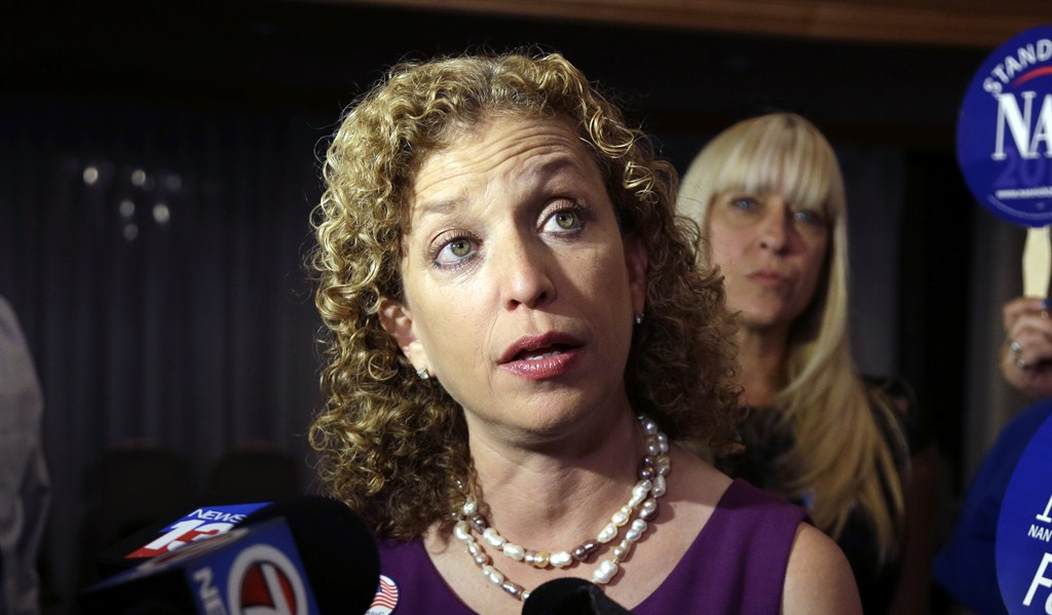
Debbie Wasserman Schultz, the chairwoman of the Democratic National Committee, recently appeared on MSNBC's "Hardball with Chris Matthews." Matthews asked, "What is the difference between a Democrat and a socialist?"
Wasserman Schultz laughed, looked stunned, and began hemming and hawing. Matthews helpfully interjected, "I used to think there was a big difference. What do you think it is?" Still, Wasserman Schultz refused to give him a straight answer. "The difference between -- the real question," she said, "is what's the difference between being a Democrat and being a Republican."
Matthews tried again: "Yeah, but what's the big difference between being a Democrat and being a socialist? You're the chairwoman of the Democratic Party. Tell me the difference between you and a socialist."
Still, Wasserman Schultz wouldn't answer the question
A few days ago Chuck Todd of NBC's "Meet the Press" offered her a chance for a do-over. He replayed the exchange with Matthews, then asked: "Given that (Democratic presidential candidate) Bernie Sanders is an unabashed socialist and believes in social democratic governments -- (he) likes the ones in Europe -- what is the difference? Can you explain the difference?"
And again she either could not or would not answer, and wanted to discuss the difference between Republicans and Democrats.
On the one hand, Wasserman Schultz might have refused to answer because she did not want to put her thumb on the scale of the self-described socialist candidate Bernie Sanders or the likely nominee, Hillary Rodham Clinton. No matter what Wasserman Schultz would've said, it would injure one while helping the other.
That's one explanation. But the more likely explanation is simple. There is no real distinction between today's Democrats and socialists. A few years ago Congresswoman Maxine Waters, D-Calif., conducted hearings in which she grilled oil executives for alleged price fixing. She threatened to nationalize their business. Did any Democrat speak out against her threat? No.
Newsweek, in 2009, ran a cover story with the headline: "We Are All Socialists Now." Jon Meacham wrote:
"The U.S. government has already -- under a conservative Republican administration -- effectively nationalized the banking and mortgage industries. That seems a stronger sign of socialism than $50 million for art. Whether we want to admit it or not -- and many, especially Congressman (Mike) Pence and (Sean) Hannity, do not -- the America of 2009 is moving toward a modern European state. ...
"... If we fail to acknowledge the reality of the growing role of government in the economy, insisting instead on fighting 21st-century wars with 20th-century terms and tactics, then we are doomed to a fractious and unedifying debate. The sooner we understand where we truly stand, the sooner we can think more clearly about how to use government in today's world. ...
"... This is not to say that berets will be all the rage this spring, or that Obama has promised a croissant in every toaster oven. But the simple fact of the matter is that the political conversation, which shifts from time to time, has shifted anew, and for the foreseeable future Americans will be more engaged with questions about how to manage a mixed economy than about whether we should have one."
Polls, too, show that most Democrats are quite comfortable with socialism. A recent poll found 52 percent of Democrats had a favorable opinion about socialism.
Bernie Sanders has always caucused with Democrats, and they are perfectly comfortable with him. He's still a long shot for the Democratic nomination, but he is rising in the polls. If there is a distinction between him and President Barack Obama on anything major, what is it? Both pushed "universal health care." Both oppose the Keystone pipeline. Both believe taxes should be raised on "rich" people. Both believe in the redistribution of income. Obama wants two years of "free" community college. Sanders wants to make college "free" altogether. Both attack "corporate greed" and both belong to the school of economics that says, "you didn't build that."
Andy Stern, then the head of the Democratic Party-supporting Service Employees International Union, said, "I think Western Europe, as much as we used to make fun of it, has made different trade-offs which may have ended up with a little more unemployment but a lot more equality."
That's an acceptable trade-off in today's Democratic Party.
Jack Kennedy, a tax cutter, defended his plan by arguing it would invigorate the economy. He wanted growth and said, "A rising tide lifts all boats." Today's Democrat, like Wasserman Schultz, would deride Kennedy as a greedy Republican advocate of "trickle down."

Join the Conversation
VIP members get the ability to comment on articles.