
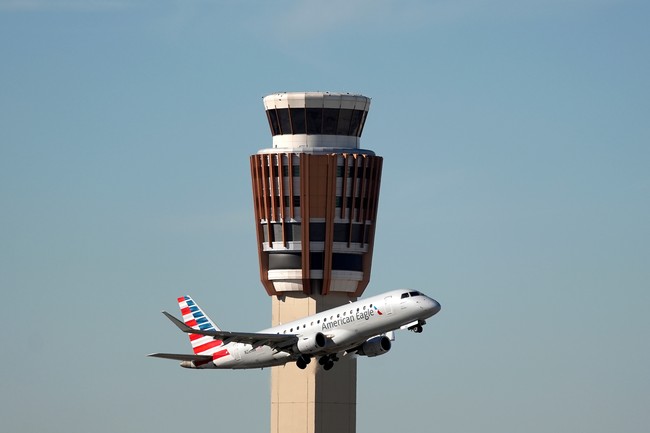
Friday the 13th of November was a wake-up call. Not because it’s customarily a day of bad luck, but ironically the Federal Aviation Administration (FAA) grounded all flights for the second time since 9/11. A newly installed router malfunction in El Dorado, Arkansas, flooded the network, creating instability with aircraft communications.
Keeping everyone safe is paramount. The FAA had to make a tough call. But the glitch is emblematic of an antiquated air traffic control system (ATC) in dire need of an overhaul. The 45,000 daily flights carrying 2.7 million passengers and 61,000 tons of cargo deserve a functional and reliable network; Congress needs to make this a priority.
A faulty system is no surprise. The FAA has struggled for decades to modernize its outdated ATC systems. Transportation Secretary Sean Duffy summarized the main problem: “We use 1980s technology, 1990s software, to use 1970s radar that we don’t make parts for anymore.” The needed upgrade would merge the systems into a common or integrated platform.
Last year, Congress approved $12.5 billion for ATC upgrades. Before the November incident, Duffy had asked for another $30 billion; now he is asking for $50 billion. But the request faces pushback and uncertainty. Some congressmen are questioning why the administration is “asking for more funding.”
The Government Accountability Office reported in 2024 that over 75 percent of FAA’s 138 ATC systems were unsustainable or potentially unsustainable. The U.S. ATC needs modernized telecommunications and radar infrastructure, better staffing, and stronger cybersecurity. After the November incident, Duffy stated, “It’s going to continue to fail.” That is not reassuring.
If grounding flights due to system miscommunications and failures is the new normal, the airline industry and the many ancillary enterprises that depend on it will continue to be negatively impacted. Too much is at stake, and Americans will pay the price.
Accounting for roughly 5 percent of GDP, commercial aviation contributes $1.54 trillion annually to the U.S. economy. Air travel fuels major spending on lodging, dining, and local attractions. Disruptions send massive shock waves that ripple through airlines, airports, hotels, car rentals, restaurants, and local economies. Because destination businesses rely on steady flight schedules, reductions or cancellations in air service translate to fewer hotel stays, rental car pickups, and retail sales.
Some regions get hit particularly hard with large-scale travel interruptions. In major tourism hubs like Orlando, Las Vegas, New York, and Miami, air travel is the lifeblood of local hotel occupancy, restaurant revenue, and entertainment venues. The hospitality industry and the employees that operate them lose substantial business in these locations.
Perhaps worse than the financial repercussions are the experiences forgone and stress involved. Ground halts mean missed meetings, weddings, or concerts as well as shortened vacations and less time with family and friends. It could also mean scrambling to find last-minute accommodations or alternative arrangements if away from home, which often costs travelers more with unexpected expenses.
Disruptive air travel additionally erodes consumer confidence. A survey taken just days after November 13’s grounding indicates that 37 percent of U.S. travelers are somewhat or a lot less likely to fly to a vacation in the next year. Despite assurances that airlines have fully recovered from the ground stop, 72 percent said they were more concerned about cancellations or significant delays in the wake of the incident.
The U.S. Travel Association estimated that the U.S. economy would lose at least $26 billion if leisure and business travelers skipped even a single trip in 2027.
A router failure may have triggered the worst tech-related flight disruption in history, but the broader problem is a decades-old ATC system that is increasingly unable to meet the demands of a modern aviation network. With trillions of dollars in economic activity, millions of travelers, and countless businesses relying on reliable air service, ATC modernization is no longer optional; it is essential.
Congress should prioritize the investments needed to ensure the safety, reliability, and resilience of America’s aviation infrastructure. The cost of inaction is too high.
Kristen Walker is Senior Policy Analyst and Manager for Energy and Transportation with the American Consumer Institute, a nonprofit education and research organization. For more information about the Institute, visit www.theamericanconsumer.org or follow us on X @ConsumerPal.