





American higher education has a free speech problem, as recent events at the University of Oklahoma show.
When students were asked to incorporate their “own thoughts” into an essay, one student shared her own thoughts on gender stereotypes and cited her views from the Bible. The graduate teaching assistant, who uses she/they pronouns, proceeded to call the student’s views “offensive” and gave the student’s assignment a 0/25 based on her opinion instead of the grading rubric. Instructors are allowed to give students bad or failing grades, of course, but the fact that she gave the student a zero for a completed assignment points to a political rationale: students are free to share their thoughts, so long as those thoughts align with the instructor’s worldview.
This is yet another example, in a year filled with campus controversies, in which freedom of speech has been challenged and targeted—not because of incivility or disruption, but simply because certain viewpoints fall outside the preferred ideological boundaries.
On September 9th, 2025—the day before Charlie Kirk was murdered while engaging in open debate at Utah Valley University—the Foundation for Individual Rights and Expression (FIRE) released a survey showing that, for the first time, “a majority of students would prevent speakers from both the Left and Right who express controversial views, ranging from abortion to transgender issues, from stepping foot on campus.”
But rather than challenging their students intellectually, colleges have taken on a customer service mindset and have generally complied with their students’ wishes.
For instance, the New York University School of Law attempted to cancel a Federalist Society talk by conservative Jewish scholar Ilya Shapiro on the second anniversary of Hamas’ October 7th attack on Israel. While NYU, after public pressure, eventually backtracked, it initially cited safety concerns to cancel Shapiro—just as other colleges have done to cancel conservatives and other dissidents from speaking in any capacity.
I was one of those dissidents.
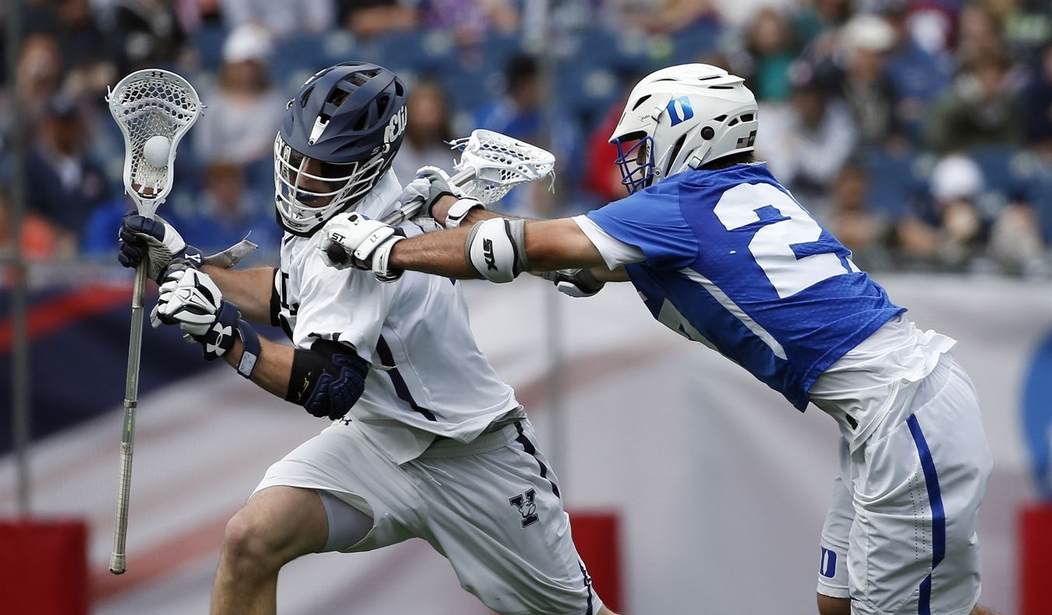
In 2018, I accepted a position as head women’s lacrosse coach at Oberlin College. As a 51-year-old woman, a mother of four, and someone known as the “Hippie Love Coach,” I thought Oberlin, a liberal school with a female athletic director and a black female president, would be the perfect place for me. I quickly found I was wrong.
What I came to realize during my time at Oberlin was not only disheartening, but disturbing. Over the next five years, I watched with heartbreak and horror as an intense ideology—marketed as “kindness” and “inclusion”—swept through the institution and captured the minds of students and faculty. I discovered that an institution I believed to be a perfect fit for me would be the most hypocritical institution I had ever worked for.
In 2022, while I was in my role at Oberlin, I spoke out on my social media when I saw a man competing in women's DI swimming. To my surprise, Oberlin subjected me to a series of disciplinary hearings, and forced me to apologize in front of my entire team. Instead of being allowed to express my views, I was burned at the stake by Oberlin College for supporting female-only sports.
When I first told my story publicly in 2023, many of my colleagues and students at Oberlin were afraid to contact me. They were afraid to be shunned or fired if anyone found out that they were “on my side.” I was told that my beliefs, simply standing up for women, fell “into a category of people that are filled with hate in the world.”
Unfortunately, Oberlin has not changed since then.
In September of this year, a student leader at Oberlin College openly called for “bringing back political assassinations” in the wake of Charlie Kirk’s tragic murder. The same institution that disciplined me for defending female athletes has yet to meaningfully respond to a student publicly advocating for political violence.
When truth is punished and violent speech excused, education stops being about free inquiry and becomes about enforcing ideological loyalty. Such selective enforcement distorts culture, erodes trust in institutions, and makes communities less safe by normalizing extremism while silencing reality. In short, college campuses have traded truth for ideology, turning classrooms into chambers of orthodoxy instead of arenas of inquiry.
Fear has been winning at our educational institutions. But if we allow ourselves to be silenced, fear will win.
Violence and hate-filled speech are no longer outliers on college campuses — they are often tolerated, even justified, if the target holds the “wrong” opinions. Meanwhile, the rest of us are paralyzed.
If now is the “turning point,” we must continue to stand up for truth.
Unless we find the courage to resist—to speak, even when our voice shakes—we will lose the most precious parts of our society: truth, trust, and the very idea of shared reality.
But there is hope. In a world where at any given time you can log onto a website, forum, app—you name it—and see record-setting amounts of vitriol and hate, it may not always be what it seems.
A recent study from Scientific Reports shows that most Americans have a deep misunderstanding around political debates. In fact, the study suggests that Americans are doing the majority of debating around dinner tables and in coffee shops, citing that their close friends and family are who they most debate with, yet simultaneously assume that most of these debates happen online.
Noticeably, the study goes on to say that when asked about how these debates go, the sentiment is that they walk away with a positive feeling. How counter-cultural is that idea? If anything, this study shows that we aren’t debating enough—and that our skewed perceptions of reality are getting in the way of bridging these divides.
While many fear that they will be ostracized by family and friends—especially during the holidays—for expressing their views or bringing up a hot topic at the dinner table, I compel you to step out of that fear and embrace courage.
America was founded on the idea of exceptionalism. Exceptionalism inherently breeds curiosity and diverse thought—not censorship or cowardice. If we truly want to embody American exceptionalism and free speech, we must keep engaging—one conversation at a time.
Kim Russell is an Independent Women ambassador and the former head women’s lacrosse coach at Oberlin College. After she shared her story in Independent Women’s Features’ exclusive documentary, “Burned at the Stake,” Russell was removed from her position and restricted from talking with her student-athletes.
Editor’s Note: Do you enjoy Townhall’s conservative reporting that takes on the radical left and woke media? Support our work so that we can continue to bring you the truth.
Join Townhall VIP and use the promo code FIGHT to get 60% off your VIP membership!

Join the Conversation
VIP members get the ability to comment on articles.