
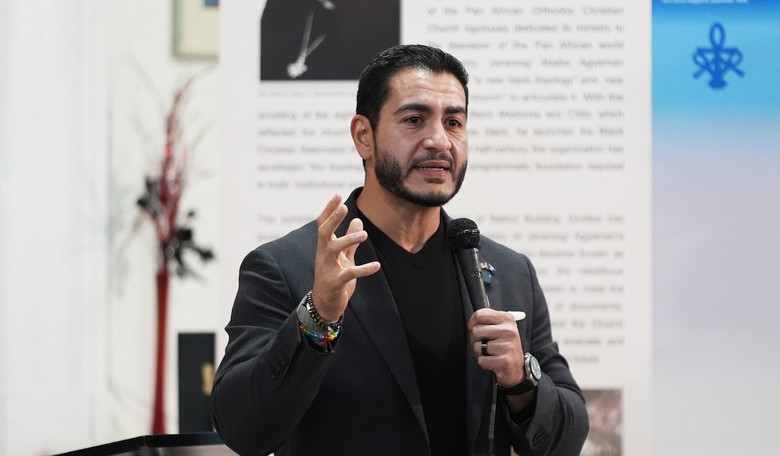
Bret Baier asked a question. Abdul El-Sayed didn't like it.
And in the space of roughly a minute, Michigan's Democrat nominee for the United States Senate told voters considerably more about himself than he probably intended.
Not with his answers.
With his refusal to let the questions get asked.
Baier was trying to ask El-Sayed about a 2012 letter he signed, addressed to Mohamed Morsi, Egypt's then-president and a Muslim Brotherhood figure.
El-Sayed cut him off before he finished the sentence.
"No, no, no, let me just stop there."
He meant it, too. Baier tried again. El-Sayed interrupted again, accusing the journalist of questioning his loyalty to America. Then came the line of the whole exchange.
"Be a journalist."
"I am," Baier said.
There it is.
The quiet arrogance of a man who's decided a journalist's job is only legitimate when the candidate approves the question in advance.
I've watched the clip more than once. Watch his eyes. Listen to the register of his voice climb half a step with every interruption. That's not composure. That's tempered rage — the particular indignation of someone who seems genuinely offended that anyone would dare press him on something he'd rather not discuss.
How dare you ask me this?
That's the impression he leaves. And impressions matter plenty when a man is asking voters to hand him six years of constitutional responsibility. El-Sayed says he's never belonged to the Muslim Brotherhood and never will. He's denied the allegations outright. Fair enough — a denial deserves to be reported accurately, and an allegation isn't proof.
But an interruption isn't an answer either. And indignation was never evidence of innocence.
Here's the part that actually gets me: the constitutional defense he kept reaching for.
"My loyalty belongs to the Constitution of the United States," he insisted.
Okay. Which Constitution?
Because in April 2023, in a video he later made private, El-Sayed proposed something worth sitting with: "What if we tweaked the Constitution, amended the amendment, and instead of the right to bear arms, we change it to the right to have healthcare?"
Not a new program. Not expanded coverage. A trade. Erase one constitutional right, write in a different one.
The Constitution has a lawful amendment process, and proposing to use it is itself protected speech. Nobody should pretend otherwise. But it's entirely fair to ask a candidate what he actually believes that document is supposed to protect — especially when he's invoking loyalty to it as the answer to a completely different question an hour later on cable news.
I believe the Second Amendment protects a liberty the government didn't create and has no business casually erasing. El-Sayed floated trading it away for a government benefit. Those are not small, compatible differences. They're two different theories of what the Constitution is even for.
So when he assures Bret Baier his loyalty belongs to the Constitution, I'd genuinely like to know: the one Americans actually have, or the one he'd prefer to write?
His campaign now says he "respects" the Second Amendment. Fine. Then explain the 2023 video. Tell voters plainly whether you still believe what you said. That's not persecution. That's the job.
The same standard applies to the Muslim Brotherhood letter. El-Sayed signed something in 2012. He says the meaning's been distorted. There's an easy way to settle that: explain what you signed, why you signed it, and what you believe now.
Instead, Michigan got 60 seconds of a candidate trying to run the interview himself.
I've sat across the table for thousands of interviews over the years. Most guests handle hard questions fine. Some push back on the premise, which is healthy. Every once in a while, somebody tries to make the question itself the offense.
That last move is always the most revealing one. Suddenly the person asking becomes the problem. Not the letter. Not the video. Not the contradiction sitting right there on tape.
The person asking.
If that's how a Senate candidate handles one Friday-afternoon interview with Bret Baier, Michigan has every right to wonder how he'd handle six years of sustained scrutiny from an actual Senate seat. Will constituents' questions get answered, or reframed as attacks? Will disagreement get debated, or will the disagreeing get accused of bad motives?
El-Sayed wanted everyone watching to know he intends to swear allegiance to the Constitution. Good. So does every senator who's ever taken the oath. The oath isn't the finish line. It's the starting gun on the responsibility that follows.
And that document he's so eager to defend also happens to protect Bret Baier's right to ask an uncomfortable question. A man who hopes to swear loyalty to it should be able to survive a reporter exercising that same freedom without reaching for the mute button.
Asking the question was never the crime.
Trying to keep it from being asked at all?
That told us more than El-Sayed probably realizes.