





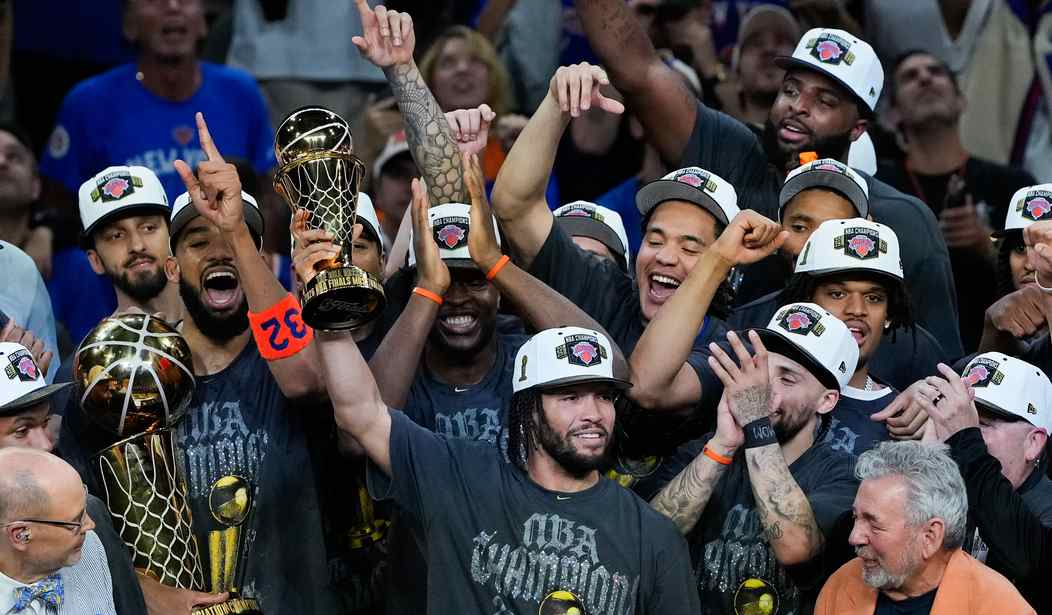
As the basket dropped to tie the game 83-83, I gently woke my bride from the couch.
She had endured enough already.
The emotional swings. The blown coverages. The missed calls. The impossible shots by San Antonio. The first 95 percent of the game had been a stress test for even the most devoted Knicks fan, and somewhere around the middle of the third quarter, exhaustion finally overtook her.
But the final blows in this series were about to be traded.
And she wasn’t missing this.
Playing what felt like five-on-eight for most of the night, the New York Knicks finally grabbed their first lead late in the fourth quarter. Madison Avenue swagger met blue-collar stubbornness. And as had become the pattern throughout the Finals, the Knicks adjusted when it mattered most.
Mitchell Robinson—a backup center and arguably the least graceful free-throw shooter in modern basketball—ripped down a rebound that changed the game. Bench players made the extra pass. They milked the clock. They punished the Spurs for helping too aggressively off shooters.
And Jalen Brunson—who has clearly rehearsed these moments in empty gyms his entire life—did what leaders do.
He penetrated the lane, collapsed the defense, found open shooters, hit short jumpers in traffic, absorbed contact, and calmly buried free throws while twenty thousand hostile Texans screamed themselves hoarse.
Then came the final twenty-six seconds.
The Knicks built the lead to four.
And they never surrendered it again.
When the buzzer sounded and the trophy was handed over, what struck me wasn’t arrogance.
It was gratitude.
No chest-thumping dynasty behavior. No manufactured villain energy. No self-obsessed theatrics.
Just imperfect players, overcoming deeper talent, on the road, against overwhelming odds, acknowledging one another, acknowledging God, and understanding fully what it took to arrive there.
And honestly?
The whole thing felt strangely American.
Which is fitting because this nation is approaching her 250th birthday.
And the more I watched this Knicks team, the more they reminded me of the colonies that somehow defeated the greatest empire on earth.
Think about it.
The British Army and Navy were the unquestioned superpower of their age. Trained professionals. Superior equipment. Superior financing. Superior logistics. The finest military machine on the planet.
The colonials?
Farmers.
Tradesmen.
Shopkeepers.
Preachers.
Immigrants.
At times, they lacked shoes. Their uniforms were mismatched and inadequate for the weather conditions. Supplies were inconsistent. Pay was unreliable. Morale fluctuated wildly. Entire campaigns nearly collapsed from hunger, exposure, and exhaustion.
And nearly everyone watching from the outside assumed they had no chance.
Sound familiar?
The Knicks entered these Finals facing the league MVP, the league’s best defensive player, and the rookie everyone already anointed the next face of basketball. Analysts spent most of the series explaining why New York couldn’t possibly survive the talent gap.
Yet there they were.
Still standing.
Still fighting.
Still adjusting.
And that’s where another parallel emerges.
Jalen Brunson famously left nearly $100 million on the table to help create financial flexibility for the organization moving forward. In an era where athletes often maximize every possible dollar, Brunson voluntarily sacrificed personal wealth for the health of the team.
That is not normal in modern America.
Neither was George Washington surrendering power after the Revolution.
History tends to produce victorious men who cling to authority once they possess it. Washington did the opposite. After leading the colonies to victory, he stepped away and allowed his fellow citizens room to build something larger than himself.
King George III reportedly remarked that if Washington voluntarily surrendered military power, he would be “the greatest man in the world.”
Because selflessness always shocks people accustomed to ambition.
The Knicks displayed that same spirit throughout this run.
Nobody cared who scored 25 as long as somebody did.
Nobody demanded constant spotlight.
Bench players became essential. Role players became trusted. Sacrifice became contagious.
That’s how functioning republics work, too, by the way.
Not merely through talent.
Through shared burden.
And then there was the faith.
Several Knicks players openly acknowledged God after the victory. Not performatively. Not awkwardly. Naturally. Gratefully.
That also felt deeply American.
The men who stood beside Washington through Valley Forge and beyond spoke similarly. They believed providence mattered. They prayed. They feared God. They understood liberty not merely as political independence but as moral responsibility under divine authority.
Modern elites often sneer at this part of the founding because dependence upon God irritates people addicted to dependence upon self.
But humility has always been one of America’s secret strengths.
And this Knicks team displayed it beautifully.
No perfect roster.
No invincible superstar.
No guaranteed outcome.
Just grit. Trust. Sacrifice. Discipline. Faith. Adjustment. Perseverance.
That sounds suspiciously like America herself.
And maybe that’s why this championship landed emotionally differently for so many people.
Because beneath all the noise of modern life—beneath the outrage algorithms, the narcissism, the division, the constant self-promotion—Americans are starving to see something noble again.
Something earned.
Something collective.
Something that reminds us greatness is still possible when imperfect people commit themselves to a purpose bigger than ego.
That’s the story of 1776.
And oddly enough, it became the story of these Finals, too.
A hostile road environment.
Long odds.
A deeper opponent.
Doubters everywhere.
Yet somehow, through sacrifice, courage, trust in one another, and refusal to quit, victory emerged anyway.
As America approaches 250 years, perhaps that’s the reminder we needed most.
That nations and teams alike are strongest not when every individual demands maximum glory for themselves, but when ordinary people willingly surrender comfort, recognition, and ego for something greater than their own name on the back of the jersey.
Watching the Knicks celebrate that way—humble, grateful, selfless—felt beautiful and complimentary to America’s founding all in one swish.
And honestly, at a moment when humility, sacrifice, and gratitude feel increasingly rare in our culture, it felt like something far more important than basketball had won, too.
Editor’s Note: Do you enjoy Townhall’s conservative reporting that takes on the radical Left and woke media? Support our work so that we can continue to bring you the truth.
Join Townhall VIP and use promo code FIGHT to receive 60% off your membership.

Join the Conversation
VIP members get the ability to comment on articles.