





President Trump said it out loud this week—and whether Europe likes it or not, he’s not wrong.
After weeks of war, failed negotiations, and finally a decisive U.S. blockade of Iranian ports, Trump turned his frustration toward allies like Italy and the United Kingdom, who have, at best, responded with hesitation—and at worst, quiet indifference. Or as Trump essentially put it: you want the benefits, but you don’t want the burden.
And that’s the problem.
What is unfolding in the Middle East right now is not just another regional flare-up. It is one of the most significant geopolitical realignments of the modern era. The Iranian regime’s ability to project power, threaten global shipping, and pursue nuclear ambitions is being directly challenged in a way that hasn’t been seen in decades.
And who benefits the most from that? Europe.
Not the United States. Europe.
Let’s start with the obvious.
Nearly 20 percent of the world’s oil supply flows through the Strait of Hormuz. When Iran chokes that lane—as it has attempted to do repeatedly in recent weeks—it’s not American commuters who feel it first. It’s Europe.
Italy. Germany. The UK. Spain. Energy-dependent economies that rely heavily on imported oil and gas—much of it tied directly or indirectly to Middle Eastern stability.
And yet, when the United States steps in—first militarily, then diplomatically, and now economically through a full-scale blockade—to neutralize that threat, what does Europe do? It shrugs.
Or worse. Take Italy.
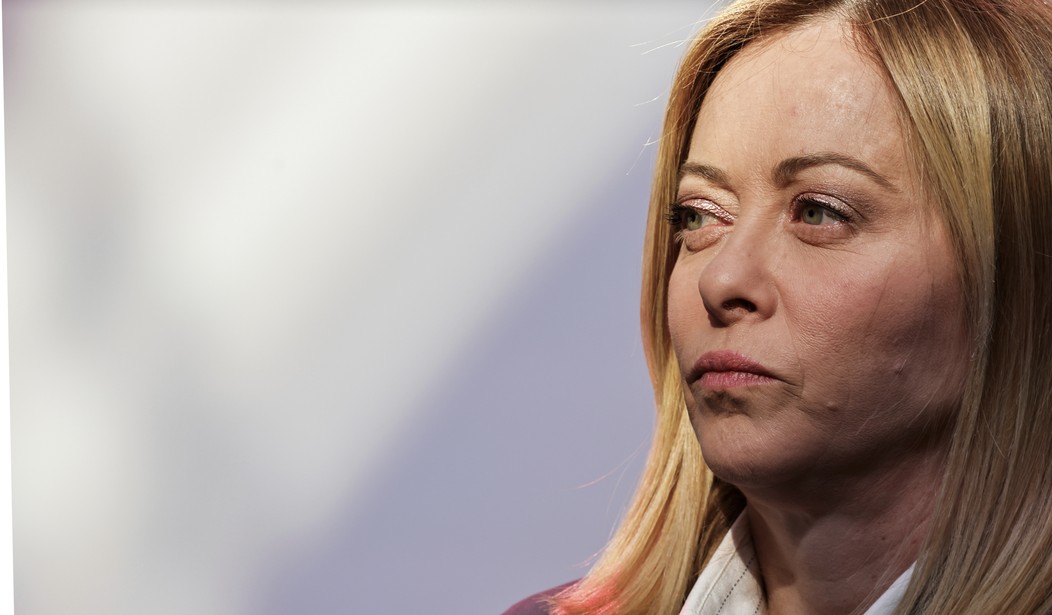
Prime Minister Giorgia Meloni—once considered one of Trump’s closest allies in Europe—has now openly distanced herself from U.S. efforts. She refused to support military action, declined to allow certain operational cooperation, and has instead emphasized “diplomatic solutions” while the region burns.
Trump didn’t mince words. He said he was “shocked” by her lack of courage. And honestly? Why wouldn’t he be?
Italy is one of the countries most exposed to energy disruption from Iran’s behavior. Rising oil prices have already hit Italian consumers hard. And yet, when it comes time to actually secure the very shipping lanes that keep their economy functioning, the response is effectively: “You handle it.”
Trump called that out directly, noting that Italy depends on the U.S. to keep the Strait open while refusing to step up themselves.
That’s not an alliance. That’s freeloading.
Now look at the broader European posture.
Across the continent, leaders have largely rebuffed calls to actively support U.S. efforts in securing the Strait of Hormuz or confronting Iran’s aggression. They cite fears of escalation. Domestic politics. Economic uncertainty.
All valid concerns—until you realize they are enjoying the benefits of American action while refusing to share the cost.
That’s not caution. That’s convenience. And it’s exactly what Trump has been calling out for years.
Europe wants stability—but doesn’t want to enforce it. Europe wants secure energy—but doesn’t want to defend it. Europe wants America to lead—but complains the entire time it’s happening. Meanwhile, what has the United States actually done?
Let’s review the facts.
After Iran refused to agree to terms in negotiations held in Pakistan—talks that were meant to de-escalate the conflict—the U.S. didn’t blink. It escalated with purpose. President Trump ordered a naval blockade of Iranian ports, effectively shutting down maritime trade and cutting off a major economic artery of the regime.
Within 36 hours, U.S. forces had achieved maritime superiority in the region and halted Iranian sea trade entirely.
That’s not symbolic. That’s decisive.
And what has Europe done in response? Talked about “restoring navigation.” Held meetings. Issued statements.
Italy, for example, has discussed participating in maritime security efforts—but only under strict conditions like a U.N. mandate.
Translation: we’ll help… eventually… maybe… if everything is perfectly aligned.
That’s not leadership. That’s delay. And delay is exactly what regimes like Iran exploit.
Here’s the reality Europe doesn’t want to admit: Trump’s actions have done more to stabilize their future than anything they’ve done themselves.
The blockade alone—by restricting Iran’s ability to threaten shipping and fund its operations—directly protects European energy supply chains. The military pressure applied over the past weeks has degraded Iran’s capacity to disrupt the region. And the negotiation strategy—force first, diplomacy second—has created conditions where Iran is now far more likely to concede than dictate.
All of that benefits Europe. Massively. And yet the response is lukewarm at best.
At worst, it’s outright criticism, which is why Trump’s frustration isn’t just understandable—it’s overdue.
Because this isn’t about personality. It’s about reality. Alliances are not one-way streets. They are not built on one side doing all the heavy lifting while the other side critiques the method.
They require participation. They require risk. They require—yes—courage.
And that’s the word Trump used. Courage.
Because that’s what’s missing.
Not intelligence. Not awareness. Not even resources.
Courage.
The courage to recognize that the world is changing. The courage to act when the stakes are high. The courage to stand with the ally that is actually doing something to secure your future.
Instead, Europe has chosen hesitation. And hesitation, in moments like this, is not neutral. It’s a choice. A choice to let someone else carry the burden. A choice to benefit without contributing. A choice to hope the problem gets solved without having to be part of the solution.
But here’s the part they’re going to have to come to terms with: The world is not going back to the old model.
The days of America doing everything while Europe debates everything are ending. And leaders like Trump are making that very clear.
So yes—Trump’s not wrong on the Euros. Not even close.
In fact, the only thing he might be wrong about…
Is how long they think they can keep getting away with it.
Join the Conversation
VIP members get the ability to comment on articles.