





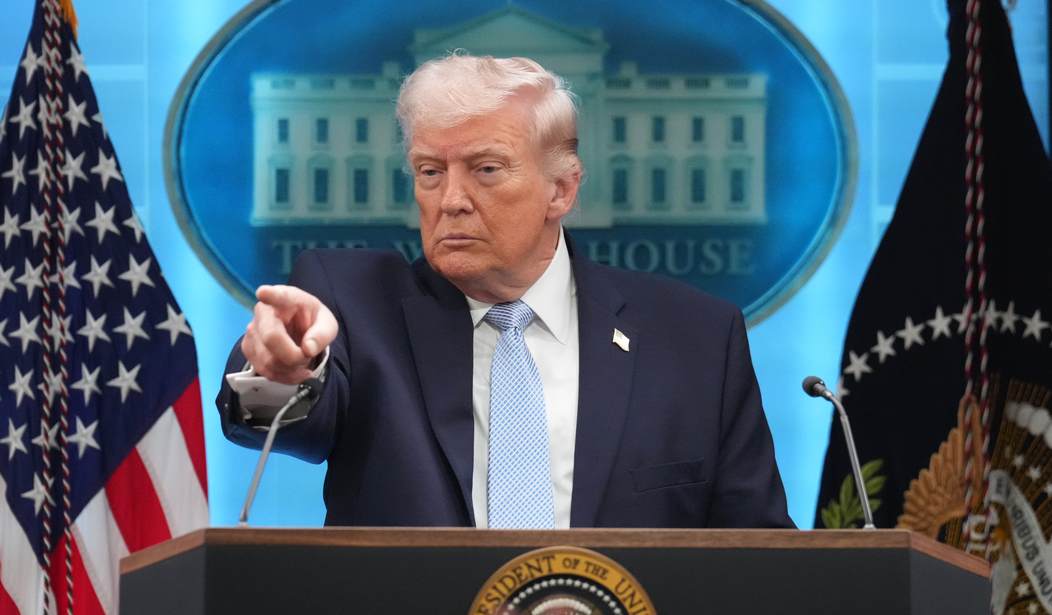
There’s a moment in every conflict—every negotiation, every standoff—when reality becomes unavoidable. Not debated, not spun, not “messaged.” Just obvious. And we are living in that moment right now.
Step back from the punditry, the pearl-clutching, and the endless parade of “experts” who seem perpetually wrong about everything, and what you see unfolding is not complicated at all. It’s simple. There is overwhelming strength on one side and diminishing options on the other. Which is why, if I were them—honestly—I’d just do what he says.
Now, I know that’s not the kind of advice that wins you invitations to Georgetown cocktail parties. It’s not the language of think tanks or the posture of diplomats who’ve built careers on sounding sophisticated while achieving very little. But it is the language of reality. And reality has a way of asserting itself whether you acknowledge it or not.
Let’s talk about what’s actually happened. A regime that for decades has projected power through proxies, intimidation, and carefully cultivated fear has suddenly found itself facing something it has rarely encountered: decisive, unapologetic force. Not hesitant. Not half-measured. Not bogged down in endless deliberation. Decisive.
And the results have been swift. Military capabilities have been degraded. Strategic assets have been neutralized. Regional influence has been disrupted. And perhaps most telling of all, diplomatic posture is shifting.
Here’s what people often misunderstand about power: it doesn’t just change what happens on the battlefield. It changes how people think. It changes how they calculate risk. It changes what they are willing to say out loud—and what they are willing to concede behind closed doors.
Right now, those calculations are being rewritten in real time. You can see it in the sudden willingness to talk. You can see it in the quiet channels opening. You can see it in the public statements that sound strong—but feel different. Less certain. Less defiant. More like positioning.
Because when you know you’ve lost leverage, you start looking for off-ramps. And make no mistake—that’s what this is. An off-ramp.
Now contrast that with the chorus we heard just days ago: “Forever war.” “Quagmire.” “Another endless Middle East disaster.” We’ve heard it all before. The same voices. The same predictions. The same absolute certainty that America, if it acts, will inevitably fail.
And yet here we are.
Days—not years—into a conflict that has already reshaped the strategic landscape. Days—not decades—into a moment that has forced adversaries to reconsider their entire position. Days—and already the conversation has shifted from “how bad will this get?” to “how quickly can this end?”
That doesn’t happen by accident. It happens when strength is applied with clarity, when objectives are defined, and when leadership understands that half-measures don’t end conflicts—they prolong them.
And that’s the part that seems to confuse the critics the most. They have built an entire worldview around the idea that American power is inherently destabilizing, that it inevitably leads to chaos, and that it cannot produce order.
But what we are witnessing right now tells a very different story.
When American power is used decisively—when it is not shackled by hesitation or diluted by indecision—it creates clarity. It forces choices. It brings timelines into focus. And it makes the cost of continued resistance unmistakably clear.
Which brings us back to the simplest, most obvious conclusion of all.
If you are on the receiving end of that kind of clarity—if your options are narrowing by the hour, if your leverage is evaporating, and if your ability to dictate terms is gone—then what exactly are you waiting for? Pride? Optics? A better deal that isn’t coming?
This is where leadership—real leadership—reveals itself. There are moments when continuing to posture is not strength; it’s denial. There are moments when defiance is not courage; it’s recklessness. And there are moments when the smartest, most rational, most life-preserving decision you can make is the one that ends the conflict—not prolongs it.
That moment is now.
And that’s why I say, without hesitation or apology, and without any need to dress it up in diplomatic language: if I were them, I’d just do what he says.
Not because it’s politically convenient. Not because it’s emotionally satisfying. But because it’s the only path that avoids further destruction, the only path that preserves what remains, and the only path that acknowledges reality instead of fighting it.
And for those here at home who are still clinging to the tired scripts of the past—who are still hoping this somehow turns into the catastrophe they predicted—I would simply ask: at what point do you admit you were wrong?
At what point do you recognize that strength, properly applied, doesn’t trap us in endless wars—it prevents them?
Because that’s what’s happening here. Not escalation, but resolution. Not chaos, but clarity. Not a forever war, but an ending.
And endings, as it turns out, are a lot easier to reach when one side finally recognizes the obvious—and acts on it.

Join the Conversation
VIP members get the ability to comment on articles.