





There are 535 members of Congress. Representatives chosen by qualified Americans fill those seats, in a system defined by political equality and economic liberty.
The U.S. Supreme Court inverted this principle in 1986 with the Thornburg v. Gingles decision. Attempting to equalize economic outcomes, political power was unequally allocated to congressional districts drawn with a majority of black voters. This scheme aimed to right the effects of historic wrongs and drew broad support from citizens across the country.
Embedded in the decision was the racist idea that all blacks think the same, an affront to American principles. In this pre-DEI, misguided mindset, Nature’s God in our Declaration of Independence allocates sovereignty by skin color. There is no colorblind individuality our government must humble itself before, just tribes of belief.
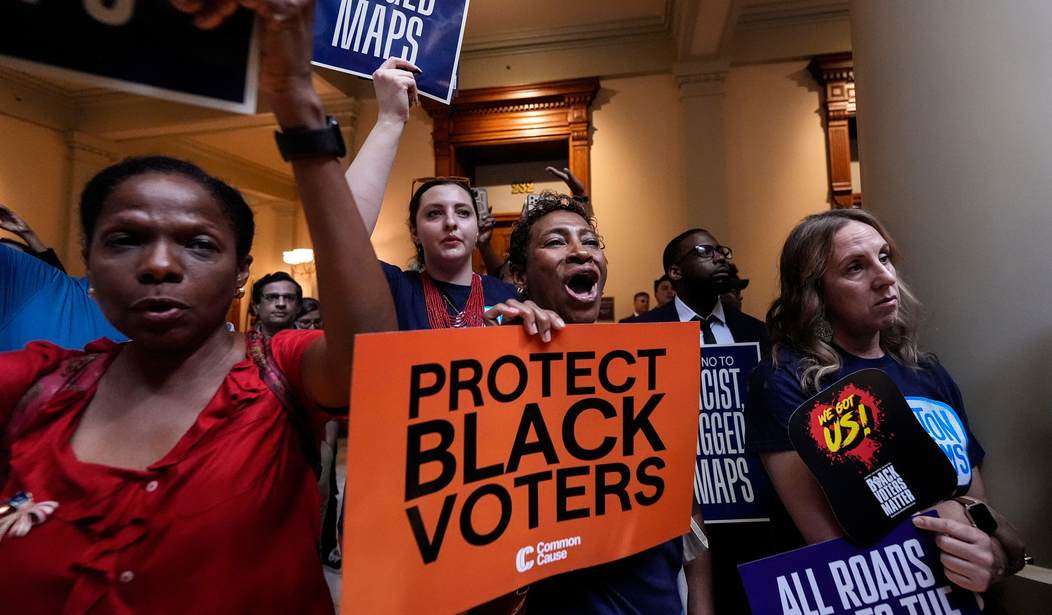
SCOTUS reversed that disgraceful policy in April with Louisiana v. Callais, ending an era in which states were humiliatingly scrutinized — Southern states, that is — on their conformity to court-ordered racial quotas in congressional mapping. The fact that every such “majority-minority” congressional seat went to a Democrat in a Republican state, with an ever-expanding number of such districts, was presumed to be justice at work.
Democrat civil rights and congressional leaders such as Kamala Harris, Chuck Schumer, Hakeem Jeffries, and Al Sharpton have decried the Callais ruling as a return to “Jim Crow” and an attack on voting rights. Broadly speaking, they infer it is a political effort to achieve white nationalism.
A new report from RealAmerica.Vote challenges this claim. Researchers investigated outcomes for six majority-minority districts formed or protected by the early 1990s under the Voting Rights Act Section 2. Given the immense opportunity for political, educational, and economic transformation generously apportioned by the American people, what transpired? Did the opportunity for black racial blocs to choose congressional representation equalize socioeconomic conditions in those districts as compared to surrounding districts?
Six districts (AL-7, GA-5, LA-2, MS-2, SC-6, VA-3) were selected for study since they persisted throughout the duration (2000-2024) without being overturned or invalidated by the court and maintained a majority or at least a plurality of black voters throughout.
A set of “Basic” (e.g., employment) and aspirational “American Dream” needs (e.g., own a home) were used to measure the socioeconomic performance of these districts. Data were sourced from the Census for 2000 and the American Community Survey.
The districts have seen, at best, only a slight improvement in meeting basic and aspirational needs of majority-minority black districts. Recent boundary changes in GA-5 and LA-2 appear to be driving a lot of the observed improvement, so it is hard to say whether single-member minority congressional representation improved the situation at all.
Analysis resulted in examples like this chart, where the prevalence of single motherhood ranged from 39-46 percent worse in majority-minority districts than surrounding districts, for 24 years. Blacks who were stuck stayed stuck.
The data show that Democrats locked in control of densely black-populated swaths of the South for decades, failed the incredible leadership opportunity to uplift them, and used national taxpayer dollars to incentivize broken homes and government dependence over rebuilding stable families and developing economic and individual civic potential. All six majority-minority black districts studied significantly lag their peer state districts across all need areas.
With the return of colorblind political representation, we have a new opportunity. Using the great principles of our founding, including limited government, political equality, rule of law, free markets, education in American civics to build engaged citizens, and incentives to hard work such as low taxes and respect for property rights, we can engage the potential of every American who develops their God-given gifts within the framework of our social contract.
Will Callais be the Economic Emancipation Proclamation for America’s marginalized black populations? The answer depends on each of us voting for representatives who boldly support and defend our core national values of political equality and economic liberty, known to Americans as the right to pursue happiness.
Ken Blackwell is the President of the Council for National Policy and Chairman of the Conservative Action Project.
Editor's Note: Do you enjoy Townhall's conservative reporting exposing the radical Left and woke media? Support our work so we can keep bringing you the truth.
Join Townhall VIP and use promo code FIGHT to receive 60% off your membership.



Join the Conversation
VIP members get the ability to comment on articles.