





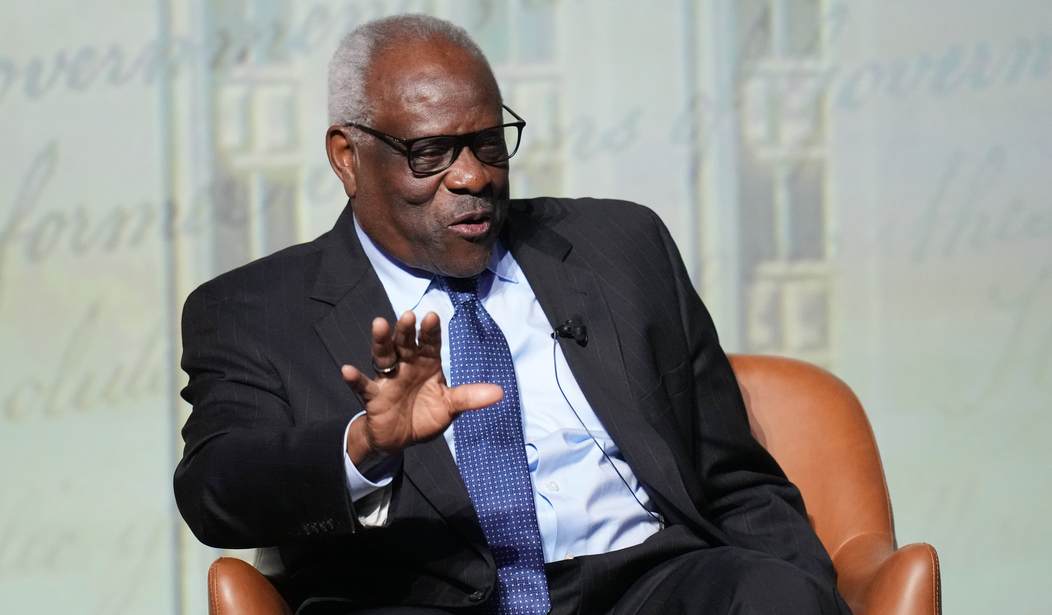
An important new book by Sen. Ted Cruz (R-Texas), "Going Further," calls attention anew to the life and career of the single greatest living American, Supreme Court Justice Clarence Thomas.
For many years after Thomas arrived on the court in the early 1990s, his conservative, originalist views were relegated to dissenting opinions. Three and a half decades later, Thomas, now the second-longest-serving justice in the court's history, regularly finds himself in the majority.
Thomas, in short, has won the long game. But how?
Thirty-five years ago, mainstream legal training and judicial practice suggested the proper way to interpret a legal document is to probe for nebulous concepts such as legislative history and legislative intent. It's now hard to believe, but the commonsense notion that one should begin the interpretive exercise with a document's text and plain meaning was pretty much unheard of.
Thomas, along with his then-colleagues Justice Antonin Scalia and Chief Justice William Rehnquist, galvanized an intellectual revolution in American legal and judicial practice. Today, law schools instruct students to begin the interpretive exercise with the text. In fact, this is hardly controversial. As the liberal Justice Elena Kagan put it in a 2015 Harvard Law School lecture, "We're all textualists now."
\A big part of this success is simple: sheer persuasiveness. The straightforward nature of the originalist and textualist position quickly found mass appeal, putting defenders of legislative history or "living constitutionalism" on their back feet. They haven't been able to keep up.
In the area of legal interpretation, liberals have lost the public argument — badly. In recent years, we've seen this manifest in conservative victories at the high court on religious liberty, abortion, gun rights, affirmative action and the administrative state.
There is an underappreciated additional ingredient in Thomas' winning formula: his kindness, affability and genuine human decency.
Thomas' life story is the stuff of legend. He grew up in the most abject poverty imaginable in Jim Crow-era rural Georgia. English was not even his first language. He overcame all that, in addition to his one-time wavering faith and even an infatuation with Malcolm X and the black Power movement, to become one of the greatest conservatives in American history.
But here's the thing: Thomas never forgot where he came from.
It is well known that, inside the Supreme Court building, Thomas is the personal favorite justice. That's true for the justices themselves, for the law clerks, and even for the janitors. Thomas is the justice who will talk NASCAR with the court security guard (he's a big fan of the sport), and he is the justice who will regale law clerks with funny stories from years gone by — with his signature, boisterous laugh.
The one topic Thomas will not talk about, because it would offend his old-school Southern manners, is himself.
The Supreme Court, unlike Congress or the executive branch, is a small, intimate institution. Passions can run high, but a justice can best achieve success over the long haul if he can persuade his colleagues in conferences, memoranda, and other communications. As the saying goes, you usually catch more flies with honey than with vinegar.
That was not always Scalia's way, but it is definitely Thomas' way.
The next Supreme Court term begins in just over a month, and the court's senior-most member will once again anchor the court's originalist bloc.
There will be Viramontes v. Cook County, a prime opportunity to extend a Second Amendment guarantee to modern sporting rifles ("AR-15s"). There will be St. Mary Catholic Parish v. Roy, another case out of stubborn Colorado that could, and should, extend otherwise-universal preschool voucher access to religious schools. Other big cases on the docket touch on voting rights, climate change, and more.
Thomas' influence will be palpable. He will once again serve the role he always has: that of dependable workhorse and beacon of intellectual clarity. He will once again be the court's most principled originalist, establishing a barometer off of which other originalists can assess their own instincts and rulings.
In a nation short on exemplary role models, Thomas fills the void. He would never dream of saying so himself, but Thomas is an American hero and the nation's most inspiring man.
The only question is whether he will remain on the court until May 20, 2028, at which point he will become the nation's longest-serving justice.
If there's one thing we know from Clarence Thomas' life: Don't bet against him.
Editor's Note: Do you enjoy Townhall's conservative reporting that takes on the radical Left and woke media? Support our work so that we can continue to bring you the truth.
Join Townhall VIP and use promo code FIGHT to receive 60% off your membership.



Join the Conversation
VIP members get the ability to comment on articles.