





[Editor's note: this piece was co-authored by David Nekrutman]
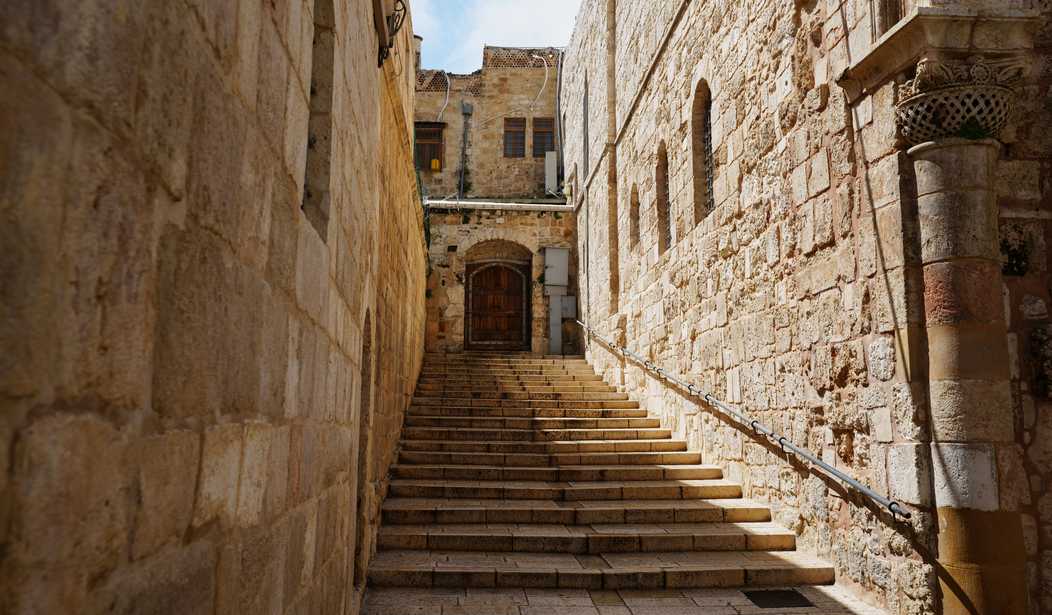
The images from last month’s Iranian missile barrage remain seared into our collective memory, specifically the sight of ballistic missile streaks over Jerusalem’s Old City. Amidst this high-stakes war, a localized controversy erupted that touched the very heart of the faith communities with whom we spend our time building bridges. During Holy Week, Israeli police barred Cardinal Pierbattista Pizzaballa from entering the Church of the Holy Sepulchre for a private, livestreamed Palm Sunday service.
Predictably, the incident became a Rorschach test for the region’s geopolitics. Critics of Israel seized upon it as evidence of anti-Christian bias, while defenders pointed to the genuine threat of falling shrapnel, noting that religious gatherings for Jews and Muslims were also restricted. The fallout was significant enough that Israeli government leaders, including the Prime Minister himself, condemned the police decision and intervened to ensure a solution was found for future services.
But while high-level political fixes can salvage a holiday, they do not address the underlying infrastructure failure. As leaders of The Isaiah Projects and the Genesis 123 Foundation, we believe the time has come to ask a glaring, practical question: Why does one of the most significant religious sites on Earth, in a place that has been targeted by terrorist missiles, lack a bomb shelter?
Streamlining Security for the Clergy
The absence of a shelter doesn’t just impact pilgrims; it hamstrings the ability of Israel’s Home Front Command to make nuanced security calls. When the sirens wail and the threat level rises, as we experienced during last month's state of war, the military’s default position must be the total shutdown of unprotected spaces.
If the Church of the Holy Sepulchre had an on-site shelter, the logistical calculus would change overnight. It would provide the Home Front Command with the safety "cushion" needed to allow the Cardinal and his clergy into the building even during high-alert periods. While a shelter might not allow for full congregational attendance, it would alleviate some of the safety concerns that currently lead to total bans on public holy sites. A shelter turns a high-risk security gamble into a manageable situation, ensuring the liturgy does not have to go dark while protecting lives—a value central to both Judaism and Christianity.
A Coalition of Willing Neighbors
Recognizing this gap between spiritual necessity and physical safety, our organizations have publicly offered to donate and install a bomb shelter within or adjacent to the church premises. We would be working in tandem with Operation Lifeshield, an Israeli organization with decades of specialized experience installing shelters for both Jewish and non-Jewish communities across Israel.
To date, however, the Church has yet to accept our offer. We understand the complexity of the "Status Quo"—the centuries-old web of agreements between different denominations that govern the Holy Sites. Historically, even moving a ladder can trigger an internal Christian crisis. Yet, as the region prepares for a potential "Phase 3" escalation with Iran and the lack of a long-term solution becomes glaring, the absence of modern safety infrastructure is a liability that prayer alone may not solve.
Beyond the Status Quo
The threats last month in Jerusalem and across Israel were real. While any physical change requires a delicate consensus among the various Christian denominations at the Church of the Holy Sepulchre, "bureaucracy as usual" is a luxury we can no longer afford when the stakes are human lives.
Moving beyond these administrative hurdles would signal a profound shift in interfaith relations, especially as an initiative of two Jewish-led organizations supported by both Jews and Christians. We are currently 60 years post-Nostra Aetate, the landmark declaration that reshaped the relationship between the Catholic Church and the Jewish people. We speak often of "rapprochement," but it is often confined to high-level summits and theological papers.
We believe a bomb shelter for the Church of the Holy Sepulchre, facilitated by Jewish neighbors with a proven track record of protecting all citizens, would be the ultimate modern manifestation of that vision. It would be a tangible, “concrete” sign of a brotherhood that prioritizes the sanctity of life over the friction of the past.
Looking Ahead to Phase 3
As tensions with Iran threaten to escalate into a "Phase 3" conflict, the issue of shutdowns in public and even sacred spaces will only intensify. Israel has recently appointed a new Christian envoy; while he is still getting his feet wet in this complex space, he cannot carry the burden of the Church’s safety alone.
The Church leadership must step up. It is easy to blame security forces for restrictions, but it is much harder to justify the lack of basic safety infrastructure in a high-profile target area frequently caught in the crosshairs of regional conflict.
Our offer stands. We are ready to work with the Church to navigate the technical and diplomatic hurdles. Accepting this shelter would ensure that when the next barrage of missiles from Iran, Hezbollah, or the Houthis comes, the Church remains a protected sanctuary rather than a site for political standoffs. Let us work together to ensure that the prayers at the Holy Sepulchre never have to be silenced by the sound of sirens. To learn more about this initiative, please visit Shelters for Christian Holy Sites.
David Nekrutman is the Executive Director of The Isaiah Projects. Jonathan Feldstein is the President of the Genesis 123 Foundation.


Join the Conversation
VIP members get the ability to comment on articles.