





“The sins of the father” is a timeless phrase that hits hard because it captures something deeply human: how the mistakes, choices, traumas, or wrongs of one generation ripple forward, often burdening the next.
The expression comes most famously from Biblical passages like Exodus 20:5 and 34:7, where God describes Himself as“…visiting the iniquity of the fathers on the children and the children’s children, to the third and the fourth generation…”
The idea isn’t that God arbitrarily punishes innocent children for what their parents did. It’s a Biblical principle that’s been wrapped into modern jurisprudence that people are judged for their own actions. However, it does reflect a harsh reality: sin (especially things like idolatry, abuse, addiction, violence, or neglect) echoes through families. Children learn behaviors, inherit environments, repeat cycles, or suffer the fallout of their parents’ evils. It’s generally a consequence more than direct divine punishment.
While God might not punish the children for their father’s sins, should a child openly disavow the father’s sins, or knowingly perpetuate them? Is a child who perpetuates the sins of the father guiltless?
One modern case to examine is the stories of two Iranian women named Fatemeh.
Fatemeh #1 is a pseudonym, her identity hidden for her safety. In a viral video, “Fatemeh” called in to a Farsi TV program in the UK from inside Iran. Her accounts were chilling. She openly and painfully calls out the evil of her father as an operative of the regime. “My father is a member of the oppressive forces.” “(He) ordered me to be killed.” “They killed the children…they oppressed them.” “Do you know how much we suffer from them, these cruel parents. If I could, I would be the first person to kill him.”
Fatemeh # 2 is Fatemeh Ardeshir-Larijani, a doctor at Emory University whose very presence in the United States has created massive controversy. A recent petition has gone viral, garnering more than 95,000 signatures from Iranian expatriates and others, calling for her to be deported. Another campaign calls for Emory University to sever all ties with Larijani. Additionally, Rep. Earl L. “Buddy” Carter (R-GA) is leading a campaign to have her medical license revoked. He writes in his statement, “Patient safety, public trust, and national security demand decisive action now.”
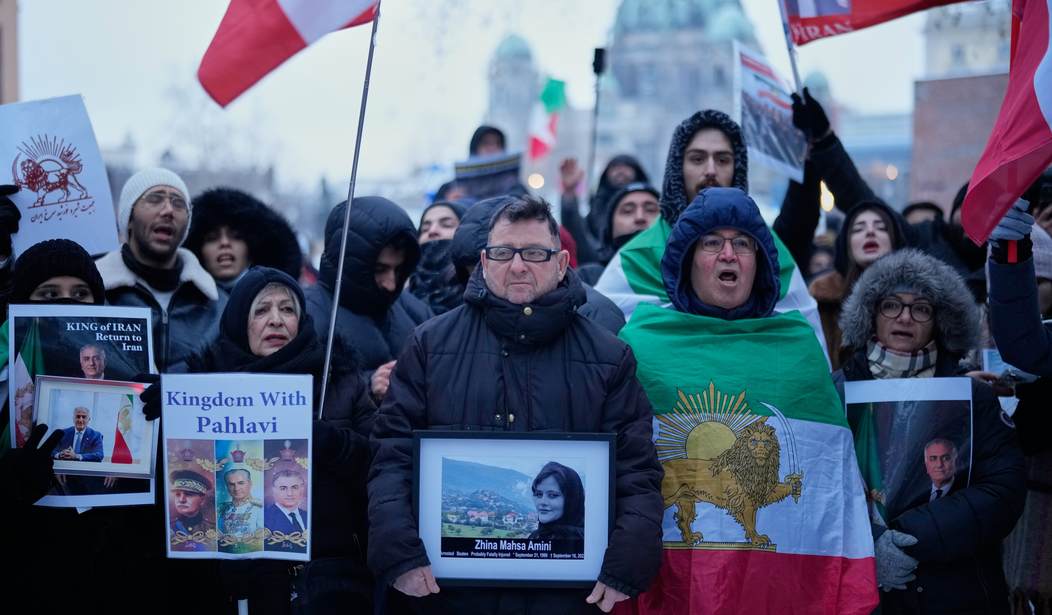
For nearly a month, Iranians have taken to the streets protesting their government. They have been met with a blackout in internet access and phone service, and unspeakable brutality. Reliable reports coming from doctors inside Iran are that more than 16,500 Iranians have been massacred by forces of the Islamic Republic, and more than 330,000 have been injured. Agents of the regime are reportedly entering hospitals where those injured are being treated and executing them on the spot. Estimates are that more than double the number of casualties.
Alongside the protests of Iranians inside Iran, something that has become even more widespread and life-threatening, numerous protests on behalf of the people of Iran are taking place across the world. Recently, one such protest took place at Emory. Why the controversy?
Fatemeh Ardeshir-Larijani is the daughter of Ali Larijani, Secretary of Iran’s Supreme National Security Council. Inside Iran, Iranian officials constantly chant “death to America.” Iran’s president has openly stated that Iran is at war with America. Yet many of the regime’s leaders have family members living safely inside the U.S.
Ali Larijani is a senior operative of the Islamic Republic’s leadership. As a cornerstone of the terrorist regime, he openly threatens the United States, yet his daughter lives and works in the U.S., ostensibly protecting American lives, while her father serves a hostile regime and slaughters Iranian lives.
The Iranian diaspora is united in calls for freedom for Iran, yet as the daughter of one of the most cruel repressors of the Islamic Republic, Fatemeh Ardeshir-Larijani is living under the protection of the very freedoms for which Iranians are protesting, and as a result of which they are being brutalized and slaughtered. With a senior Islamic regime leader who makes hostile threats against America, having his immediate family benefit from and sheltered by the freedoms of the very country her father seeks to destroy is a clear national security threat.
Unlike Fatemeh #1, who expressly condemns the horrors that her own father is guilty of in repressing and torturing Iranians, Fatemeh Ardeshir-Larijani has been silent. Not only has she never separated herself from her father, much less condemned him and the Islamic Republic, but she sits in the free world where doing so would not cause her any risk, unlike those in Iran who risk their lives for simply being on the street and protesting. Her silence is compliance.
As a doctor, her silence is particularly noteworthy as Iranians are being slaughtered by one of the most evil regimes on earth, in which her father is a member of its inner circle. With a slaughter of this magnitude, and her father as a chief perpetrator whom she has not disavowed, she fails in morality and fails in her Hippocratic Oath. While she lives peacefully in the U.S., countless young Iranians are dying due to the policies and decisions made by Khamenei and his inner circle, including her father.
After President Trump stated that he would support Iranian protesters, Ali Larijani accused him of interfering in Iran’s internal affairs and warned that the United States should be concerned about the safety of its soldiers.
The discovery that Ardeshir-Larijani lives and works in the U.S. as a doctor has many up in arms over potential national security threats. One example is Bijan Rezai Jahromi, a Middle East and Iran expert, wrote on X: “Larijani, the daughter of the Islamic Republic's terrorist regime, has been in the United States for years, and her father threatens Americans. This pattern repeats in Europe as well, since the West's spineless leaders enable asylum for terrorists.”
The Iranian diaspora expresses anger that the children of a regime that stripped them of their freedom are allowed to live freely in the US, often with access to wealth allegedly linked to laundered regime funds. The demonstrators at Emory held banners with pointed slogans that matter. “Enemy of the USA Welcomed by Emory,” “Did You Know Iran Terror Chief’s Daughter is Your Co-Worker,” and “No Place for IRGC” with blood dripping from the IRGC.
Under the Obama and Biden Administrations, the US gave numerous visas to family of the regime’s leaders and other regime agents. They need to be found, exposed, and deported. America cannot be a safe harbor for these terrorists and their unrepentant relatives.
As an alumnus of Emory, I look at the protesters with pride and nostalgia. In my day, I led and participated in protests on campus, mostly against Soviet persecution of Jews and unrepentant antisemitism. As the Jewish sage Hillel asks and charges, “If I am not for myself, who will be for me? But if I am only for myself, who am I?”
Emory has the right to employ anyone it wants. It should have vetted Fatemeh Ardeshir-Larijani better, but it did the right thing to dismiss her. It’s an example for others in the West harboring progeny of the Islamic regime, and to such people themselves, that here is no safe harbor. Ardeshir-Larijani is not a refugee persecuted by the regime, but the daughter of one of its most cruel leaders. Now that Emory has broken ties with her, she should be deported and sent packing to Tehran, where she can put her medical skills to work saving lives of the hundreds of thousands of Iranians her father and his terrorist cohorts are brutalizing and executing.
[Editor's note: this op-ed has been updated to reflect that Fatemeh Ardeshir-Larijani no longer works for Emory]
Editor’s Note: Do you enjoy Townhall’s conservative reporting that takes on the radical left and woke media? Support our work so that we can continue to bring you the truth.
Join Townhall VIP and use promo code FIGHT to receive 60% off your membership.


Join the Conversation
VIP members get the ability to comment on articles.