





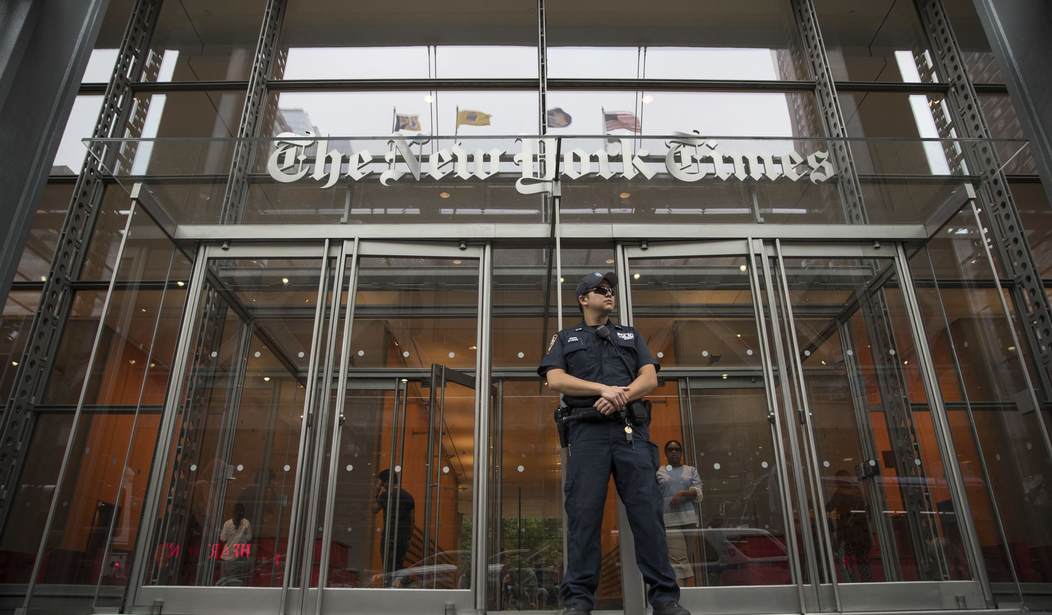
It's a perfect mess befitting our imperfect age. The New York Times announced it was hiring a Sarah Jeong to join its editorial board. A respected reporter on technology and the internet, Jeong is Asian-American.
Nanoseconds later, a number of her objectively racist tweets emerged. "Oh man it's kind of sick how much joy I get out of being cruel to old white men," reads one. "Are white people genetically predisposed to burn faster in the sun, thus logically being only fit to live underground like groveling goblins," she mused in another.
Jeong, issued a statement explaining that she was satirically "counter-trolling" at racists who attacked her. She says her comments were not intended for a "general audience." As someone who's been subjected to vicious anti-Semitism from trolls, I'm inclined to give her the benefit of the doubt.
Meanwhile, The New York Times issued its own statement saying it would stand by its decision to hire her, but that "type of rhetoric was not acceptable" at the Times.
One reason this episode is difficult to look at in isolation is that it is just one episode in a long-running series, with any number of spin-offs. Roseanne Barr lost her hit TV show for posting something racist on Twitter. One of the people who led, or at least joined in, the virtual mob was Hollywood director James Gunn, who tweeted during that controversy: "Roseanne is allowed to say whatever she wants. It doesn't mean @ABCNetwork needs to continue funding her show if her words are considered abhorrent."
Two months later, Gunn's own past offensive tweets were unearthed and he lost his job directing the "Guardians of the Galaxy" franchise.
Old tweets aren't the only thing that can ignite a digital prairie fire of protest.
My friend Kevin Williamson was hired by The Atlantic and before he could figure out where the bathroom was, a comment he made on a podcast - that was deliberately misconstrued - was held up like Caesar's bloody toga to incite the shock troops of social justice. The Atlantic fired him.
The back and forth reprisals resemble a mob war. And each time, the decision to fire - or not fire - invites entirely legitimate charges of hypocrisy, which prime the kindling for the inevitable next bonfire.
That's one reason why I think the Times' leaders are correct to stand by Jeong, even though they open themselves to the hypocrisy charge (In February they hired Quinn Norton, another technology reporter, and then immediately un-hired her when some of her offensive tweets were weaponized).
The idea of free expression traces itself back to the Peace of Westphalia, which put an end to the continent-wide, tit-for-tat religious wars that wracked Europe for centuries. Simple exhaustion and the acceptance of "the essential futility of putting the beliefs of the mind to the judgment of the sword," in the words of C.V. Wedgwood, led the West to grudgingly accept the right to be wrong.
Admittedly, the analogy is flawed in several ways. But the lessons for everyone are relevant. We live in a time when partisan affiliation and ideological worldviews serve as substitute religions. And if we've learned anything from the last few years, the capacity for outrage on the left and right is near infinite. There's nothing wrong with forcefully expressing disagreement, but the constant hunt for scalps will leave everyone bald and bloodied.
Newspapers, magazines, and other businesses have every right to hire and fire whomever they want, but if they do hire someone, they should stand by their decision until the new employee does something worthy of firing while employed by them, not because a mob chooses to weaponize something they said in the past. And even then, they should make the decision on the merits, not simply to appease jackals. Obviously this can't be an inflexible law, but it should be the rule of thumb.
At the same time, people shouldn't tweet - or say - indefensibly stupid, racist or dumb things on the assumption that only "their people" will see it, hear it or process it in precisely the way the author intended. The Internet has made it impossible for such "narrowcasting" to stay narrow. As Jeong has learned, we all live in one "general audience" now. Again, it can't be law: people shouldn't hold themselves hostage to the most excitable and humorless among us. But it's a worthy principle.
And so is this: We should all save our outrage for when it's really needed.
Join the Conversation
VIP members get the ability to comment on articles.