





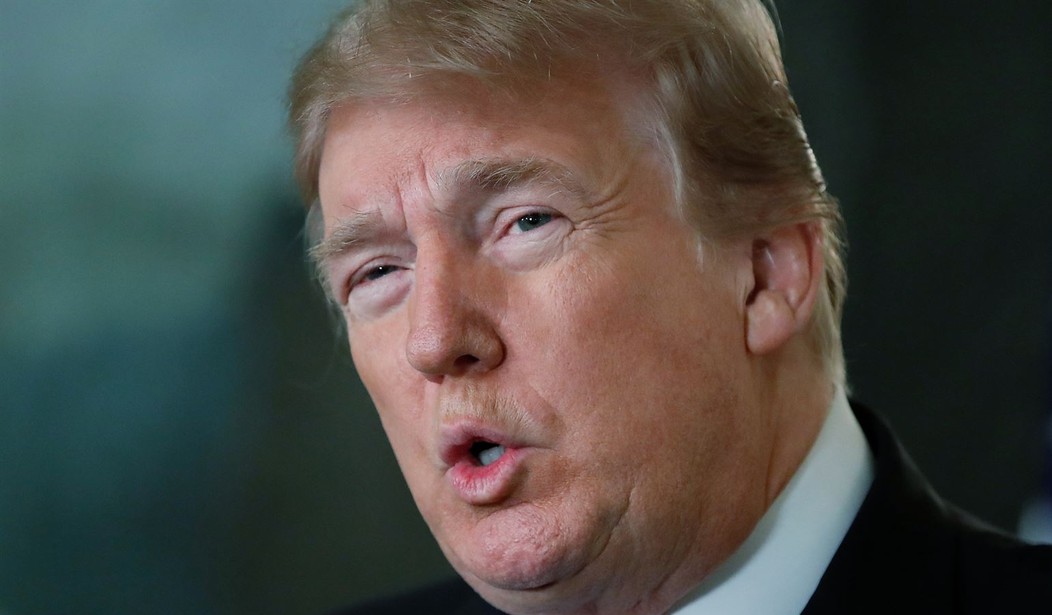
For a while, a set of liberals has argued that Donald Trump isn't an aberration from other Republican presidents. Now, some surprising conservatives, including friends and colleagues of mine, are starting to agree.
The conservative arguments take several forms, but a key point shared by all of them is that there's nothing new about Trump's melding of populism and conservatism.
"I think people who see Trumpism as something aberrant in the Republican Party haven't thought much about the history of the Republican Party. Unless they're NeverTrumpers, in which case they're in a state of denial," Sean Trende of Real Clear Politics argued in a much-discussed Twitter peroration. "Successful Republican campaigns and presidencies have always involved an integration of the party's populist and establishment wings."
Henry Olsen, a scholar at the Ethics and Public Policy Center, has been arguing for quite a while that Trump is a more authentic incarnation of Reaganism, because "Trump's active leadership style and his combination of populism with market economics is far closer to Reagan's words and deeds than anything House Speaker Paul Ryan of Wisconsin or Senate Majority Leader Mitch McConnell of Kentucky offer."
Rich Lowry, my boss at National Review, agrees. Writing in Politico, he recounts Reagan's and other past Republican presidents' deft use of populist issues and themes to win both the GOP nomination and the White House. "We can argue about what role populism and nationalism should have in conservative politics," Lowry said, "but that they have a place, and always have, is undeniable."
Lowry is right. It is undeniable. It is also undeniable that Democrats from Andrew Jackson to FDR to Barack Obama have used populism to galvanize their candidacies and presidencies. This fact alone should tell you something: Not all populisms are the same, because though they all claim to be the voice of the people, they invariably speak with a specific voice for a specific subset of the people.
Or as then-candidate Trump put it in May 2016: "The only important thing is the unification of the people -- because the other people don't mean anything."
Populism is a bottom-up phenomenon, but it is shaped and defined by rhetoric from the top. And just as there are differences between left and right populism, there are different kinds of conservative populism.
Until recently, right-wing populism manifested itself in the various forms of the tea party, which emphasized limited government and fiscal restraint. That populism was not only very different from the populism of Occupy Wall Street, it is very different from Trump's version.
It is true that Reagan championed populist themes, but no one can seriously dispute that Reagan's themes and rhetoric were decidedly un-Trumpian. The conservative populist who delivered "A Time for Choosing" used broadly inclusive language, focusing his ire at a centralized government that reduced a nation of aspiring individuals to "the masses."
This was a running theme of Reagan's rhetoric. "I've been privileged to meet people all over this land in the special kind of way you meet them when you are campaigning," he said in a 1978 radio address. "They are not 'the masses,' or as the elitists would have it -- 'the common man.' They are very uncommon. Individuals each with his or her own hopes and dreams, plans and problems and the kind of quiet courage that makes this whole country run better than just about any other on place Earth."
Reagan's populist rhetoric was informed by a moderate, big-hearted temperament, a faith in American exceptionalism and a fondness for immigration. He warned of concentrated power that corrodes self-government.
"From time to time we've been tempted to believe that society has become too complex to be managed by self-rule, that government by an elite group is superior to government for, by and of the people," Reagan declared in his first inaugural. "Well, if no one among us is capable of governing himself, then who among us has the capacity to govern someone else?"
Trump rejects American exceptionalism, saying that other nations have outsmarted us. His indictment of our own government is that it is too weak and dumb. His solution: "I alone can fix it."
I'm not merely indulging in Reagan nostalgia. Every president enlists populist passion, but to leave it at that ignores the purpose of that passion and reduces "the people" to nothing more than the masses.


Join the Conversation
VIP members get the ability to comment on articles.