





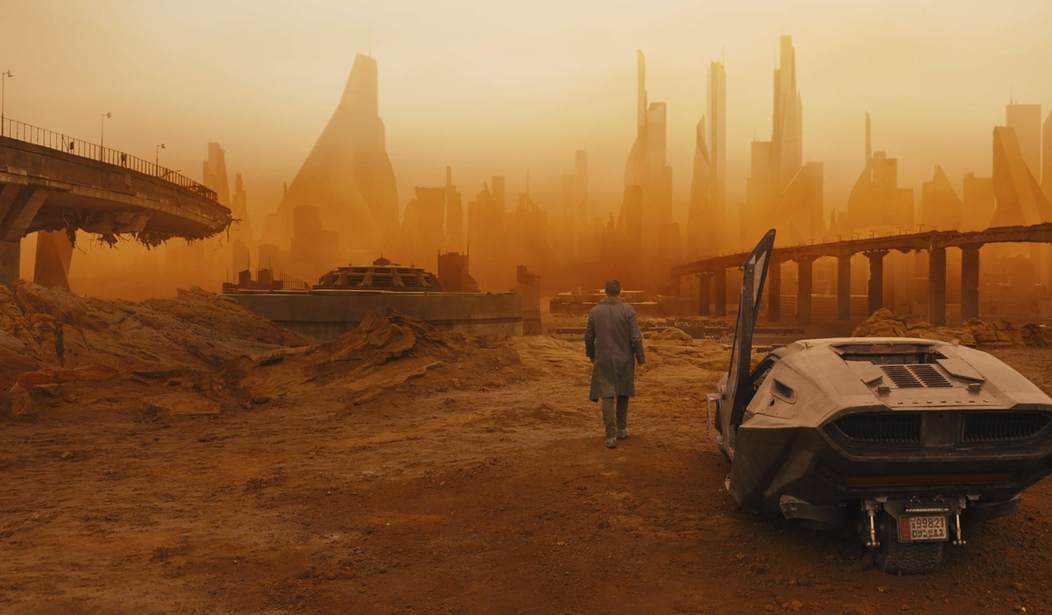
The Wall Street Journal recently reported on the "Blade Runner" curse. If you're familiar with the 1982 sci-fi cult classic starring Harrison Ford, constantly reissued in some new "director's cut" or "special edition," you'd be forgiven for thinking the "Blade Runner" curse had something to do with a mysterious crone casting an evil eye on the producers, vowing that the film would spend eternity in an editor's suite. But that's not the whammy the Journal had in mind.
The movie "conjured a Los Angeles of 2019 whose steamy streets teem with flying cars and neon advertising," writes Don Steinberg. "Then came the curse: Many of the robust brands shown thriving in the cinematic future ran into financial troubles in the real world."
Director Ridley Scott thought that using real corporate titans at the time -- Coca-Cola, Atari, RCA Corp, Bell Telephone, Cuisinart, Pan Am, Koss headphones, Tsingtao beer -- would help convey his gloomy foreboding about the triumph of corporate power in our not-too-distant future.
By my count, of the eight companies depicted in the movie, five either disappeared, were broken up or were bought by other firms. Atari, which controlled 80 percent of the home video game market, went belly-up, though the name has been bought and revived by another company. Koss and Cuisinart went bankrupt (though Conair bought the Cuisinart brand out of Chapter 11 in 1989). Bell Telephone was split into a bunch of different companies. Coca-Cola survived, of course, but in 1985 it took it on the chin with the New Coke debacle.
Hence the "Blade Runner" curse. Appearing in the movie apparently jinxed businesses. And yet, many companies are lining up to appear in the forthcoming sequel, "Blade Runner 2049." Maybe these firms aren't superstitious? Or perhaps they know something that's lost on science fiction writers.
As my National Review colleague Kevin D. Williamson noted in a brilliant essay ("Hey, Where's My Corporate Dystopia?"), the idea that corporations will one day take control of our lives has been a staple of science fiction -- and left-wing Jeremiahs -- for generations.
"At its best," Williamson writes, "science fiction imagines a future that illuminates the present, but on the subject of the social role of the corporation, science fiction has long been backward-looking, out of touch with the reality it would analyze."
For all their alleged power, big corporations are often powerless when it comes to the simple task of surviving. As Williamson notes, "Only 67 of the firms in the Fortune 500 in 1955 remained there by 2011."
"The average age of a company listed on the S&P 500 has fallen from almost 60 years old in the 1950s to less than 20 years currently," a team of Credit Suisse analysts wrote last month. And the death rate is accelerating.
The same dynamic holds true for another favorite supervillain: the super-rich. French economist Thomas Piketty argued in his widely celebrated book "Capital in the 21st Century" that the rich only get richer over a long period of time, creating a permanent aristocracy of wealth. And while it's true that the combined net worth of the "1 percent" has increased, the actual people in the 1 percent come and go.
Fewer than 10 percent of the 400 wealthiest Americans who appeared on the Forbes list in 1982, when "Blade Runner" was released, were still there in 2012. As for the permanent aristocracy of wealth, of the 20 biggest fortunes on the 2013 Forbes list, 17 of them were self-made.
What explains this? Simply: capitalism itself. The "Blade Runner" curse isn't real; it's normal. The economist Joseph Schumpeter famously pointed out that monopolies can't last forever in a free market because monopolies get ossified and overly dependent on their existing business models. Entrepreneurs and innovators figure out new techniques and technologies that run circles around the big guys. That was the whole point behind another Ridley Scott masterpiece, his "1984"-themed Super Bowl commercial for Apple Computer, which symbolically dethroned IBM as the Orwellian colossus bestriding the personal computer industry.
As Adam Smith noted in "The Wealth of Nations," the only thing that can make a monopoly permanent is government, because only government can prevent the sort of innovation and competition that undermines every corporate behemoth.
And that's why the most plausible dystopian visions, like Orwell's "1984," involve the state exceeding its rightful authority and imposing its idea of how everyone else should live -- humans, replicants, and businesses alike.



Join the Conversation
VIP members get the ability to comment on articles.