





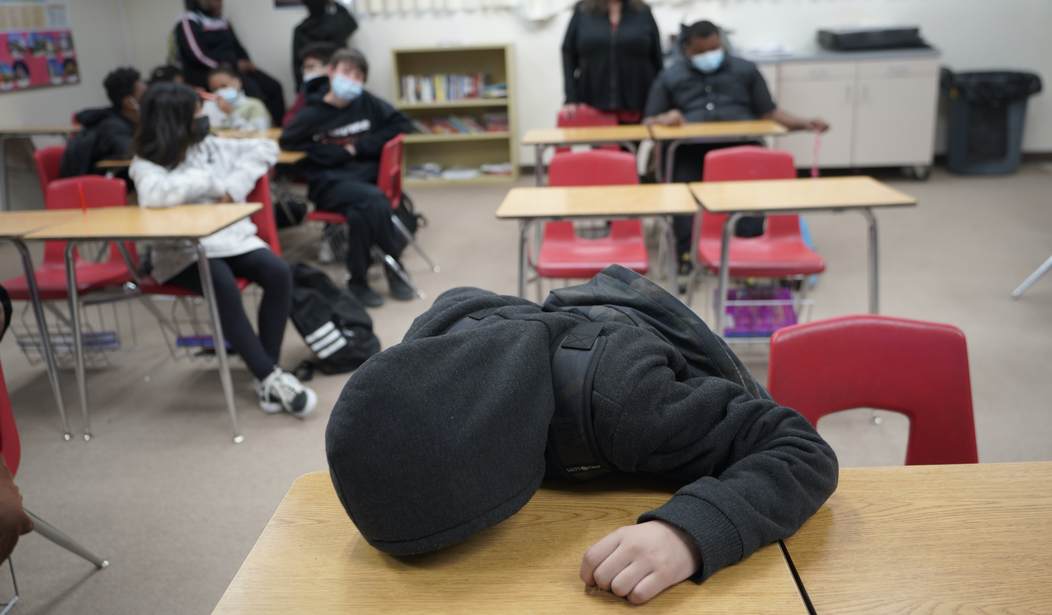
"Mental health is declining," says psychologist Jonathan Haidt.
This week, his book, "The Anxious Generation," is number one on The New York Times bestseller list. His book has been a bestseller for more than a year.
Haidt argues that smartphones and social media have "rewired childhood" and made kids more anxious and depressed.
My son agrees. He brings Haidt's argument to schools.
Max Stossel's nonprofit, "Social Awakening," arranges for him to talk to students, parents, and teachers about how social media erodes kids' sense of self, diminishing real relationships.
Many teachers agree. Many schools, as well as some states, have banned the use of smartphones during school hours.
But wait. We adults always worry about new things.
When I was a kid, cops raided pinball arcades. They said the game caused delinquency.
Then, politicians got upset about comic books. Sen. Estes Kefauver said they caused "a substantial amount of juvenile delinquency." They cited an "expert" who said the government should ban the sale of comic books to children.
Might the current worry about smartphones be just another overblown panic?
Before Haidt published "The Anxious Generation," he asked other researchers to review it.
"My advice to him was not to publish it," psychologist Chris Ferguson says in my new video.
"Look at kids today," he adds, "They're less violent, they smoke less, they use drugs less. All that happened during the social media smartphone age ... We're probably in the midst of another moral panic."
Why a moral panic?
Because parents can cast themselves as noble warriors resisting evil.
"Evil social media companies are the bad guys. I'm a good parent because I'm not letting my kid have a smartphone until they're 37," cracks Ferguson.
Haidt does want governments to prohibit kids from using social media, not "until they're 37," but until they're 16.
"Kids will just buy fake IDs," I push back.
"Kids can still get an older brother to buy them beer," replies Haidt. "But does that mean we should get rid of minimum age laws and let every kid buy alcohol?"
Ferguson reminds people that "experts" wanted similar limits on pinball, comics, and rock music:
"We are raising our children on a massive diet of violence," complained Tipper Gore, Al Gore's wife.
Then lawyers piled on.
"Ozzy Osbourne got sued over the idea that he had caused some kids to commit suicide ... music needed to be regulated, tamed by the government. The irony is that as people began to try to censor rock music, suicides among youth actually went up."
Politicians moved on to video games.
"Violence at the time was actually going down," I note.
"Absolutely ... It turns out that mass homicide perpetrators actually play fewer violent video games."
Maybe they were wrong about pinball, comic books, rock music, and video games. But this time, I suspect Jonathan Haidt and Max are right about smartphone addiction.
"I get hooked watching videos!" I tell Haidt. The social media algorithms have learned what I'll look at a second longer, so they send me more of those.
"We adults are hooked, too," he replies, "but at least we made it through puberty."
With kids, however, "Sleep goes down, time with friends goes down, exercise goes down."
Ferguson argues that most kids are doing fine.
"They drink less. They stay in school more. They volunteer in their communities more. We look for the bad news and only attribute the bad news to something like social media or smartphones, and we don't attribute any of the good news."
"What's the cost of banning it in schools?" I ask Ferguson.
"Unintended negative consequences. ... A lot of schools suspend kids for cellphone use, and that can cause real harm."
Also, "people get convinced that they fixed a problem when they didn't. That's going to waste a lot of time rather than looking at what might actually work."
I push back. "In the court of public opinion, (Haidt's) winning. You're losing."
"Give it 15 years," he replies. "We'll be panicking about something else."

Join the Conversation
VIP members get the ability to comment on articles.