







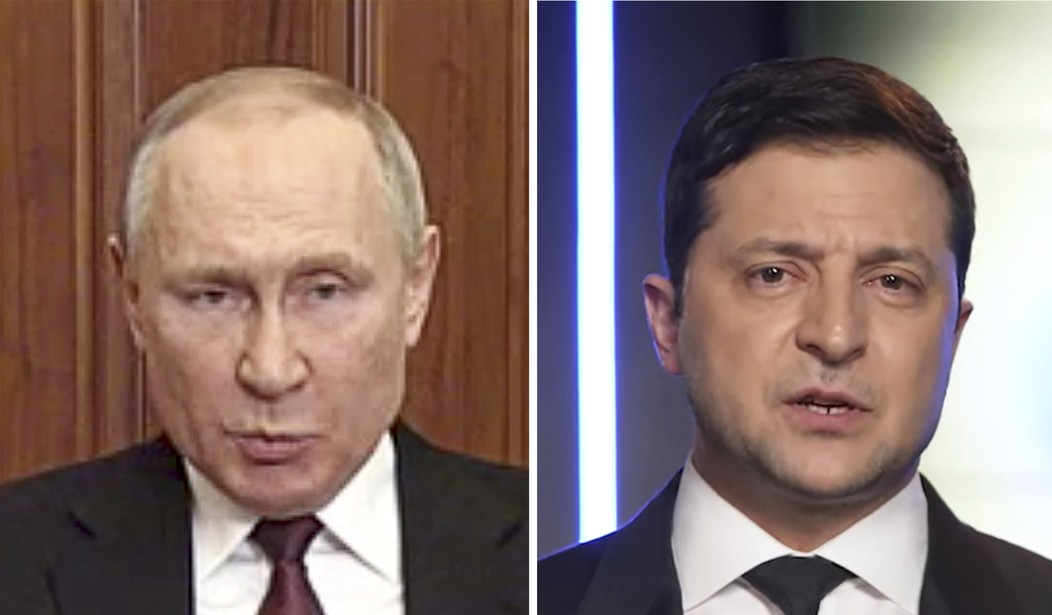
Russia's invasion revealed big differences in how politicians deal with threats.
The president of Ukraine, when offered evacuation, said, "I need ammunition, not a ride." He's a leader.
By contrast, in Canada a few weeks before, when truckers staged a protest against COVID-19 rules, the cowardly Prime Minister Justin Trudeau felt so threatened by the peaceful protesters that he went to "a secret location." Then he invoked Canada's Emergencies Act.
That empowered authorities to forcibly break up the protest. In one instance, police rode into a crowd on horseback. People were trampled.
Nasty as that was, the part of the act that turned out most effective at stopping protest was freezing protesters' bank accounts.
That's similar to what the West is doing to Russian President Vladimir Putin now.
But Trudeau did it to his own people!
"You do have to have a bank account, really, to be able to live," says George Mason University law professor Todd Zywicki in my new video.
"Imagine if, during the Civil Rights era, Martin Luther King could have lost his bank account because he trespassed at a Woolworth's counter."
Of course, more people used cash then. Now we rely on banks and credit cards.
The easily frightened Trudeau justified his use of the Emergencies Act by saying the truckers received "disturbing amounts of foreign funding to destabilize Canada's democracy."
Really? The truckers were going to "destabilize Canada's democracy"?
"I don't know why you would say it's 'destabilizing democracy,'" says Zywicki. "This is democracy. Canadians trying to stand up for their rights."
Fortunately, such abuse of power doesn't happen in the United States.
Except it does.
In 2013, Zywicki reminds us, "Companies engaged in completely legal services found themselves losing access to bank accounts ... being forced to shut down."
It happened because the Obama administration launched Operation Choke Point, which encouraged banks to choke off accounts of pornographers, gambling businesses, payday loan operators, gun dealers and other businesses that they didn't like.
Gun dealer Kat O'Connor did everything the government demanded -- filled out the paperwork, got federal and state licenses, paid hefty fees. But suddenly, online payment processors wouldn't deal with her. She then tried companies like Stripe, PayPal and Square. "It always ended up with an email saying they were closing my accounts," she told me. She assumes the blacklisting was "a backdoor attempt at gun control."
It probably was.
Choke Point continued until Donald Trump was elected.
But O'Connor is still blacklisted. Once government labels you a problem, the bureaucrats may choke off your finances forever.
That's infuriating.
But part of my job is taking the other side. So, I said to Zywicki, banks are private businesses, lending their own money. Why should they lend to people they don't like? Private businesses can make whatever choices they choose.
Zywicki had a good answer: Banks are not really private businesses. "There are barriers to entry. You have to get permission to start a new bank. ... The financial services industry is so intertwined with government."
That government connection means bureaucrats who regulate banks can silence government's critics by cutting off access to their money. In Canada, protesting truckers resisted pressure from police and politicians for weeks. But once Trudeau froze their money, that was the beginning of the end of their protest.
When governments can de-bank you, you are not really free.
"We need to tolerate people saying things we don't like and separate that from their ability to make a living," says Zywicki. "We've merged those two things. That's a very big threat to the free society."

Join the Conversation
VIP members get the ability to comment on articles.