





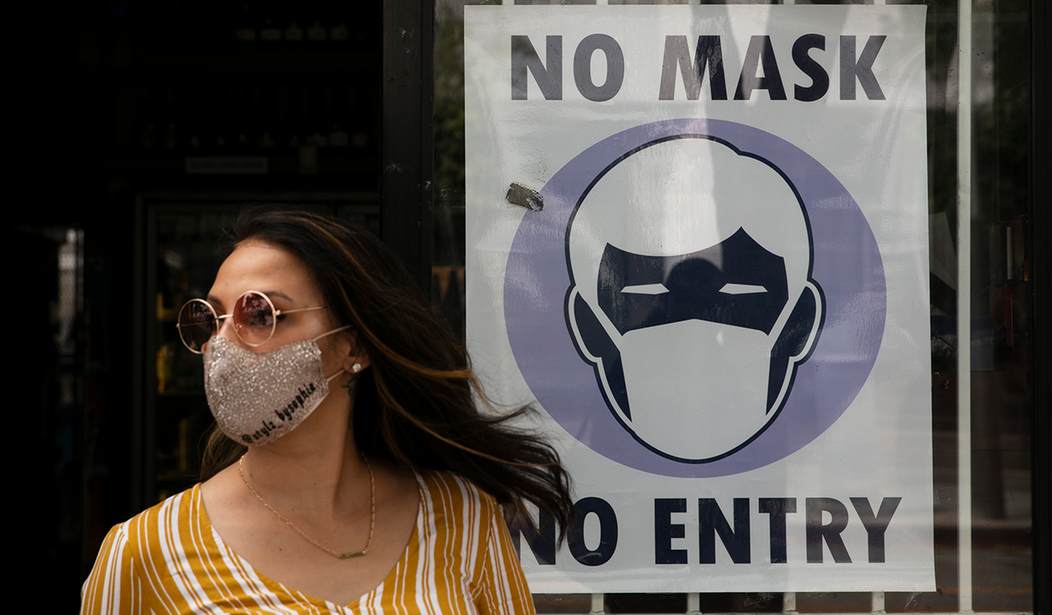
Between 2 million and 3 million Americans will die!
That was the prediction from "experts" at London's Imperial College when COVID-19 began. They did also say if there was "social distancing of the whole population," the death toll could be cut in half, but 1.1 million to 1.46 million Americans would still die by this summer.
Our actual death toll has been about one-tenth of that.
Nevertheless, Imperial College's model was extremely influential.
Politicians issued stay-at-home orders. They said we must trust the "experts."
"Follow the science. Listen to the experts. Do what they tell you," said Joe Biden, laughing at what he considered an obvious truth.
But "there is no such thing as "the science!" replies science reporter Matt Ridley in my new video about "expert" predictions. "Science consists of people disagreeing with each other!"
The lockdowns, he adds, were "quite dangerously wrong."
Because Imperial's model predicted that COVID-19 would overwhelm hospitals, patients were moved to nursing homes. The coronavirus then spread in nursing homes.
Ordering almost every worker to stay home led to an economic collapse that may have killed people, too.
"The main interventions that helped prevent people dying were stopping large gatherings, people washing their hands and wearing face masks, general social distancing -- not forcing people to stay home," says Ridley.
Even New York Governor Andrew Cuomo now admits: "We all failed at that business. All the early national experts: 'Here's my projection model.' They were all wrong."
If he and other politicians had just done just a little research, then they would have known that Imperial College researchers repeatedly predict great disasters that don't happen. Their model predicted 65,000 deaths from swine flu, 136,000 from mad cow disease, and 200 million from bird flu.
The real numbers were in the hundreds.
After such predictions were repeatedly wrong, why did politicians boss us around based on those same "experts" models?
"If you say something really pessimistic about how many people are going to die," explains Ridley, "the media want to believe you. The politicians dare not believe you."
This bias towards pessimism applies to fear of climate change, too.
Thirty-two years ago, climate "experts," said rising seas would "completely cover" the islands of the Maldives "in the next 30 years." But now, 32 years later, the islands are not only still there, but they're also doing better than ever. They're even building new airports.
"Climate change is real," says Ridley, "but it's not happening nearly as fast as models predicted."
Models repeatedly overpredict disaster because that's "a very good way of attracting attention to your science and getting rewarded for it," says Ridley.
One more example: For years, "experts" predicted an oil shortage. President Jimmy Carter warned, "The oil and natural gas we rely on for 75% of our energy are simply running out." All the "experts" agreed.
But as the demand for oil grew, oil prices rose. That inspired entrepreneurs to invent new ways of getting more oil and gas out of the same rocks. They succeeded so well that America now has so much oil and gas that we sell some to other countries.
Ridley's new book, "How Innovation Works," shows how innovators prove "experts" wrong all the time.
He points out that the founder of Digital Equipment Corporation once said: "There is no reason anyone would want a computer in their home."
Microsoft's CEO confidently said: "There's no chance the iPhone is going to get significant market share."
New York Times columnist Paul Krugman wrote that because "most people have nothing to say to each other... the Internet's impact on the economy (will be) no greater than the fax machine's."
Of course, not all experts are wrong. Useful experts do exist. I want a trained civil engineer to design any bridge I cross.
But Ridley points out: "There is no such thing as expertise on the future. It's dangerous to rely too much on models (which lead politicians to) lockdown society and destroy people's livelihood. Danger lies both ways."
Join the Conversation
VIP members get the ability to comment on articles.