





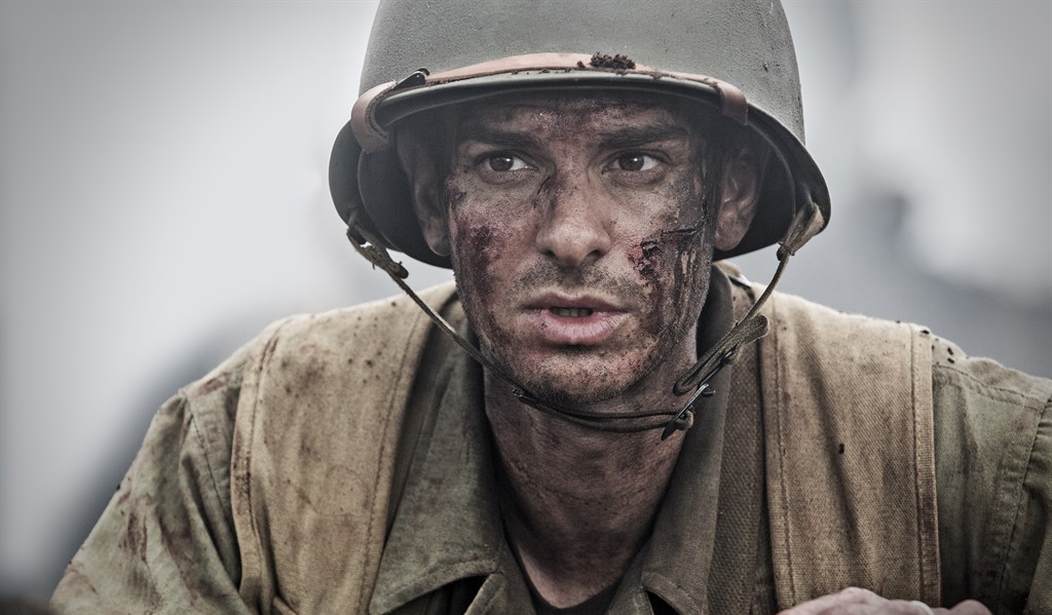
Director Mel Gibson is best known for his acclaimed 1995 best picture winner Braveheart and his unforgettable drama The Passion of the Christ. The former focused on war with Gibson starring as the commanding leader William Wallace. The latter focused on faith with Jim Caviezel starring as Jesus Christ.
Considering these two well-received passion projects, it seems obvious that Gibson would be the perfect choice to bring Desmond Doss’ story to the big screen. Doss was an Army medic who served on the front lines in World War II while standing by his faith and refusing to kill his opponents or even touch a weapon. Hacksaw Ridge, Gibson’s latest directorial production (his first in a decade), tells this brave man’s story.
In the feature’s opening moment, the lead character asks “Have you not heard the Lord is our everlasting God?” Juxtaposed with that message are scenes of violence and war — displays of hatred that would make many true believers pause. Doss was a true believer who witnessed war firsthand but maintained his faith throughout it.
After a few scenes here showing Doss as a young boy struggling with both an older brother and an abusive father, Andrew Garfield takes the stage as the main character. He plays Doss as a humble and charming servant of God who watches as his friends and his brother volunteer to fight the war overseas. As a religious man, Doss doesn’t believe in taking lives but he believes that our country is fighting the good fight. He enlists in the army but vows to never hold a gun.
The film’s first half focuses on Doss’ personal life at home (where he grows up under cruel circumstances), his romantic life (he starts dating a young nurse) and his military training. He is tested in each circumstance. The subtle but patient script by Andrew Knight and Robert Schenkkan allows these characters to breathe and develop thoughtfully before Doss even makes it onto the battlefield.
Even the cruelest character introduced here— Desmond’s vengeful father Tom (Hugo Weaving) — is given the screen time that allows him to come across as a real but horrifically flawed man.
The film’s second half takes place at Hacksaw Ridge, a location that had been taken by the Allies at least six times before they were forced to retreat. Much will be made of the brutal war scenes depicting one such battle. Like the opening scene in Saving Private Ryan, the violence is brutal and difficult to watch. That only makes Doss’ story more remarkable. Here was a man who stood defenseless on the battlefield where he was assaulted by the enemy but still remained faithful to the principles he held dear.
“I don’t know if I can live with myself if I don’t stay true to my beliefs,” Doss says earlier while being criticized for his values. It would be difficult to understand how remarkable Doss was without seeing him surrounded by violence, weapons, and bloodshed while remaining a man of great convictions. Gibson depicts the battle as an overwhelming experience where a soldier’s friends and allies can be knocked down with a single blow.
Gibson delivers powerful scenes of great violence here while also focusing on the smaller, more personal moments of war (including a scene where Doss bonds with one of his tormentors from the barracks). It’s only after the main battle though that Doss’ courage is fully revealed. Despite refusing to carry a gun or fire a weapon, Doss showed true courage as he fought to rescue the wounded after a harrowing day of torment.
“What you did on that ridge is nothing short of a miracle,” one character states in one of the film’s last moments. Hacksaw Ridge tells a truly remarkable story and works so well because it emphatically explores both the war itself and Doss’ religion. The feature never shies away from either tricky subject and is made all the more powerful because of it. Hacksaw Ridge qualifies as one of the year’s best films and is a testament to Mel Gibson’s work behind the camera and Garfield’s work in front of it.
Looking for some more films that celebrate patriotism? Check out our list of 10 great movies about American patriots.


Join the Conversation
VIP members get the ability to comment on articles.