





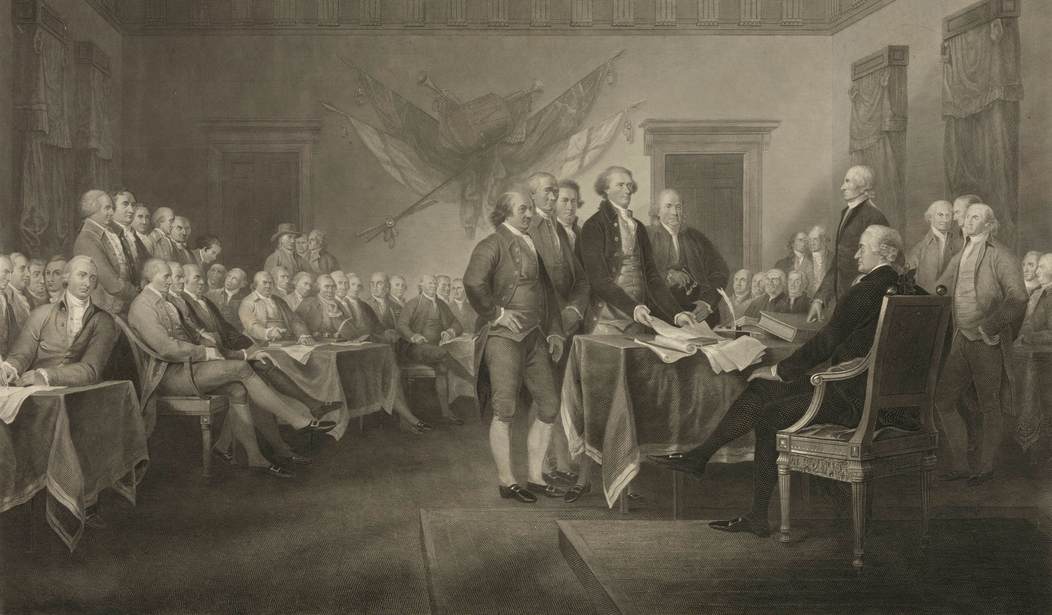
On July 4, Americans will celebrate the 250th anniversary of the Declaration of Independence. At the heart of that document is the proclamation that “all men are created equal” and “are endowed by their Creator with certain unalienable Rights.”
Today, many people think that belief in a Creator is a subjective preference based on their personal faith. But that was not the view of America’s Founders. Nor was it the view held by many of the thinkers who preceded them.
More than two millennia ago, key Greek and Roman thinkers already argued that nature supplies objective evidence of a Creator. Marveling at the vast array of stars in the heavens, the Roman statesman and philosopher Cicero concluded: “Not merely did their creation postulate intelligence, but… intelligence of a high order.”
The Bible taught the same: “The heavens declare the glory of God; the skies proclaim the work of His hands” (Psalm 19:1, NIV) and “since the creation of the world God’s invisible qualities—His eternal power and divine nature—have been clearly seen, being understood from what has been made, so that people are without excuse” (Romans 1:20).
Christian thinkers during the earliest centuries of the church made similar arguments, as did Catholic and Protestant Christian thinkers of later eras. For example, Protestant Reformer John Calvin (1509-1564) argued that “astronomy, medicine, and all the natural sciences” were “designed to illustrate” the proofs of God’s existence.
The rise of modern science in the 16th and 17th centuries reinforced this consensus rather than undercut it.
Sir Isaac Newton (1642-1727) was one of the greatest scientists who ever lived. He declared that our “most beautiful” solar system “could only proceed from the counsel and dominion of an intelligent and powerful being” and argued that “the best argument” for an omnipotent and omniscient God “is the frame of nature & chiefly the contrivance of the bodies of living creatures.”
John Ray (1627-1705) was a pioneering English botanist. He wrote "The Wisdom of God Manifested in the Works of the Creation," which claimed: “There is… no more palpable and convincing argument of the existence of a Deity, than the admirable art and wisdom that discovers itself in the make and constitution, the order and disposition, the ends and uses of all the parts and members of this stately fabrick of heaven and earth.”
English philosopher and clergyman Samuel Clarke (1675-1729) was a friend of Newton. In his book "A Demonstration of the Being and Attributes of God," Clarke offered a full-throated argument that as natural science advanced, the case for atheism retreated. “The deeper Men inquire into Things, and the more Accurate Observations they make, and the more and greater Discoveries they find out… the stronger” the argument grows for God.
In America, Declaration of Independence signers John Witherspoon and Thomas Jefferson saw evidence of God from the study of nature as well.
A Presbyterian clergyman, Witherspoon explained that one way we can know God exists is by “contemplating the universe in all its parts, observing that it contains many irresistible proofs that it could not be eternal, could not be without a cause; that this cause must be intelligent.”
Thomas Jefferson likewise believed that the discoveries of natural science provided a rational grounding for belief in God as Creator: “I hold (without appeal to revelation) that when we take a view of the Universe, in its parts general or particular, it is impossible for the human mind not to perceive and feel a conviction of design, consummate skill, and indefinite power in every atom of its composition.”
The good news is that science today is again pointing back to the reality proclaimed by America’s Founders. As the recent film "The Story of Everything" explained, the exquisite fine-tuning of physics, chemistry, and biology for life is providing fresh and convincing proof of a Creator to our generation.
We have returned to the state of affairs of the Founders’ own day, when Thomas Jefferson could talk of believers in God “pointing ‘to the heavens above, and to the earth beneath, and to the waters under the earth’” to argue for “a first cause, possessing intelligence and power; power in the production, & intelligence in the design & constant preservation of the system.”
John G. West is author of "Endowed by Our Creator" (DI Press, 2026) and "Vice President of Discovery Institute." He is also the Distinguished Scholar of American Government and Christian Civic Engagement at Cornerstone University.
Editor's Note: Do you enjoy Townhall's conservative reporting that takes on the radical Left and woke media? Support our work so that we can continue to bring you the truth.
Join Townhall VIP and use promo code FIGHT to receive 60% off your membership.



Join the Conversation
VIP members get the ability to comment on articles.