







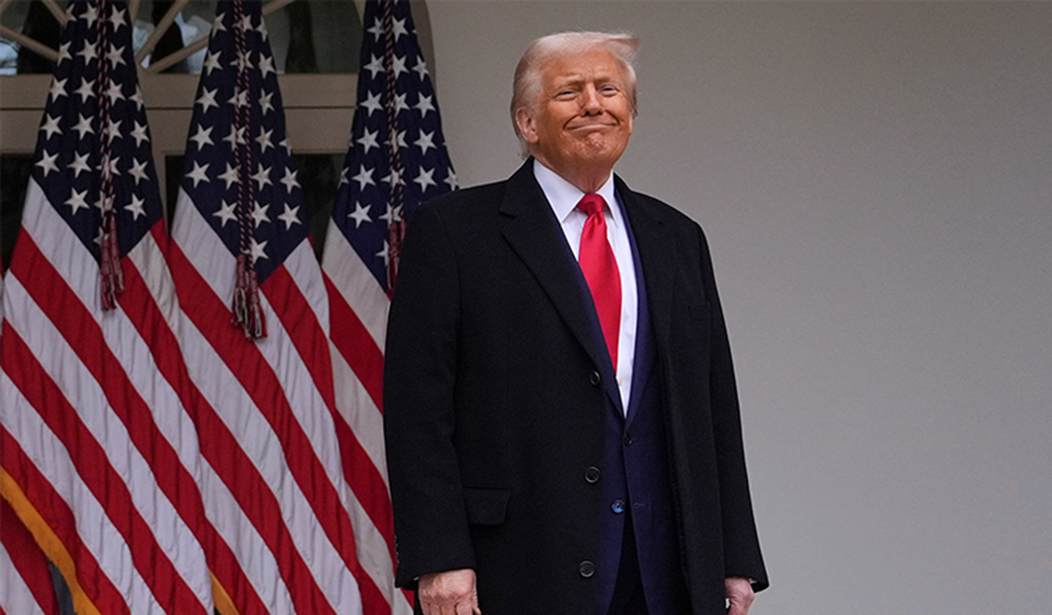
A newly empowered progressive-led Democrat coalition is preparing to settle into its majority on Capitol Hill and has made no secret of its determination to complicate President Trump’s final two years.
The incoming majority, however, does not get a veto over everything his administration can do. The president still retains considerable executive authority to deliver on the America First agenda that has been his rallying cry for the last decade.
Even before stepping onto the political scene, Donald Trump urged more balanced trade relations built on reciprocity and fairness. In fact, it is arguably the singular defining feature of his lifelong worldview. In a 1987 interview with Larry King, Trump remarked that “people are tired of watching the other countries ripping off the United States.” And nearly three decades later, at the infancy of his formal political career, his stump speeches frequently focused on China taking advantage of U.S. trade policy, often referring to our country as the “piggy bank that’s being robbed.” He echoed that language throughout his first term and returned to it as recently as July, when he lashed out at the European Union for treating America as a piggy bank and called for a Section 301 trade investigation into “the practice of robbing American companies and, in turn, the American taxpayer.”
Now, even more than before, formally initiating this investigation into Europe’s predatory digital trade practices is an opportunity to reinforce President Trump’s commitment to standing up for American interests. With a large portion of his agenda now likely to be stonewalled by congressional Democrats, prioritizing wins that don’t require congressional approval just makes sense.
Europe has certainly earned the scrutiny.
Our so-called allies across the pond have spent years invoking “digital sovereignty” and “consumer protection” to justify taxing, restricting, investigating, and fining America’s technology companies billions of dollars for the crime of outperforming their European competitors.
France’s Europe Minister Benjamin Haddad recently touted the roughly $5 billion Europe stood to collect from a single Google antitrust fine as “a new revenue stream” that can be used to lower member states’ contributions to the EU budget. Haddad is saying the quiet part out loud — and it’s exactly what President Trump has warned about for decades.
EU lawmakers are now considering a way for their telecom companies to collect, too. Just this month, the European Parliament’s industry committee took up draft changes to the already controversial proposed Digital Networks Act that could let those carriers charge American technology companies “network usage fees” — effectively making them subsidize Europe’s telecom industry — despite the EU’s commitment in its 2025 trade agreement with the United States not to implement such fees.
Beyond helping themselves to American companies’ money, European officials have been equally aggressive in asserting control over how those companies operate, using regulations like the Digital Markets Act and Digital Services Act to force changes to their products and, in some cases, to pressure platforms to censor political speech. All the while, the bloc is putting up billions of euros in public funding for AI infrastructure and sovereign-cloud contracts and advancing its newly unveiled “Tech Sovereignty Package” to prop up European competitors and reduce reliance on foreign (primarily American) providers.
The pretense is embarrassingly transparent. European leaders are using government power to stop American companies from succeeding where their own firms have failed to compete. They are propping up inferior European alternatives to the very American companies that have provided Europe’s digital infrastructure and now seek to make American companies — and ultimately American taxpayers — subsidize European carriers as well.
A formal examination of these discriminatory practices is very much in order. Through Section 301, USTR can establish grounds for penalties that would give European officials ample reason to change course. Absent increased pressure, what is their incentive to do so?
The investigation could also strengthen the case for applying pressure through other avenues, including federal contracting.
European companies continue to receive billions of dollars in American taxpayer-funded business even as their governments deny our companies fair treatment abroad. If the 301 investigation confirms what the evidence already suggests, those firms should have no reason to assume that business will remain unaffected.
For example, the Department of War could reconsider whether awarding future contracts to companies such as European SAP, Siemens, Publicis Groupe, and Accenture serves American interests. The Federal Communications Commission could reconsider the approvals that allow Deutsche Telekom to hold a majority stake in T-Mobile. The German carrier’s unrelenting support for the very regulations and network fees that threaten American companies’ ability to operate in Europe could carry particular weight as the agency reassesses the terms on which the carrier operates here.
American companies have earned their success by developing technology that powers businesses, industries, and economies around the world — and Europe has grown far too comfortable penalizing them. Even with a less-than-cooperative Congress following the 2026 midterms, the Trump administration still has the authority, and obligation, to follow through on his commitment to defend American companies against blatantly unfair treatment abroad. It’s time to open President Trump’s investigation.
John Czwartacki is the founder and President of Public Policy Solutions. He served in senior roles at OMB and CFPB during the first Trump administration.
Editor's Note: Don't miss Townhall's massive holiday sale! Use promo code FIGHT to get 60% off your VIP membership!
Join our team of Patriots today and help us fight for the truth, fight against the Democrats' radical agenda, and fight to take our country back.


Join the Conversation
VIP members get the ability to comment on articles.