


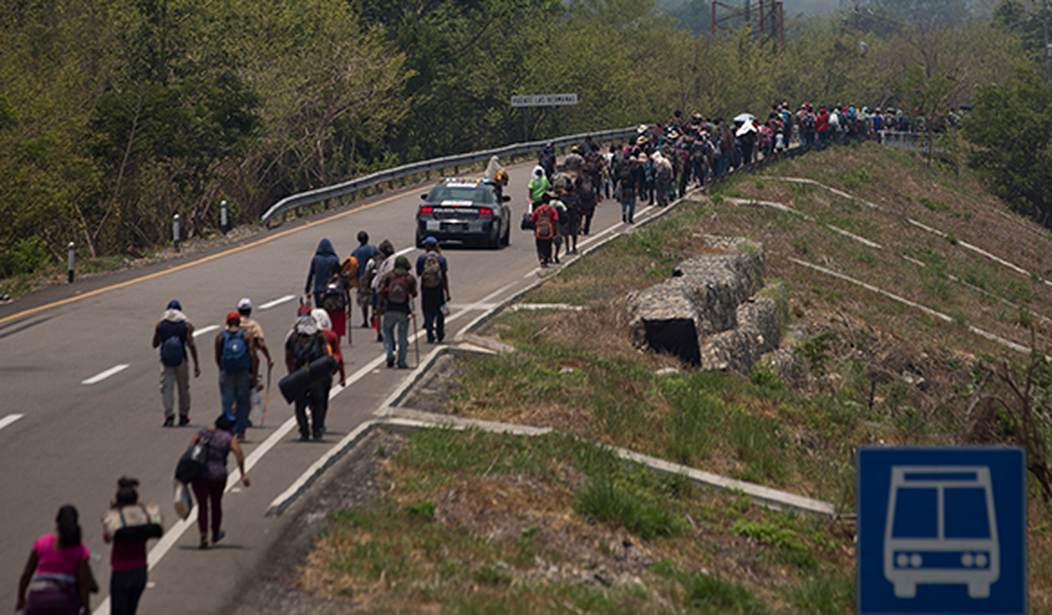
When government normalizes illegality, who answers for the innocent left behind?
A ghost is a presence that cannot quite be accounted for. It moves among the living, yet somehow remains unseen. Sometimes, what makes a ghost unsettling is not simply its presence, but what it reveals about everything left unresolved.
There is a troubling parallel in America's debate over illegal immigration. People can live among us unlawfully while government policies and institutional failures allow their identities, histories, and legal status to remain obscured. When elected officials defend policies that tolerate unlawful presence and weaken enforcement, they normalize illegality. What government chooses to tolerate eventually becomes the standard it enforces, or refuses to enforce.
But the most disturbing ghosts are not simply those who slip beyond effective enforcement. They are the ghosts of responsibility that emerge when innocent people are harmed and their families search for answers.
I know because my daughter, Katie, is gone.
On January 19, 2025, in Sanctuary Urbana, Illinois, Katie was a passenger in a car stopped at a red light when an intoxicated illegal alien struck it from behind at nearly 80 miles per hour. Katie was 20 years old. Another young woman was also killed, and three others were seriously injured.
The driver was Julio Cucul-Bol, a Guatemalan national who had previously been deported from the United States and illegally reentered in 2022. But that was not the identity he presented to authorities. When apprehended three days after the crash in Texas, he initially identified himself as Juan Jahaziel Saenz-Suarez, claiming to be a Mexican national. His actual identity was subsequently established.
The deception did not begin or end at the crash scene. A federal grand jury indictment in May 2025 alleged that Cucul-Bol had used that assumed identity in a November 2023 application to JPMorgan Chase Bank and had used a false passport. The indictment also alleged that he possessed a fraudulent permanent resident card and Social Security card on the day of the crash.
Federal prosecutors identified him as being associated with addresses in both Rantoul and Urbana, Illinois. Both communities are subject to Illinois' statewide sanctuary framework.
He was not simply moving through the country as a ghost. He was living among us, moving through Illinois communities, and driving on our roads. And here is an even more troubling dimension: federal authorities already had his true identity and deportation history in their records. They knew who he was. Yet that knowledge never translated into effective safeguards in Illinois.
Illinois' sanctuary framework restricts cooperation with federal immigration enforcement, including certain forms of information sharing and assistance. What verification was performed when Cucul-Bol obtained his Illinois driver's license? What information was available? What was checked? What was deliberately kept outside the reach of those responsible for protecting the public?
These are not incidental details. They go directly to how a previously deported individual, living under an assumed identity, could establish himself in Illinois and obtain authorization to drive on its roads.
Cucul-Bol pleaded guilty and received a 30-year prison sentence. Under Illinois law, he could be released after serving as little as 85 percent of that sentence. Katie has no release date from her grave.
The criminal prosecution punished his conduct behind the wheel. It did not answer the broader questions about how he entered, remained in, and moved through the country, or how he established himself in Illinois before that night.
I asked attorneys how I could hold the government accountable for the failures I was questioning. Their answer was that I had no legal remedy against the government for those failures. Yet the questions remain. Even obtaining the underlying records became a separate battle. In June 2026, Judicial Watch filed a lawsuit against the City of Urbana after the police department failed to produce requested records, supplemental reports, and video evidence concerning the crash.
The ghost is not just the person who escaped the system. It is the accountability that disappears when families come looking for answers.
Not every victim dies. Some survive with permanent injuries, chronic pain, psychological trauma, and emotional scars that may never fully heal. Their independence, relationships, livelihoods, and futures are irrevocably changed. Their suffering, too, becomes invisible once public attention moves on.
A society reveals something about its conscience in the suffering it chooses to see and the suffering it leaves unacknowledged.
The public pays the price for government failures that remain hidden until tragedy exposes them. By then, the warnings have become funerals, the policy debates have become investigations, and families are left carrying consequences they never chose.
That is the difference between front-end responsibility and back-end reaction: reasonable safeguards and lawful enforcement before tragedy, versus investigations, prosecutions, funerals, and families left to rebuild shattered lives afterward. No prosecution can restore a life.
Sanctuary policies, border and interior enforcement decisions, and public benefit policies deserve scrutiny for their consequences. The question is not whether lawful immigration belongs in America's story. It does. The question is what happens when elected officials normalize unlawful presence, weaken enforcement, and then treat each resulting crime as an isolated event. They must answer whether their decisions created preventable gaps and why those gaps were allowed to persist.
Illinois continues to lose residents to other states while its population is being sustained by unlawful immigration. What do elected officials count as progress? What costs do they measure? Do public safety and accountability receive the same attention as the policies they champion?
When someone is harmed by a federal immigration officer, demands for accountability and legal remedies follow. When citizens are killed by people unlawfully present, families deserve the same seriousness in examining the government decisions surrounding those deaths. The legal circumstances differ, but the obligation to explain those decisions should never depend on which political narrative is more convenient.
Katie cannot come back. But another innocent life can still be saved. That is what this must be about: confronting government failures, demanding accountability, and closing the gaps that put lives at risk. The measure of government is not how effectively it responds after tragedy, but what it does to prevent the next one.
The deepest tragedy is not only that ghosts move among us. It is that unlawful presence is normalized, the suffering that follows is ignored, and those entrusted with responsibility retreat into silence when the innocent demand answers.
The people harmed are not ghosts. Their families are not ghosts. Their suffering is not invisible.
And the responsibility to answer for it must not disappear into the shadows.
Editor's Note: Do you enjoy Townhall's conservative reporting exposing the radical left and woke media? Support our work so we can keep bringing you the truth.
Join Townhall VIP and use promo code FIGHT to receive 60% off your membership.

Join the Conversation
VIP members get the ability to comment on articles.