





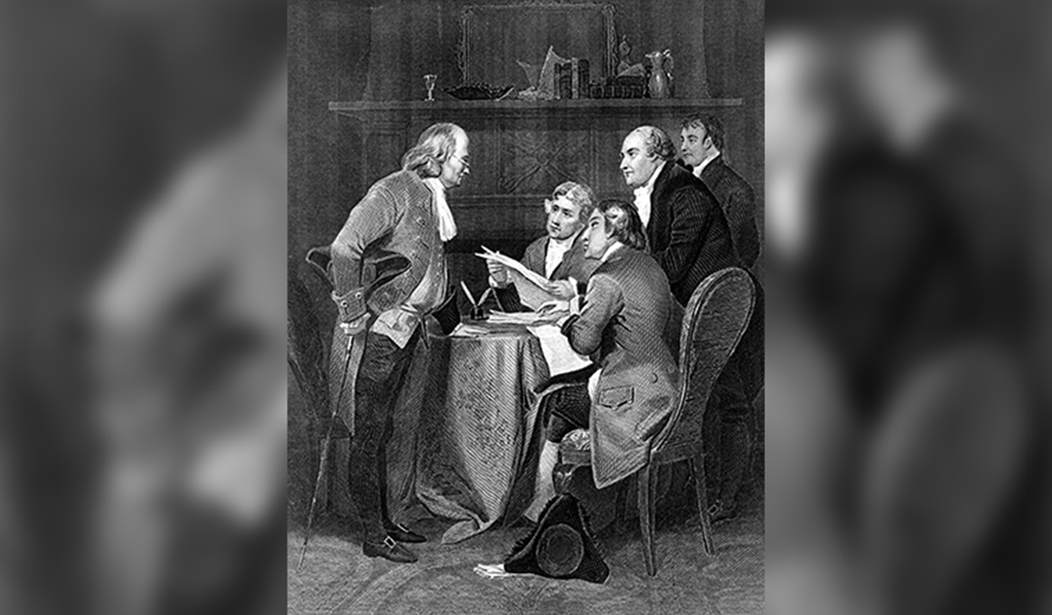
In February 1777, Thomas Jefferson helped establish an evangelical church. What? Yes, that Thomas Jefferson. It was called the Calvinisitical Reformed Church of Charlottesville. And it met in the local courthouse. Why, that’s enough to give the ACLU apoplexy.
This was less than a year after he wrote the first draft of the Declaration of Independence.
It’s important to understand that the early Thomas Jefferson was much more faithful to his professed Christian faith than we are led to believe.
Yes, he harbored serious doubts later in life. But the early Jefferson who wrote that “all men are created equal” and who referenced God in our nation’s chief founding document was, by all outward appearances, a believing Christian.
This is important to grasp because for the last century or so, Thomas Jefferson has often been portrayed as some sort of lifelong skeptic. And that is not true.
About a decade ago, I coauthored with Dr. Mark Beliles the book Doubting Thomas, about the faith or lack thereof of our third president. Just in time for America at 250, soon we plan to release a condensed version, entitled Jefferson and the God Who Gave Us Liberty (Morgan James).
The title is based on Jefferson’s statement that “God who gave us life gave us liberty at the same time.” You’ll find it chiseled in stone at the Jefferson Memorial.
One key point of the book is that it is wrong to read into the younger Jefferson’s writings skeptical views of God that do appear in the older Jefferson’s work.
As the late constitutional attorney and law school dean Herb Titus wrote in his endorsement of our original edition: “in his critical younger years—when he drafted the Declaration of Independence and the Virginia bill for religious freedom—Jefferson was a practicing orthodox Christian.… [T]he authors refute those scholars who would superimpose Jefferson’s later doubts about core Christian doctrines in support of their views that religion must be separated from politics.” [Emphasis added]
Indeed, as we write in our forthcoming edition, “The Jefferson of 1776 and the Jefferson of 1820 have different religious viewpoints that must be evaluated in their own context. Unorthodox beliefs are not necessarily present throughout his long life.”
That explains it all. To try to discount the references to God in the Declaration of Independence because of Jefferson’s later skepticism is a historical error.
So, let’s return to Jefferson’s 1777 work as a layman to co-found an evangelical church in Charlottesville, which called a patriotic, evangelical minister, ordained as an Anglican: the Rev. Charles Clay. In his “Subscription to Support a Clergyman in Charlottesville,” Jefferson wrote that he and other “subscribers” were “desirous of encouraging and supporting the Calvinistical Reformed church, and of deriving to our selves, through the ministry of its teachers, the benefits of Gospel knowledge and religious improvement…by regular education for explaining the holy scriptures…approving highly the political conduct of the Revd. Charles Clay, who, early rejecting the tyrant and tyranny of Britain, proved his religion genuine.”
Jefferson was a decades-long friend of Rev. Charles Clay. He sat under his pulpit. He corresponded with him for a long time. They had many talks about religion through the years.
In 1992, the descendants of Charles Clay donated their ancestor’s sermon notes to the Virginia Historical Society. Mark Beliles obtained copies of these, and we included two of Rev. Clay’s sermons in Doubting Thomas, and plan to include them in the upcoming book.
To our knowledge, no sermon of Jefferson’s pastor had been in print prior to our 2015 book.
And what kind of sermons did Rev. Clay preach? One of his sermons we published is “God, the Adversary of the Sinner.”
In that message, Clay preached, “The eternal God is an Adversary to every man in a state of nature; and every man that is not born again of the Spirit of God, is in a state of nature consequently in a state of enmity with God. To this Adversary it is every man’s interest to be reconciled, as he would avoid eternal misery….The only way to be thus reconciled, is to turn from sin, and be united to the Lord Jesus Christ by faith.”
Jefferson supported this man’s ministry. He not only wrote up the agreement for the establishment of the church that called Rev. Clay, he faithfully attended and donated more money than any of the other laymen who participated in this evangelical church. As noted, Jefferson modified his views over time. But it should not be held against the younger man.
As we celebrate America’s 250th anniversary this year, we should honor the Christian faith that emboldened the Founding Fathers—including the young Thomas Jefferson—and shaped their conviction that God, not man, is the source of human rights.
Jerry Newcombe, D.Min., is the executive director of the Providence Forum, an outreach of Coral Ridge Ministries. He has written/co-written 33 books, including George Washington’s Sacred Fire (with Providence Forum founder Peter Lillback, Ph.D.) and What If Jesus Had Never Been Born? (with D. James Kennedy, Ph.D.).
Editor’s Note: Do you enjoy Townhall’s conservative reporting that takes on the radical Left and woke media? Support our work so that we can continue to bring you the truth.
Join Townhall VIP and use promo code FIGHT to receive 60% off your membership.

Join the Conversation
VIP members get the ability to comment on articles.