
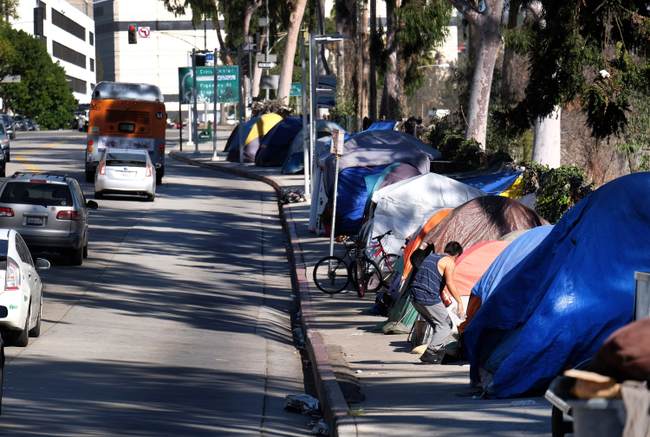
The Los Angeles Homeless Services Authority (LAHSA) is leaving the federal funding business, and swapping administrators will fix little unless the rules change with them. Under a settlement HUD announced on November 17, LAHSA hands over about $150 million, loses HUD homelessness funding by the end of 2027, and watches Los Angeles County take over its portfolio under federal oversight. Taxpayers who have financed the homeless industrial complex for years can cheer. Then they should ask what keeps the county from inheriting the same habits.
I've spent more than 30 years in investment management and countless hours testifying as an expert witness on fiduciary duty. One lesson that I have learned is that whoever handles other people's money must show the receipts, or the money disappears.
HUD says the Los Angeles Continuum of Care that LAHSA leads was awarded $944 million since 2021. California's state auditor found the state spent roughly $24 billion over five years on homelessness programs and did not consistently track whether they worked. HUD says its funding for Los Angeles has risen 178 percent since 2013 while homelessness there has risen 100 percent. The City Controller found that Prop. HHH supportive housing projects under construction averaged $596,846 per unit in total development cost in 2021, against a 2016 estimate of $350,000 to $414,000. A hedge fund reporting that way would draw subpoenas from its own investors.
One contractor shows how it worked. Alex Soofer, who ran the nonprofit Abundant Blessings, pleaded guilty in October to federal wire fraud. He admitted to obtaining $23 million in public homelessness money, at least some of it through fraud, and that at least $2 million went to personal enrichment and unrelated businesses. Sentencing is set for April 7, and he faces up to 20 years. The county district attorney separately charged him with defrauding LAHSA of more than $5 million, and he pleaded not guilty in that state case. Compliance officials labeled the group "High-Risk" on May 6, 2024. Eighteen days later, the commission authorized renewals worth more than $2 million, and the staff recommendation never mentioned the warning. In my house, that earns a family meeting.
Then came the delay. Auditors say LAHSA had credible evidence of possible federal crimes by August 23, 2024, yet did not tell HUD and its inspector general until April 25, 2025, about eight months later. Federal rules require prompt reporting, and LAHSA's management said it did not disagree with the findings. In my expert witness work, a gap like that becomes Exhibit A. A trustee who sits on evidence of possible theft for eight months doesn't get a performance review. They get deposed.
Who was supervising? A 10-member commission. Mayor Karen Bass appointed herself in 2023, and LAist found she missed 13 of 21 meetings in a recent 12-month stretch before leaving the commission in September. Attendance records prove nothing criminal. They do show who was watching. The City Council, citing the lack of an alternative contracting system, approved $358 million for LAHSA in May, a 5 percent increase.
Washington shares the blame. U.S. District Judge David Carter, who presided over the lawsuit, said HUD had been on notice of LAHSA's oversight failures since 2007 and abandoned its own oversight role. Thomas Sowell observed in "Intellectuals and Race" that the intelligentsia pay no price for being wrong. Agencies at every level of government enjoy the same immunity, and a settlement doesn't remove it.
Defenders of the old approach will point to Housing First, which offers permanent housing without requiring sobriety or treatment first. HUD says it is replacing Housing First with Treatment First. Critics who blame the model for the whole crisis overreach. Housing First began in New York in 1992, and the Bush administration backed it through its Chronic Homelessness Initiative. A 2019 review of four randomized trials found it improves housing stability without an increase in problematic substance use, though all four carried a high risk of bias. Skeptic Stephen Eide of the Manhattan Institute wrote in 2020 that it has not been shown to end homelessness at the community level. The county count fell two years running, then rose 1.2 percent to 73,040 in 2026.
So I won't claim Housing First caused L.A.'s crisis. The evidence doesn't reach that far. The audit trail needs no stretch. Auditors, prosecutors, and a federal judge found the problems, and the agency's own management did not dispute the reporting failure.
Every youth team I've coached knew the score. This system has never posted one. Five changes would beat any slogan. Contracts should pay for results: people who stay housed for a year, enter treatment and hold jobs, with outcomes posted online. Suspected fraud should reach federal funders within days, and the settlement's quarterly reports to the court should be public. The county needs independent auditors in place before the first check clears. Housing should come with treatment built in. In a New York randomized trial, treatment-first participants were more likely to use treatment services, and a Canadian trial found housing paired with assertive community treatment teams increased stability for high-need participants. I found no trial showing treatment-first beating Housing First at keeping people housed, so I'd add treatment rather than demand sobriety up front. And one elected official, with a name and a phone number, should own the results.
Louis Brandeis wrote that sunlight is the best of disinfectants. LAHSA spent three decades in the dim light of its own paperwork. Jerry Maguire demanded, "Show me the money." Taxpayers deserve a better question: show me where it went. The county now holds the ledger, and the same county government that helped oversee LAHSA will oversee its replacement, so the sunlight has to come from outside. If the county can't produce receipts either, the axe has another swing coming.
Jay Rogers is a financial professional with more than 30 years of experience in private equity, private credit, hedge funds, and wealth management. He writes about issues in finance, constitutional law, national security, human nature, and public policy.