





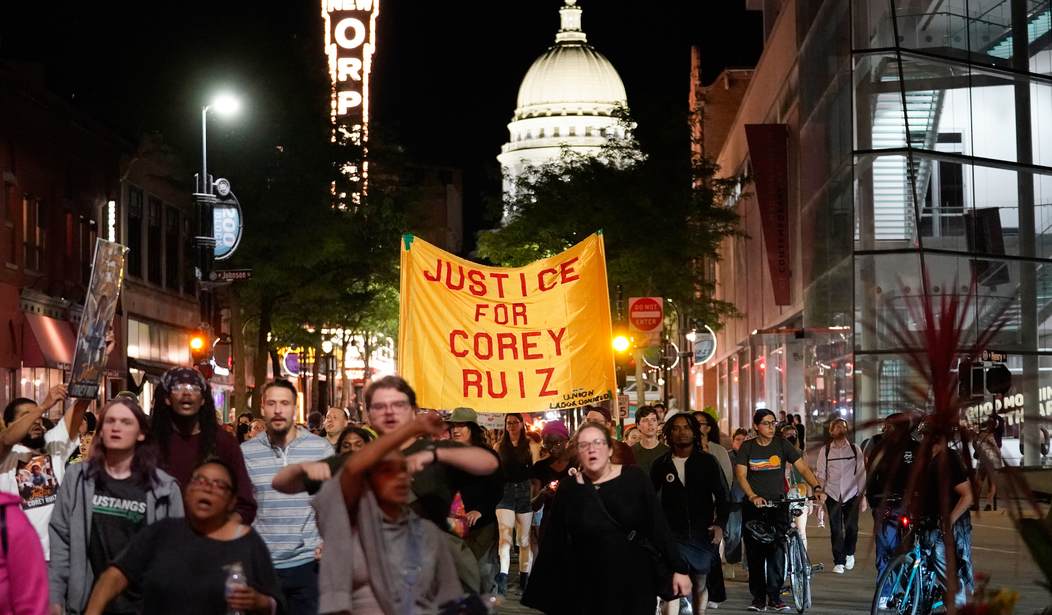
Corey Durell Ruiz died on a public street in Madison, Wisconsin, on July 22 with a fixed-blade knife in his hand and roughly 40 prior convictions on his record. Within forty-eight hours, protesters had stormed a police press conference, civil rights attorney Ben Crump had flown in to call the shooting an “execution,” and the mayor was promising a “rigorous” investigation of the officer. Nobody at either microphone asked the obvious question: why was a man with 15 years of documented violent conduct, including two felony convictions for assaulting police, riding a bicycle through a residential neighborhood on a weekday afternoon instead of sitting in a cell?
Every business I've worked in treats a documented pattern of past behavior as the best predictor of future behavior. Every business, apparently, except the one we task with keeping violent repeat offenders off the street.
Here's what the record shows. Wisconsin public records reviewed by NBC News list roughly 40 misdemeanor and felony convictions for Ruiz from 2009 to 2025, including felony resisting an officer with substantial bodily harm and felony threats against police in 2021, per Urban Milwaukee, and two counts of strangulation and robbery by force in 2009. In between: theft, disorderly conduct, drug possession, bail jumping, and auto theft, per a history compiled from Wisconsin court records. It reads less like a rap sheet than a career.
By the time of the shooting, Ruiz was homeless, and his family has said he struggled with addiction. Those are real hardships, and I don't discount them. But they don't explain a 40-count record that includes two counts of strangulation, a robbery by force, and repeated felony assaults on police. Thomas Sowell has spent a career pointing out that a society which stops treating consequences as consequences shouldn't be surprised when behavior stops changing. Wisconsin kept releasing Ruiz back into the same circumstances after each conviction, without the enhancements sitting right there in the statute book, then acted stunned when the pattern continued for the fortieth time.
The system had a tool built for a case like this. Under Wis. Stat. § 939.62, a “repeater” with one prior felony in the preceding five years can have the maximum sentence increased by up to four years, and a “persistent repeater” with two prior serious felonies faces life without parole. That three-strikes law predates Ruiz's first conviction, and Dane County has had the same elected district attorney, Ismael Ozanne, since 2010. Charging the enhancement is his office's call. In practice, prosecutors must allege repeater status, prove the priors, and resist trading it away for a faster plea. Multiply that math across roughly 40 cases, and you get a man who had spent his second, third, and 15th chances.
Ruiz's own conduct on July 22 fits the pattern. Police say officers approached him for allegedly checking parked cars, and rather than produce identification, he fled on a bicycle through backyards. When officers caught up minutes later, he pulled a fixed-blade knife and injured one badly enough to require hospitalization. Whatever happened next, the sequence began with his decision not to comply. A man with two prior felony convictions for assaulting police had every reason to know how that could end, and he made that choice anyway.
None of this makes the shooting itself open-and-shut. Bystander video reportedly shows Ruiz tased and on the ground before the fatal shots, and Madison, unlike most comparably sized cities, still doesn't require body cameras, leaving investigators to reconstruct the encounter from cellphone footage instead of a clean officer's-eye record, per Wisconsin Public Radio. That's a real transparency failure. A department policing a city of nearly 300,000 without body cameras in 2026 has no excuse, and anyone who believes in accountability should say so plainly. Wisconsin's Division of Criminal Investigation will determine whether the officer's response was proportionate, and that's the question a use-of-force review exists to answer.
What isn't a legitimate question is the one Ben Crump answered for the cameras before that investigation was finished. Crump built his national profile on the Trayvon Martin, George Floyd, and Breonna Taylor cases, and ran the same playbook here: the word “execution,” chants of “Say his name,” a legislator invoking a 2015 Madison shooting nearby, and a Capitol press conference built for headlines rather than local facts. That's not truth-seeking. It's a traveling production that arrives in every city with a police shooting and treats a 40-conviction record as a footnote to a script written before the plane landed. The family's grief is real. The narrative sold around it is a business model.
But here's my “to be sure”: I don't doubt Ruiz's mother and daughter loved him, and I'm not interested in mocking their grief. What their grief doesn't answer is why a state with a working three-strikes statute let a man with two felony convictions for assaulting police cycle back onto the street to confront a third one. That's not a policing failure. It's a charging and sentencing failure, compounded by a man who chose to run, then chose to pull a knife, instead of complying.
I coached high school hurdlers for years, and the first thing you teach a kid clearing a barrier is that the hurdle doesn't care about excuses. It's there whether you clip it or clear it. Wisconsin's repeater statute is that hurdle. It's been sitting on the track since 2009, and prosecutors, judges, and Ruiz himself all ran around it for a decade and a half. A policy response that prevents the next Wednesday afternoon like this one starts with a district attorney's office that stops trading enhancements for docket speed, judges willing to use the tools the legislature gave them, and a police department that finally invests in body cameras. Outrage at the officer is the easy story. The harder, truer one is that the system had roughly 40 chances to stop this before Corey Ruiz ever picked up that knife, and it took none of them.
Jay Rogers is a financial professional with more than 30 years of experience in private equity, private credit, hedge funds, and wealth management. He has a BS from Northeastern University and has completed postgraduate studies at UCLA, UPenn, and Harvard. He writes about issues in finance, constitutional law, national security, human nature, and public policy.
Editor’s Note: Do you enjoy Townhall’s conservative reporting that takes on the radical Left and woke media? Support our work so that we can continue to bring you the truth.
Join Townhall VIP and use promo code FIGHT to receive 60% off your membership.



Join the Conversation
VIP members get the ability to comment on articles.