





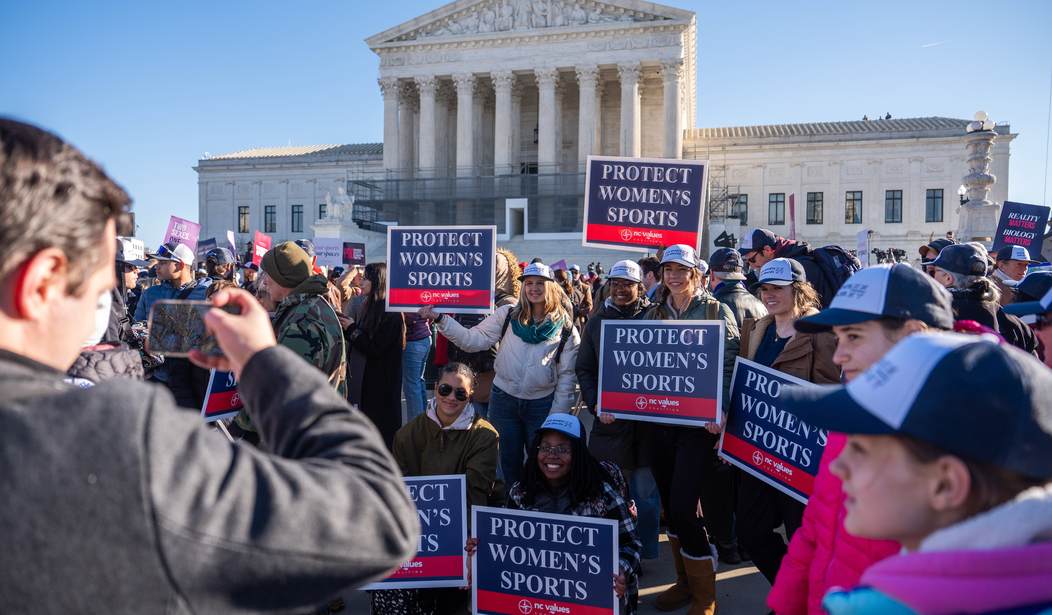
I coached girls' track and field for years. Sprints and hurdles, the same events I ran in high school and college. I watched 15-year-old girls push themselves to the edge of what their bodies could do, competing for a state medal that meant something because everyone on that track started from the same biological baseline. That baseline is the entire point of women's sports. It's why the category exists.
On June 30, the Supreme Court got half of that right. In a decision split 6-3 on the constitutional question, the justices upheld Idaho and West Virginia laws, in Little v. Hecox and West Virginia v. B.P.J., barring biological males from competing on girls' and women's teams. Justice Brett Kavanaugh, writing for the majority, pointed to the “inherent physical differences” between the sexes relevant to athletic performance, from height and strength to speed and endurance, and concluded that separate teams for biological males and females are a reasonable way to protect safety and competitive fairness. The plain meaning of “sex” in Title IX, he wrote, can't plausibly mean anything other than biological sex. Justice Clarence Thomas went further in concurrence, writing that a man doesn't get a legal right to compete against women just because he believes himself to be a woman. That's not a controversial statement of biology. It's a correct one.
Justice Neil Gorsuch added a separate opinion worth noting. He grounded the ruling in Congress's spending-clause power, the authority that lets Washington attach strings to federal education dollars, and found that Title IX never clearly told schools they had to let biological males compete on girls' teams. A funding condition has to be spelled out in plain terms or it doesn't bind anyone. That's a textualist argument, but it's also a roadmap. If Congress wants a uniform rule, all it has to do is write one down clearly. Right now, nobody has.
But read the opinion closely, and you'll see the Court did the minimum it could get away with. The ruling is permissive, not mandatory. It tells the Movement Advancement Project's count of 27 states with statutory bans and two more with agency policy bans, 29 in all, that they're on solid constitutional ground. It says nothing to the 21 states that still allow biological males to compete against women. California's Assembly Bill 1266 stays on the books, requiring schools to let students compete on the team matching their gender identity. Governor Newsom's office says the ruling “does not affect California's laws,” and legally, he's right. That's the problem.
Even some states with bans on paper aren't fully protected yet. Court injunctions blocked enforcement in Arizona and Utah before this ruling, separate from the Idaho and West Virginia cases the justices just decided, and those don't resolve automatically just because the legal question is settled. A win on paper isn't a win on the field until the lower courts catch up.
I've spent 30 years as an expert witness on fiduciary duty, which means I get paid to figure out where a standard applies uniformly and where it doesn't. A rule that protects girls in Boise but not in Sacramento isn't a rule. It's a jurisdictional accident. The Justice Department is already suing California's education department and its high school sports federation over this gap, and it hit Maine's education agency with a nearly identical lawsuit after the state rejected the same compliance ultimatum. This isn't one settled question. It's 29 settled ones and 21 unsettled ones, playing out state by state, lawsuit by lawsuit, for years.
Defenders of the status quo like to point out how few athletes this actually affects. Fair enough. NCAA president Charlie Baker has put the number at fewer than 10 transgender athletes out of 510,000 competitors nationwide. But that cuts against them, not for them. If the number is genuinely that small, there's no policy cost to a uniform standard, and no reason blue-state officials should keep fighting federal enforcement to defend a patchwork that barely moves the needle either way.
Justice Sotomayor's dissent, joined by Kagan and Jackson, argued the majority's own logic is incoherent: transgender athletes as a class are supposedly large enough to threaten girls' sports but too small to warrant equal protection. She's not wrong that the majority left this unresolved. She's drawing the wrong conclusion from it, though. The fix isn't a broader constitutional right to compete based on gender identity. It's a Title IX regulation, or better, a statute, applying the Idaho and West Virginia standard nationwide instead of relitigating it 50 times over.
Congress has the authority to do this. Title IX is a federal statute, and Congress can define its terms with the same clarity Kavanaugh's opinion just supplied, and the spending-clause hook Gorsuch just handed them. Instead, the executive branch runs Title IX enforcement against blue states one at a time, which is slower and more easily undone by the next administration than a clean statutory fix would be.
I've got no illusions about how Sacramento or Augusta will respond to that suggestion. But girls competing in states that still allow male participation aren't getting a different Constitution than girls in Idaho. They're getting a different governor. A level playing field shouldn't depend on which side of a state line you're standing on, or which party controls the statehouse. The Court settled the legal question. Now Congress needs to settle the geography.
Jay Rogers is a financial professional with more than 30 years of experience in private equity, private credit, hedge funds, and wealth management. He has a BS from Northeastern University and has completed postgraduate studies at UCLA, UPENN, and Harvard. He writes about issues in finance, constitutional law, national security, human nature, and public policy.
Editor's Note: Do you enjoy Townhall's conservative reporting that takes on the radical Left and woke media? Support our work so that we can continue to bring you the truth.
Join Townhall VIP and use promo code FIGHT to receive 60% off your membership.



Join the Conversation
VIP members get the ability to comment on articles.